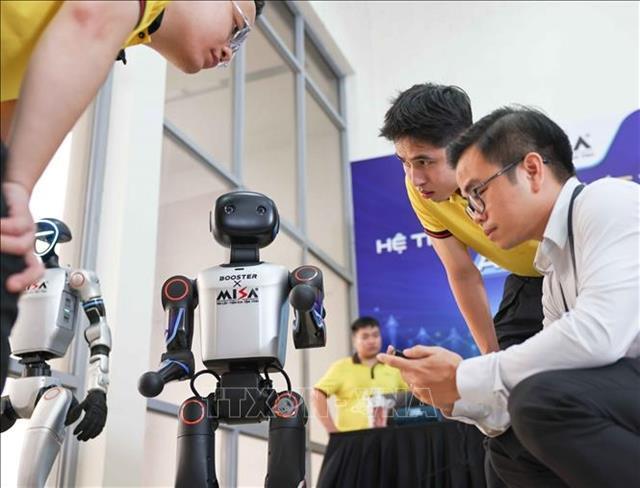
As Việt Nam advances its ambitions in strategic technologies, experts say the country''s success will depend not just on producing more engineers, but on rethinking how future technology talent is trained.
STEM majors have attracted more than half of all university applicants this year, marking a notable shift in students'' choices amid stronger policy support and rising demand for science and technology talent.

Professor Vũ Văn Yêm, Vice President of Hà Nội University of Science and Technology (HUST), spoke to Việt Nam News reporter Lê Hương about the university''s development strategy and its programme to attract Vietnamese academics working overseas back to the...
The Ministry of Industry and Trade is stepping up the implementation of Resolution 57 by accelerating digital transformation, innovation and strategic technology development to modernise the sector and deliver tangible results.
Enterprises would receive State support covering 50 per cent of interest payments on commercial loans used for technology application, transfer and innovation projects, capped at 6 per cent a year for up to five years.
As Việt Nam accelerates ambitions in AI, semiconductors and other strategic technologies, experts say winning the global talent race will depend on building an ecosystem where scientists and engineers can innovate and long-term value.
The province ranked tenth among 60 ministries, agencies and local authorities nationwide in the rate of fully electronic document processing, marking progress in the development of digital government.
The changes are not only transforming how banks serve customers but also creating room to reduce compliance costs, improve government services and support broader economic growth.
The master plan with a 100-year vision reflects the capital''s aspiration to strengthen its role as Việt Nam''s leading economic centre through clearly defined development targets and a comprehensive implementation programme.
Vietnamese businesses and universities have called for stronger policy support to accelerate strategic technologies, with proposals focusing on AI infrastructure, research commercialisation and regulatory reforms.
Slow capital disbursement remains a major obstacle to implementing Resolution 57, despite expanded funding and continued institutional reforms to support science, technology, innovation and digital transformation.