Tech sector growth opens up opportunities for Việt Nam to go global
With this golden opportunity at hand, the time to act is now. However, the country must accelerate the sector's development, as the chance is narrowing given the rapid pace of AI growth.
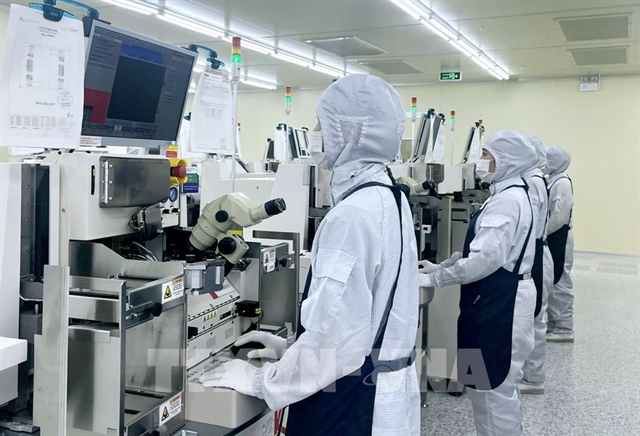
HÀ NỘI — The growth of the electronics, semiconductor and high-tech sectors worldwide is opening up a variety of opportunities for Vietnamese enterprises to integrate more deeply into the global supply chain.
However, to become suppliers for these corporations, domestic enterprises must meet rigorous standards regarding quality, technology, productivity and order fulfilment capabilities.
Industry insiders have said that in the semiconductor sector, opportunities lie not only in chip manufacturing, but also in supporting sectors such as components, materials, precision engineering, equipment and automation.
These areas can serve as entry points for domestic enterprises to gradually integrate into the manufacturing ecosystem, gain experience and enhance their technical capabilities.
But simply possessing a factory or production line is insufficient to guarantee status as a supplier to major corporations.
Enterprises must also demonstrate their ability to control quality, maintain process stability, ensure timely delivery and meet technical standards. Within the electronics and semiconductor supply chain, even a minor quality deviation can impact the entire production process.
International buyers thus often impose rigorous requirements regarding suppliers' quality management systems, traceability and risk management capabilities.
It is thus necessary for Vietnamese enterprises to invest more systematically in technology, automation and production management systems. Rather than competing solely on labour costs, businesses need to improve productivity, reduce defect rates and enhance their capacity to fulfil orders with demanding technical specifications.
Experts suggest that a practical approach is to begin by supplying components, materials or support services to FDI enterprises operating in Việt Nam.
Such partnerships enable domestic firms to adopt international standards, refine their production processes and build a foundation for gradually participating in higher value-added stages of the industry.
Aside from technical capabilities, experts said Vietnamese enterprises should also prioritise environmental, social and governance (ESG) standards, as they are increasingly becoming a key factor in international supply chains, ranking alongside product quality, cost and delivery schedules.
Trần Thị Thu Trang, chairwoman of Hanel PT New Generation Technology JSC, said that Vietnamese enterprises have never had such a significant opportunity as they do now.
With double-digit growth targets, Việt Nam has issued Resolution 57-NQ/TW to make science, technology, innovation and digital transformation core drivers of national growth and self-reliance.
Trang said that with this golden opportunity at hand, the time to act is now. However, she noted that the country must accelerate the sector's development, as the chance is narrowing given the rapid pace of AI growth.
The selection process for suppliers is rigorous and determines which ones will move forward. During this critical phase, Trang urged enterprises to promote cooperation, as it is difficult to expand alone.
In addition, Trang also emphasised that ESG should not be viewed merely as a cost, but rather as a profitable investment and opportunity for businesses.
"Without proper risk management, the faster we grow, the greater the risk of being eliminated from the game," she noted.
Vice Chairman of the Bắc Ninh City People's Committee Phạm Văn Thịnh said that Bắc Ninh has advantages in electronics manufacturing, high-tech industries and a network of FDI enterprises. To capitalise on opportunities to join the supply chain, Vietnamese businesses must invest in technology, personnel and research and development, while strengthening connections with experts.
According to Thịnh, neither Bắc Ninh nor Việt Nam has much time left to establish itself as a major global supply hub. The opportunity may last only about five years. By 2031, the influx of large factories relocating to Việt Nam, and especially Bắc Ninh, may significantly diminish.
To support Vietnamese enterprises, Thịnh said that administrative procedure reforms have been identified as a key priority for the city.
“Administrative processing and decision-making must be carried out swiftly and decisively to keep pace with the rapid growth of the semiconductor industry,” he said. — BIZHUB/VNS