Auto supporting industry urged to move beyond assembly as imports surge
Rapid growth in Việt Nam’s auto industry is exposing reliance on imports, underscoring the need for deeper localisation and a stronger industrial ecosystem.
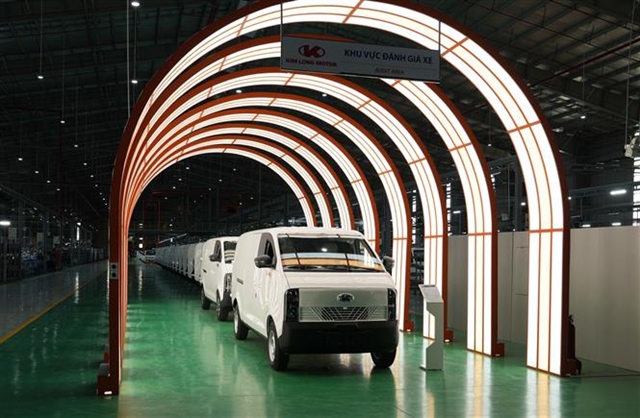
HÀ NỘI — Việt Nam’s auto supporting industry must move up the value chain and build a stronger domestic ecosystem as production accelerates and imports of components surge, officials and industry insiders said.
Chu Việt Cường, director of the Industrial Development Support Centre under the Ministry of Industry and Trade, said supporting industries, particularly auto parts, are the backbone of a self-reliant manufacturing sector.
He noted that domestic auto output reached around 480,000 units in 2025, up more than 30 per cent year on year, while the market expanded by about 18 per cent. However, most of the more than 700 supporting firms remain concentrated in low value-added segments.
“Local firms mainly supply simple parts, while key components such as engines and control systems are still imported,” he told Công Thương (Industry and Trade) newspaper, adding that localisation for passenger cars remains only around 15-20 per cent.
The gap is becoming more evident as production scales up.
Data from the customs authority showed Việt Nam imported nearly US$1.9 billion worth of auto parts in the first quarter of 2026, up 46.5 per cent year on year, reflecting strong manufacturing activity.
During the same period, total auto sales reached more than 162,000 units, up 36 per cent, with March recording a sharp rebound after the Tết (Lunar New Year) holiday.
Notably, domestic production is now outpacing imports of completely built units. While members of the Vietnam Automobile Manufacturers’ Association sold about 52,000 imported vehicles in the first quarter, output from domestic manufacturers led by VinFast exceeded that level.
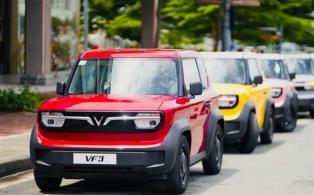
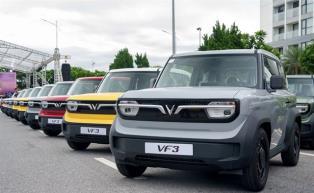
VinFast alone delivered more than 53,000 electric vehicles in the period, accounting for roughly one third of the market.
This divergence highlights a transitional phase, rising output but continued dependence on imported inputs. The current imbalance also reflects long-standing structural issues.
Experts noted that since the 1990s, Việt Nam opened its market to 11 foreign automakers with incentives tied to localisation commitments of around 30 per cent within 10-15 years, alongside technology transfer.
However, many foreign investors brought their own supplier networks into Việt Nam to benefit from lower tax rates while domestic firms faced higher rates. As a result, the country has developed only about 3,400 supporting industry enterprises.
According to the Ministry of Industry and Trade, even after more than 30 years, several foreign automakers have yet to meet localisation targets of 40 per cent, with some models still at just 10-15 per cent.
Meanwhile, localisation rates for electric vehicles produced by VinFast reached around 60 per cent in 2025 excluding batteries and are expected to rise further.
Against this backdrop, Nguyễn Vân, permanent vice chairman of the Hanoi Supporting Industries Business Association, said the sector must fundamentally change its approach.
“Firms cannot grow alone, they need to link up and join value chains to create higher-value products,” he told Auto News.
He added that growth depends on moving into higher-value segments rather than expanding output alone. Meanwhile, the shift to electric vehicles is opening a new window for deeper localisation.
The Ministry of Industry and Trade has recently drafted a development strategy for the auto industry through 2030 with a vision to 2045, setting out specific targets for production and supporting industries.
Under the plan, the supporting industry is expected to meet over 65 per cent of domestic component demand in the 2026-35 period, with localisation rates reaching around 55-60 per cent by 2030 and rising to 80-85 per cent by 2045. Vehicle exports are projected to hit about 90,000 units by 2035.
Vân from the Hanoi Supporting Industries Business Association described these targets as a clear growth space for the industry.
The ministry forecasts that once a battery plant in Hà Tĩnh becomes operational, localisation rates could increase to about 80 per cent, with battery components alone targeted at 80-90 per cent.
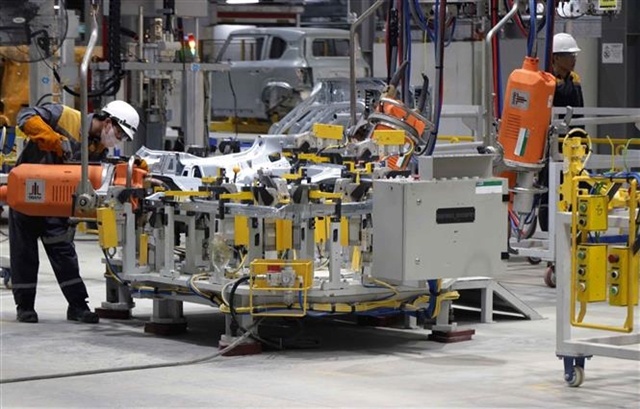
Despite this progress, around 40 per cent of high-value components still need to be imported, meaning that as production scales, import values inevitably rise to billions of US dollars.
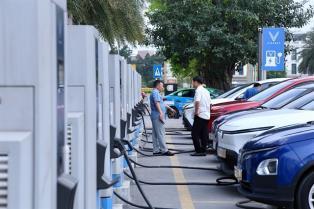
Reflecting this shift, the ministry said electric vehicles are no longer viewed simply as transport products but as a new industrial sector requiring a full ecosystem from vehicle manufacturing and batteries to charging infrastructure and supporting industries.
Director of the Industrial Development Support Centre Cường outlined three long-term priorities: technology, human resources and infrastructure.
“Việt Nam needs mechanisms to help firms access and master foreign technologies alongside clearer requirements on technology transfer from FDI investors,” he said.
He also stressed the need to develop a skilled workforce through specialised training centres and closer links between businesses and education institutions.
On infrastructure, he called for dedicated industrial parks for the auto and mechanical sectors as well as internationally accredited testing and certification centres to reduce costs and speed up product development.
Meanwhile, Vân also stressed the need for stronger linkages between domestic firms and the FDI sector as well as cluster-based industrial development. — BIZHUB/VNS