Việt Nam auto sales rise 20% in five months as hybrid vehicles lead market
Hybrid vehicles continued to gain momentum. Monthly hybrid sales reached 1,670 units in May, representing a 59 per cent increase from April.
HÀ NỘI — The automotive market continued its strong recovery in the first five months of 2026, with total vehicle sales rising 20 per cent year-on-year.
Hybrid vehicle sales surged 80 per cent, emerging as one of the strongest growth drivers in the country’s accelerating vehicle electrification trend.
Earlier this week, the Việt Nam Automobile Manufacturers Association (VAMA), whose members account for roughly 62 per cent of the country’s automotive market, reported total sales of 29,935 vehicles in May. While the figure was down 6 per cent from April, it remained 6 per cent higher than the same month last year.
Passenger vehicles accounted for 19,182 units sold during the month, down 10 per cent from April. Commercial vehicle sales increased 5 per cent to 10,288 units, while sales of specialised vehicles fell sharply by 45 per cent to 465 units.
Sales of domestically assembled vehicles reached 13,080 units in May, down 6 per cent from the previous month. Imports of completely built-up (CBU) vehicles also declined by 6 per cent to 16,855 units.
Hybrid vehicles continued to gain momentum. Monthly hybrid sales reached 1,670 units in May, representing a 59 per cent increase from April. Cumulative hybrid sales for the January–May period totalled 8,518 units, up 80 per cent compared with the same period in 2025.
Toyota remained the market leader in May with sales of 5,653 vehicles. Ford ranked second with 3,493 units, followed by Mitsubishi with 3,111 vehicles, Kia with 2,512 units and Mazda with 2,304 units.
The Mitsubishi Xpander was the best-selling vehicle in May with 1,236 units sold, narrowly ahead of the Toyota Yaris Cross at 1,214 units. The Mazda CX-5 ranked third with 1,159 units, followed by the Toyota Veloz Cross with 797 units and the Mitsubishi Xforce with 693 units.
According to VAMA data, cumulative sales during the first five months of 2026 reached 156,729 vehicles, an increase of 20 per cent year-on-year. Passenger vehicles remained the dominant segment with 103,802 units sold, up 13 per cent, while commercial vehicle sales rose 32 per cent to 50,270 units.
Battery electric vehicles (BEVs) reported by VAMA members totalled 64 units during the period, highlighting the gradual expansion of electrified vehicle offerings in the Vietnamese market.
VAMA said sales of domestically assembled vehicles increased 11 per cent during the first five months of the year compared with the same period in 2025. Meanwhile, imported vehicle sales jumped 27 per cent, reflecting intensifying competition from foreign-made models in Việt Nam.
The figures suggest that Việt Nam’s automotive sector has maintained a positive growth trajectory in 2026 despite a short-term sales slowdown in May.
Demand for personal mobility, commercial transportation and fuel-efficient vehicles, particularly hybrids, is expected to remain a key growth catalyst in the months ahead.
However, industry analysts caution that the VAMA data does not provide a complete picture of the market. Several automotive brands operating in Việt Nam do not publicly disclose sales figures, including Audi, BYD, Jaguar Land Rover, Geely, GAC, Lynk & Co, Omoda & Jaecoo, Mercedes-Benz, Nissan, Subaru, Volkswagen and Volvo.
In addition, major industry players such as Hyundai Thanh Cong and VinFast have yet to release their latest sales results, making it difficult to fully assess overall market performance so far this year.
Strong domestic production
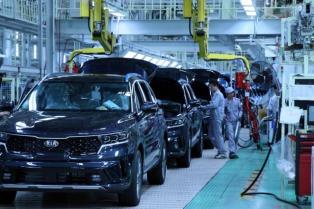
Việt Nam’s automotive industry also achieved a significant milestone on the supply side, with domestic vehicle production and assembly reaching a record level in May and substantially outpacing imports.
According to the General Statistics Office, approximately 76,837 new vehicles were supplied to the Vietnamese market during May, the highest monthly figure recorded since the beginning of the year. The total represented a 13.2 per cent increase from April.
The strongest performance came from domestic manufacturing and assembly operations. Vehicle output reached 53,700 units during the month, up 4.7 per cent from April and 40 per cent higher than in May 2025.
Domestic production significantly exceeded imported vehicle volumes, which totalled approximately 23,137 completely built-up units. The gap of more than 30,000 vehicles in a single month underscores a notable shift in supply dynamics toward local assembly plants.
During the first five months of 2026, domestic manufacturers produced an estimated 232,100 vehicles, representing year-on-year growth of 26.7 per cent.
The increase in local production has enabled manufacturers to reduce logistics costs and improve supply-chain efficiency. From a broader economic perspective, the trend is viewed as a positive development, supporting job creation, reducing import dependence and contributing to improvements in Việt Nam’s trade balance. VNS