Việt Nam, Republic of Korea sign eight AI, semiconductor cooperation deals
The eight MoUs focused on technology cooperation, supply chain development and workforce training.
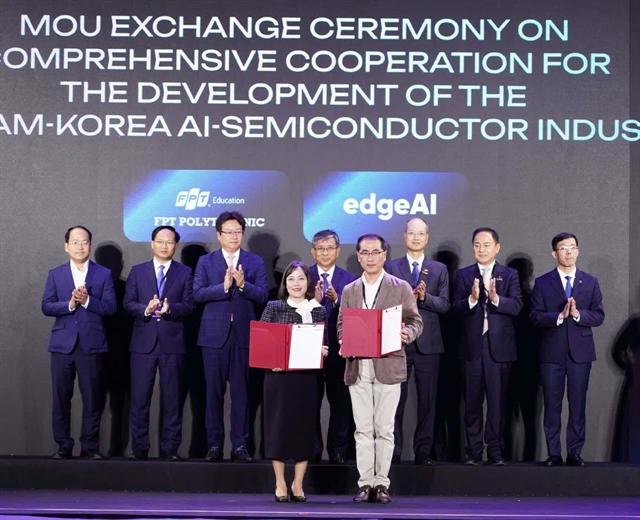
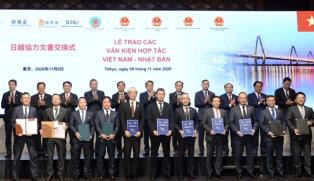
HÀ NỘI — Associations, businesses and educational institutions from Việt Nam and the Republic of Korea exchanged eight memoranda of understanding (MoUs) on technology cooperation, supply chain development and workforce training in AI and semiconductors at the first Việt Nam–Korea AI-Semiconductor Summit in Hà Nội on Thursday.
The summit was jointly organised by the Department of Digital Technology and Artificial Intelligence under the Ministry of Science and Technology, FPT Corporation, the Korea AI Semiconductor Fabless Industry Association (KAISA) and the Vietnam Software and IT Services Association.
Speaking at the signing ceremony, Deputy Minister of Science and Technology Trần Trung Tính said semiconductors and AI are leading growth industries and foundations for technological autonomy, economic security and national standing.
In the digital era, countries deeply involved in the AI and semiconductor value chains will enjoy significant competitive advantages, he said.
Semiconductors and AI have been identified as strategic technologies prioritised for development in Việt Nam under the Politburo’s Resolution 57-NQ/TW. The institutional and policy framework for the two sectors has been largely established through the Law on Digital Technology Industry, the Law on Artificial Intelligence and the Government's sectoral strategies.
In the semiconductor sector, Việt Nam is taking steps to develop specialised chips linked to the electronics industry, while aiming to train at least 50,000 university graduates and higher-level professionals by 2030.
Chip design, advanced packaging and testing have been identified as areas offering early opportunities for breakthroughs, while chip fabrication will be pursued along an appropriate roadmap in association with international cooperation.
As for AI, Việt Nam is shifting from research, development and application towards nationwide AI-driven transformation, with personnel, infrastructure and data as foundations and institutional development and AI governance as key breakthroughs.
Describing the Republic of Korea as an important partner with strengths in semiconductors and AI, Tính said Việt Nam wants to move cooperation towards joint research, chip design, the development of AI models and solutions, and the creation of products and markets, alongside technology transfer and higher domestic added value.
The two sides should also strengthen long-term workforce training tailored to business needs, build an open, safe and trusted AI-semiconductor ecosystem and cooperate in developing specialised chips and AI applications to address practical needs in both economies, he said.
At the summit, the eight MoUs focused on technology cooperation, supply chain development and workforce training. Business-matching sessions were also held to expand partnership opportunities in the two sectors.
KAISA and the Bắc Ninh Semiconductor Association established a cooperation framework to promote trade, expert exchanges and collaboration in chip design, manufacturing, packaging and testing.
Meanwhile, FPT signed collaboration agreements with HANA Micron, Supergate and EdgeAI Inc for semiconductor packaging and testing, expanding its network of partners in the sector's supply chain.
Another agreement involving FPT and SKAIChips established a framework for cooperation on semiconductor and AI projects. Areas of interest include food monitoring, electronic shelf labels, asset tracking and healthcare. The deal also aims to explore customer opportunities and expand commercial activities in Việt Nam, the Republic of Korea, Japan and Malaysia.
In terms of education, the MoUs focus on exchanges of lecturers, experts and learners, applied research, the joint development of specialised training programmes and the organisation of sector-specific workshops.
Nguyễn Thế Phương, FPT Corporation’s Deputy director, said the effectiveness of collaboration between Việt Nam and the Republic of Korea should be measured by tangible outcomes, including joint research programmes, training tailored to practical industry needs and the development of products ready for real-world applications.
FPT is gradually building its capabilities in chip research and design, preparing to pilot a semiconductor packaging and testing plant in Bắc Ninh and carrying out workforce training programmes, he said.
KAISA Chairman Kim Kyung Ho said combining the Republic of Korea's technology and semiconductor industry capabilities with Việt Nam's talented workforce and growing market will create strong synergies.
He expressed hope that the summit would develop into a sustainable cooperation platform between the two countries in AI and semiconductors. — BIZHUB/VNS