Việt Nam reports progress after nearly two years of Resolution 57 implementation
Since the adoption of Resolution 57 on October 22, 2024, science and technology, innovation and digital transformation have been accelerated nationwide.
HÀ NỘI — Việt Nam has recorded significant progress in science and technology, innovation and digital transformation after nearly two years of implementing the Politburo's Resolution 57-NQ/TW, according to a report by the Ministry of Science and Technology.
The report, submitted to National Assembly deputies ahead of a question-and-answer session on November 12, highlights advances in institutional reform, infrastructure development, research capacity and the commercialisation of domestically developed technologies.
Since the adoption of Resolution 57 on October 22, 2024, science and technology, innovation and digital transformation have been accelerated nationwide.
The Ministry of Science and Technology has led the drafting and submission of 195 legal documents while coordinating a 100-day campaign to speed up digital transformation.
Improvements
State funding for science and technology, innovation and digital transformation has increased significantly from previously just around VNĐ12 trillion (US$462 million) per year to VNĐ75 trillion in 2025 and VNĐ95 trillion in 2026 with a further increase to VNĐ120 trillion projected for 2027.
Việt Nam also improved its position in international innovation rankings. It ranked 43rd among 139 economies in the 2026 Global Innovation Index (GII), published by the World Intellectual Property Organisation (WIPO), up one place from 2025.
The country ranked third in Southeast Asia and second among lower-middle-income economies. Its innovation output placed 35th globally, up two positions, while its startup ecosystem climbed five places to 50th worldwide.
Việt Nam also ranked 45th among 195 countries and territories in the 2025 Government AI Readiness Index, six places higher than in 2024.
Mobile internet speed rises 4.5-fold on the expansion of telecommunications infrastructure, especially the deployment of fifth-generation (5G) mobile networks.
According to data from US-based internet analytics firm Ookla, Việt Nam's mobile internet speed increased from 50.9 Mbps in April 2024, when the country ranked 58th globally, to approximately 230 Mbps in September 2026, placing it at eighth position worldwide.
Fixed broadband speed reached 297.64 Mbps, putting Việt Nam among the world's top 10 countries.
By the end of the third quarter of 2026, Việt Nam had 60,034 5G base stations, providing coverage to 93.4 per cent of the population. The number of 5G subscribers reached 27.2 million in August 2026, nearly double the figure recorded in September 2025.
Advances in research and domestic technology

According to SCImago, the country ranked 42nd globally in scientific publications in 2025, up three places from the previous year. During the first 10 months of 2026, Vietnamese researchers produced 26,107 publications indexed in Scopus, exceeding the total for the whole of 2025.
By June 2026, 61 Vietnamese higher education institutions had been included in the SCImago rankings, 15 more than in 2024.
The report also highlighted progress in translating research into commercial products, including the commercialisation of a Vietnamese-developed vaccine against African swine fever and a specialised security chip.
The digital technology industry has also recorded strong growth in revenue and exports.
In 2025, the sector generated revenue of $215 billion, while exports reached $172 billion, increases of 36 per cent and 30 per cent, respectively, from 2024. During the first 10 months of 2026, revenue was estimated at $254.6 billion and exports at $212 billion, up 53 per cent and 46.2 per cent year-on-year, respectively.
As of September 30, 37 of the 79 national shared digital platforms were operational, while another 12 were undergoing testing.
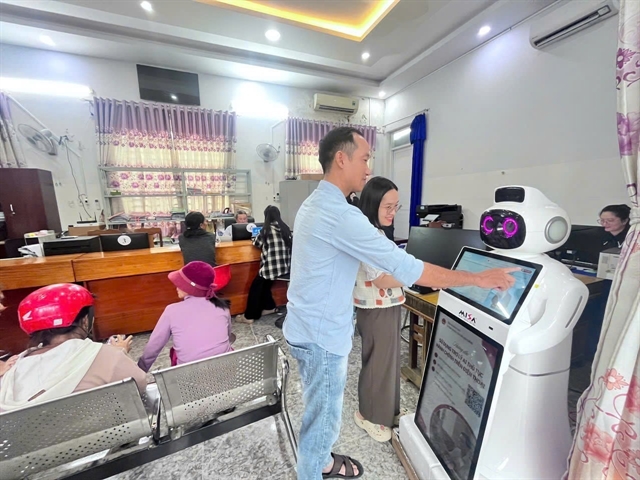
The National Public Service Portal offered 3,745 online administrative procedures, including 2,361 fully online services. By October 2026, approximately 36.16 million digital signature certificates had been issued nationwide, an increase of 36.71 per cent from the end of 2025.
Artificial intelligence is also being introduced into public administration with two nationally deployed AI platforms developed by Vietnamese companies using domestically controlled Vietnamese-language large language models being provided free of charge during their pilot phase across all 24 central ministries and agencies and all 34 provinces and cities.
However, the report also identified key issues requiring further attention, including the effective allocation and disbursement of public funding, the development of strategic technologies, the commercialisation of research findings, stronger data sharing and the management of emerging technologies.
The ministry said it would continue to improve the legal framework, accelerate the implementation of science and technology programmes, strengthen digital connectivity and improve online public services, while enhancing safeguards for the application of artificial intelligence. — BIZHUB/VNS