Digital innovation drives sustainable engineering, smart manufacturing
Experts gathered in HCM City on November 5 to map out strategies for digital innovation in smart manufacturing and sustainable engineering, aligning with national transformation goals under Resolution No. 57-NQ/TW.
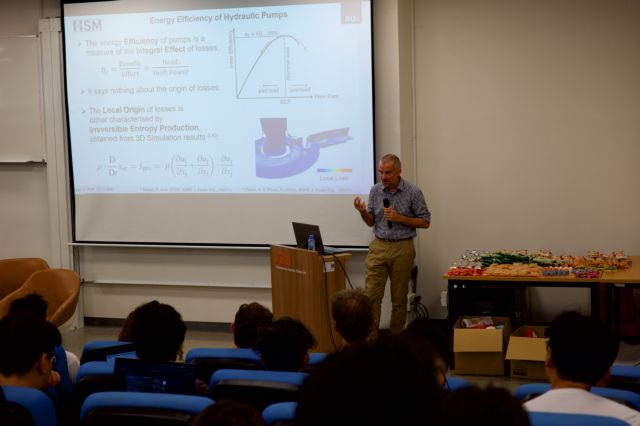
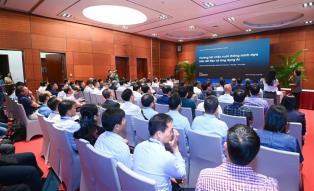
HCM CITY — Leading experts, researchers and industry practitioners gathered at a forum in HCM City on November 5 to discuss implementation strategies to accelerate digital innovation for sustainable engineering and smart manufacturing, in line with national digital transformation goals under the Politburo's Resolution No. 57-NQ/TW.
The university-industry insights forum, held at the Vietnamese-German University (VGU), brought together international researchers, industry leaders and engineering students to discuss the integration of advanced digital tools in modern industrial operations.
Discussions centred on two pivotal pillars of Industry 4.0 comprising Computational Fluid Dynamics with Reduced Order Models alongside Intelligent Sensing coupled with Digital Twin platforms.
Real-time industrial control via reduced order models
Opening the technical sessions, Professor Romuald Skoda from Ruhr-Universität Bochum presented breakthrough applications of computational fluid dynamics in mechanical and sustainable process engineering.
“Computational fluid dynamics simulations have long served as a vital tool in research and development, helping engineers optimise aerodynamic designs, reduce pollutant emissions in combustion processes, improve chemical reaction predictions, and boost the energy efficiency of fluid machinery.”
Pump systems alone consume 10 to 20 per cent of generated electrical energy in developed nations.
“Through precise modern pump and system designs evaluated via computational fluid dynamics methods, up to 30 to 40 per cent of this energy can be saved.”
However, high-fidelity simulations require immense computational resources, often requiring around 100,000 core-hours for a single circumferential pump simulation.
To address this challenge, researchers are pioneering model reduction by employing mathematical techniques such as proper orthogonal decomposition to condense complex fluid flow models into reduced order models governed by just 10 to 20 ordinary differential equations.
This dramatic speedup allows high-accuracy simulation data to run in real time on microcontrollers embedded directly inside physical machinery.
This innovation enables real-time condition monitoring, automatic control of phenomena like cavitation, and dynamic operational design adjustments without heavy computational infrastructure.
Data-driven monitoring and context-aware digital twins
Addressing operational efficiency on the factory floor, Dr Dicky Januarizky Silitonga from VGU detailed how intelligent sensing and predictive maintenance mitigate the severe costs of unplanned downtime.
Citing global industry data, unplanned downtime costs the world’s 500 largest companies roughly US$1.4 trillion annually, representing nearly 11 per cent of their total revenue.
“Unplanned equipment downtime disrupts production, increases costs and reduces operational reliability.”
While traditional maintenance waits for equipment to break or follows fixed schedules, predictive maintenance uses sensor data, oil analysis,and vibration monitoring to establish a warning window between detecting a potential failure and actual breakdown.
“Sensor readings, oil analysis and inspection findings help assess equipment condition, detect early signs of deterioration, determine appropriate maintenance actions, and estimate remaining useful life.”
Advancing beyond basic monitoring dashboards, Dr Silitonga introduced ongoing research on context-aware digital twins.
Unlike static computer-aided design models or passive data dashboards, a true digital twin maintains a bidirectional real-time link with the physical asset.
It continuously adapts its virtual baseline to reflect normal operational wear, enabling it to distinguish between routine thermal drift, payload variations, light contact, and actual mechanical collisions.
“A digital twin establishes a two-way connection between a physical machine and its digital model. This enables the model to adapt to operating data, predict machine behaviour, and incorporate feedback from interventions to guide subsequent decisions.”
Demonstrating a laboratory prototype built on a collaborative robot, the research team illustrated how real-time motor current tracking and adaptive algorithms can trigger immediate, automated safety interventions or targeted service alerts.
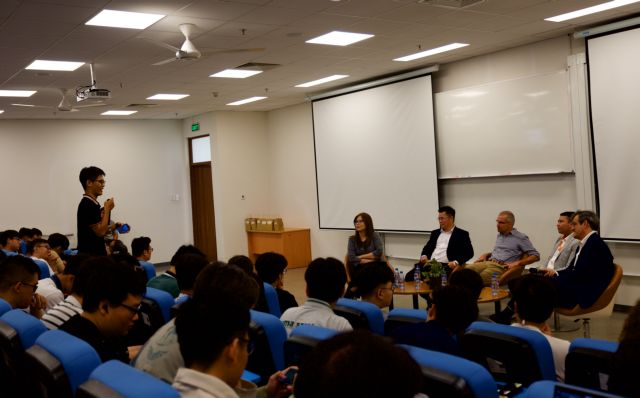
The forum concluded with an interactive panel discussion addressing the broader practical and educational challenges of implementing digital transformation.
Key takeaways from the panel experts included tailored maintenance strategies, human-in-the-loop control and engineering education adaptation.
Tailored maintenance strategies where experts stressed that predictive maintenance and digital twins are not one-size-fits-all, as selection depends on asset criticality, operating environments, and failure costs.
Human-in-the-loop control ensuring that as artificial intelligence automates routine monitoring, human engineers remain essential to focus on high-level decision-making and troubleshooting.
Engineering education adaptation stressing that students must pair core engineering fundamentals with artificial intelligence literacy so digital tools enhance analytical problem-solving rather than replace core principles. — VNS