Strategic technologies key to boost innovation capacity
Promoting the development of strategic technologies and products is expected to strengthen Việt Nam’s national innovation capacity.
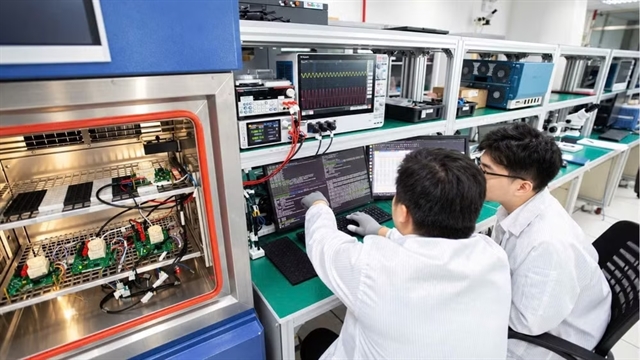
HÀ NỘI — Promoting the development of strategic technologies and products is expected to strengthen Việt Nam’s national innovation capacity.
According to the Global Innovation Index (GII) 2026, released by the World Intellectual Property Organisation (WIPO) in September 2026, Việt Nam ranked 43rd among 139 economies, up one place from 2025.
The 2025 and 2026 GII reports also show that Việt Nam continued to rank first globally in the share of high-tech exports and creative goods in trade.
According to the Ministry of Science and Technology, a large number of businesses in Việt Nam are involved in strategic technologies and strategic technology products, generating combined revenues worth tens of billions of US dollars.
However, most of this revenue comes from foreign-invested enterprises. Domestic companies account for around one-quarter of the total number of businesses in the sector but contribute only a very small share of revenue.
This reflects Việt Nam’s emergence as a major high-tech manufacturing base, while domestic companies continue to hold limited positions in value chains.
One positive development is the growing investment in research and development (R&D) by the business sector. In 2023, corporate R&D spending reached approximately VNĐ33.3 trillion, significantly higher than that of other sectors.
Experts say the scale of high-tech manufacturing, coupled with rising business investment in research, provides favourable conditions for the development of strategic technologies.
However, several indicators in the 2026 GII highlight weaknesses in the nation’s ability to create and capture technological value. Việt Nam ranked 110th for intellectual property receipts, while high-skilled employment accounted for only around 11 per cent of total employment, placing the nation 100th. It ranked 79th in the human capital and research pillar.
These figures show that although Việt Nam has become deeply integrated into global technology value chains, its capacity to capture value from technology and intellectual property remains limited.
This underscores the need to move beyond contract manufacturing and assembly towards designing, mastering, owning and commercialising technologies.
R&D spending also remains relatively low, at around 0.4 per cent of GDP. Raising this ratio to 2 per cent of GDP, as targeted under Resolution 57-NQ/TW, will be a major challenge requiring contributions from all sectors of society, particularly businesses.
Creating markets for domestic technologies
Chu Thúc Đạt, deputy director of the Agency for Innovation under the Ministry of Science and Technology, said businesses had been allowed to establish, manage and use science and technology development funds to directly undertake, commission or outsource scientific and technological tasks.
The funds can also be used to invest in research infrastructure, acquire technologies, intellectual property, equipment and software, train personnel, conduct research cooperation and invest in innovative start-ups and projects in accordance with regulations.
Experts say Việt Nam cannot rely solely on the State budget to increase R&D investment. Instead, it needs mechanisms to encourage corporate investment.
According to Nguyễn Tiến Tài, deputy director of the Department of Science, Technology and Engineering under the Ministry of Science and Technology, one proposed measure is for the State budget to cover part of the costs of developing strategic technologies and products, with businesses providing matching funds. This approach will help reduce risks during the early stages of development, when products have yet to generate revenue.
Another measure is to transfer ownership of research results funded by the State budget to the organisations carrying out the research as soon as the results are generated, without requiring them to repay the support received.
This mechanism will encourage businesses to make long-term investments in technology research, development and commercialisation.
Lê Quang Hiệp, business director of Phenikaa-X JSC, under Phenikaa Group, said businesses would have greater incentives to increase research spending if they could see clear prospects for bringing their products to market.
Through public procurement, commissioned orders and major infrastructure projects, the State could help create an initial market for domestically developed products that meet quality requirements, he said.
In addition, preferential mechanisms specifically designed for strategic technologies need to be effectively implemented in areas including taxation, human resources, intellectual property, testing and certification, interest-rate support and public procurement.
According to the Ministry of Science and Technology, the science, technology and innovation programme for strategic technologies targets areas of mastering core technologies, registering and protecting patents, and commercialising inventions.
Developing strong research teams and a skilled workforce of design engineers will also strengthen human capital and research capacity.
Meanwhile, cooperation among research institutes, universities and businesses in carrying out scientific and technological tasks will also help strengthen innovation linkages. VNS