Việt Nam must rethink FDI strategy in AI era
Việt Nam faces urgent pressure to revamp its FDI strategy as AI reshapes global investment, shifting focus to technology, talent and innovation ecosystems over cheap labour
HÀ NỘI — Việt Nam must overhaul its foreign direct investment (FDI) strategy to remain competitive as artificial intelligence (AI) reshapes global capital flows, an expert has said, warning that traditional advantages, such as low labour costs, are losing relevance in investment decisions.
According to Phan Hữu Thắng, former director of the Foreign Investment Agency (FIA), AI is fundamentally changing where and how capital is deployed, with leading technology firms now prioritising digital infrastructure, availability of AI talent and the maturity of local innovation ecosystems, over labour costs.
Writing in a story published on vnbusiness.vn, he outlined three major global trends.
First, capital is shifting away from traditional manufacturing towards digital infrastructure, including data centres, cloud computing and AI platforms.
Second, demand for labour is moving from low-cost workers to highly skilled engineers, data scientists and AI researchers.
Third, investment decisions are increasingly based on the quality of ecosystems, rather than tax incentives.
Việt Nam retains several advantages, including an established manufacturing base, a young, tech-savvy population and a favourable position in global supply chain diversification, according to Thắng.
However, the country is not yet fully prepared to attract large-scale AI-driven FDI, citing structural constraints such as underdeveloped AI infrastructure, a limited pool of high-level AI talent and a fragmented innovation ecosystem.
While AI-driven FDI could be transformative, it also carries risks, particularly technological dependence on major global platforms.
He said Việt Nam must set three core requirements for AI-related FDI projects: substantive technology transfer, joint investment with Vietnamese firms and integration into the domestic innovation ecosystem.
“Việt Nam does not need to lead the world in AI but must control how AI is deployed in the economy. That is the foundation of strategic autonomy,” Thắng said.
Major pillars
Thắng said an AI-driven FDI strategy should rest on three pillars.
The first is building national AI infrastructure, including large-scale data centres, cloud computing systems and high-performance computing capacity, alongside R&D and innovation hubs.
The second is developing AI talent by attracting foreign experts, encouraging overseas Vietnamese professionals to return and training a new generation of domestic engineers.
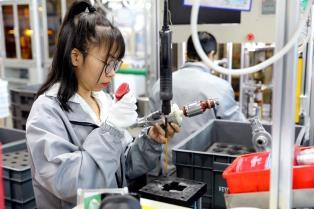
The third is leveraging existing FDI to apply AI in key sectors such as manufacturing, logistics and agriculture, to boost productivity in the short term.
He said policy design should shift away from competing on tax incentives, with Việt Nam instead setting measurable targets such as training local engineers, establishing R&D centres and sharing technology with domestic partners. Regulatory sandboxes for AI, fintech and data-driven services would also be introduced.
Thắng warned that a key risk of the AI-driven model would be technological lock-in, where reliance on a small number of global technology providers could undermine long-term autonomy.
To mitigate this, he said Việt Nam needed to diversify investment partners, strengthen domestic technology firms and gradually build core technological capabilities.
He also proposed a phased approach to implementing the strategy. The first phase, covering 2026–27, would focus on establishing legal frameworks and attracting initial large-scale AI infrastructure projects. By 2030, Việt Nam would expand the ecosystem by developing AI hubs, supporting start-ups and strengthening R&D linkages.
From 2030 to 2035, the country should aim for greater technological capability, enabling it to export AI services and participate more deeply in global digital value chains.
“The key transition Việt Nam must make is from attracting capital to attracting technological capability,” Thắng said. “That is the only way FDI can help the country avoid the middle-income trap and ensure sustainable development in the AI era.”
Official statistics showed that total registered FDI in the 2021–25 period reached US$184.2 billion, up nearly 8.4 per cent compared with 2016–20, placing Việt Nam among the world’s top 15 developing economies for FDI inflows. — VNS