Việt Nam eyes development of large railway industrial complex
Việt Nam plans to develop a large railway industrial complex, which is a foundational step toward building a domestic railway industry chain, while opening up new space to attract private investment.
HÀ NỘI — Việt Nam plans to develop a large railway industrial complex in Hà Nội, which is seen as a foundational step toward building a domestic railway industry chain while opening up new space to attract private investment.
Under Prime Minister’s Decision 2404, a railway industrial complex covering about 250 hectares has been added to the master plan for a Hà Nội railway hub. The complex will be located in the capital city's Chuyên Mỹ and Ứng Hòa communes.
The 250-hectare complex represents a strategic preparation of industrial infrastructure for what is expected to be a surge in railway investment over the next few decades.
According to the CCTDI-TEDI consulting consortium, which drafted the plan, the scale of the complex was determined based on international experience and long-term market demand forecasts.
Under the adjusted national railway network plan, Việt Nam is expected to invest in 17 railway lines by 2030, followed by an additional 19 lines in the post-2030 period.
Both Hà Nội and HCM City are currently completing their urban railway networks, generating substantial demand for rolling stock, rail cars, components and maintenance services.
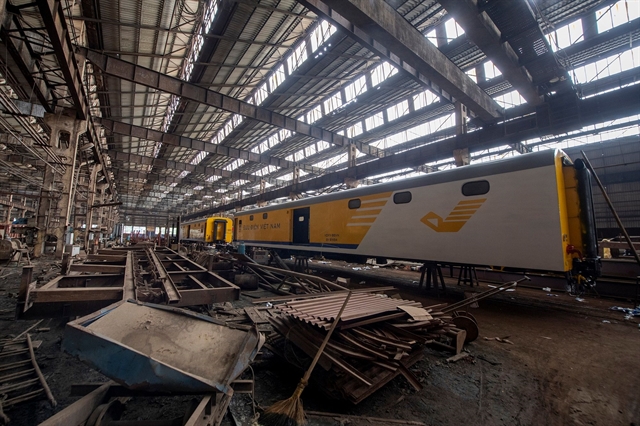
By contrast, domestic manufacturing capacity remains extremely limited. Nationwide, only two factories—Gia Lâm Railway Factory in Hà Nội and Dĩ An Railway Factory in HCMC—are engaged in the production of railway vehicles, while most other facilities focus primarily on maintenance and repairs.
Although the Gia Lâm Railway Factory covers more than 20 hectares, its inner-city location leaves little room for expansion.
“A 250-hectare railway industrial complex is not merely a factory construction project. It is a strategic component in efforts to form a modern railway industry, reduce dependence on imports and gradually integrate more deeply into the regional value chain,” said Hoàng Văn Triệu from the Institute for Railway Technology Research and Development.
According to consultants’ proposals, the railway industrial complex will be organised into 17 functional zones, covering nearly the entire value chain.
These include areas for turnout production (about 20 hectares), locomotive assembly (15 hectares), car body manufacturing, freight car assembly, Electric Multiple Units trains, high-speed trains, interior manufacturing and air conditioning systems, as well as research and testing facilities and a workforce training centre.
This approach reflects a shift in mindset. Rather than fragmented investments in standalone factories, the complex is designed as an industrial ecosystem in which enterprises can participate at multiple stages, from components and spare parts to full assembly.
From an investment perspective, this model significantly reduces market entry costs for private enterprises, particularly in a sector such as railway manufacturing, which requires large capital outlays, high technical standards and synchronised infrastructure.
Based on the approved plan, Việt Nam Railways Corporation (VNR) has been tasked with developing the railway industrial complex construction project and submitting it to relevant authorities.
According to VNR Deputy General Director Hoàng Năng Khang, the proposed project involves developing a 250-hectare complex with modern infrastructure to support the manufacturing, assembly and production of railway vehicles, equipment and components, with the goal of gradually increasing localisation rates.
The production roadmap is divided into multiple phases. The initial phase will focus on assembling and refurbishing diesel locomotives using cleaner energy, as well as producing passenger and freight cars for the existing network.
For urban railways and newly built lines, early stages will still rely partly on imported locomotives and other equipment, along with domestic assembly.
Subsequent phases aim to achieve mastery in producing passenger and freight cars with speeds of up to 160 km/h, assembling electric locomotives and raising localisation rates to around 30 per cent—a level considered feasible given the current state of Việt Nam’s supporting industries.
Despite being incorporated into the planning framework, the railway industrial complex has yet to be assigned a concrete investment timeline or a clearly defined investment model.
According to the Việt Nam Railway Authority, the State-owned operator of the railway system in Việt Nam, the adjusted plan currently serves primarily as a legal framework that enables local authorities to allocate land, forming the basis for subsequent implementation steps.
Decisions regarding public investment, public-private partnerships or hybrid models will need to be clarified during the pre-feasibility study phase.
VNR has indicated that it is in the process of selecting international consultants to prepare the pre-feasibility report, which will provide a detailed assessment of financial options, incentive mechanisms and the potential for mobilising non-budgetary resources.
Triệu noted that concentrating railway industrial activities within a large complex would create significant appeal for private investors.
When the State invests in core infrastructure, particularly environmental treatment, logistics and internal railway connections, enterprises can lease land or factory space to launch production, substantially reducing upfront investment costs.
More importantly, companies operating within the complex would benefit from preferential policies tailored to the railway industry, particularly regarding land rents and taxation.
These incentives are seen as a decisive factor in improving financial viability in a sector characterised by long capital recovery periods. – VNS