The manufacturing technology industry’s race for survival
The convergence of green manufacturing and artificial intelligence (AI) has given rise to a trend of dual transformation, compelling Vietnamese enterprises to make greater efforts to maintain their position in global supply chains.
HÀ NỘI — If the manufacturing industry was once symbolised by billowing smokestacks and factory floors roaring with machinery, today a quiet revolution is underway.
The convergence of green manufacturing and artificial intelligence (AI) has given rise to a trend of dual transformation, compelling Vietnamese enterprises to make greater efforts to maintain their position in global supply chains.
Amid mounting geopolitical uncertainties, the global economy is reshaping the rules of the game. Non-tariff barriers related to environmental standards, product traceability and data governance now influence nearly 90 per cent of global trade.
New-generation free trade agreements, such as the Comprehensive and Progressive Agreement for Trans-Pacific Partnership and the European Green Deal and the Carbon Border Adjustment Mechanism, are no longer abstract policy concepts. Instead, they have become mandatory entry passes for Vietnamese goods seeking access to international markets.
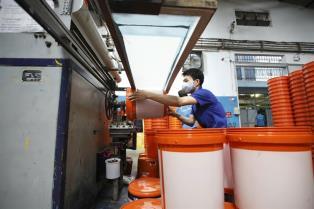
As the longstanding engine of Việt Nam’s economic growth, the manufacturing sector is now confronting a formidable challenge. According to industry experts and researchers, the sector can no longer rely on a growth model characterised by labour-intensive production, excessive energy consumption and high carbon emissions.
At numerous forums, Minister of Industry and Trade Lê Mạnh Hùng has repeatedly emphasised that the ministry will accelerate the country's dual transformation strategy by advancing the green transformation, which is closely linked to national energy security, alongside digital transformation.
Over the past several years, the manufacturing sector has maintained its role as a key growth driver, achieving an average annual growth rate of 6.9 per cent.
However, to continue leading the economy, Việt Nam must foster a more favourable investment and business environment, remove institutional bottlenecks and enable the industry to become more autonomous, interconnected, modernised and deeply integrated into global markets.
Investment in green industry and digital technologies is no longer an optional measure to enhance sustainability reports; it has become an essential prerequisite if Việt Nam is to sustain rapid economic growth and avoid being excluded from global supply chains in the net zero era.
In the race towards dual transformation, if green standards represent the destination, then AI and digitalisation are the most powerful tools for achieving it.
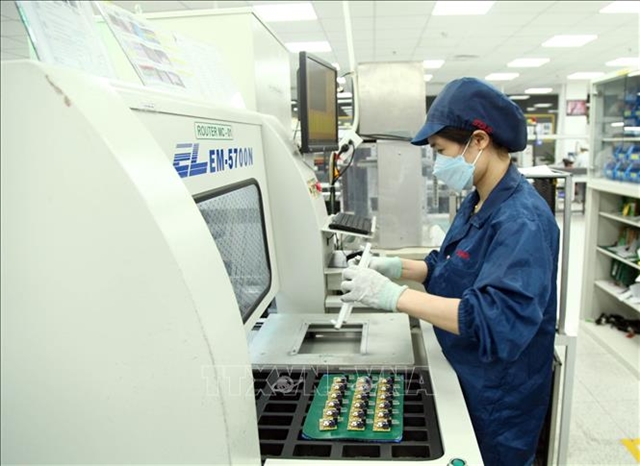
Across many industrial parks, AI and the Internet of Things are already being deployed to optimise every stage of production.
Robotic arms automatically sort waste, sensors monitor carbon emissions in real time and AI-powered software accurately forecasts raw material demand to minimise inventories and production losses. Together, these technologies are creating smart factories where economic efficiency goes hand in hand with environmental sustainability.
Assessing this technological transformation, economic expert Nguyễn Hồng Sơn highlighted the sector’s bottlenecks as well as potential breakthrough solutions.
Việt Nam’s manufacturing industry still relies heavily on manual labour and human-operated machinery, while the adoption of advanced technologies such as robotics and AI remains limited, according to Sơn.
To accelerate industrialisation and modernisation, Vietnamese enterprises needed to shift from assembly and contract manufacturing toward producing goods under the 'Make in Việt Nam' strategy, he said.
Mastering smart manufacturing technologies, strengthening research and development and integrating AI into production would be key to optimising operations and reshaping the country’s digital industries.
The rapid advancement of AI would not only reduce dependence on manual labour, but also enable businesses to monitor and transparently manage end-to-end traceability data, an increasingly indispensable requirement for international buyers.
Dual transformation would remain incomplete without small and medium-sized enterprises (SMEs), which account for more than 97 per cent of all businesses in Việt Nam and serve as the capillaries of the national economy.
For many years, the greatest obstacles preventing SMEs from adopting green production lines and AI technologies have been high upfront investment costs and a shortage of highly skilled workers.
Yet the very pressure to survive is becoming their strongest motivation for change. Export-oriented industries, such as agricultural processing, food manufacturing, textiles and garments, and wood processing, are among those demonstrating the most proactive transformation.
Dennis Quennet, director of the Sustainable Economic Development Programme at the German Agency for International Cooperation, said Germany's experience showed that SMEs had been not only the backbone of the economy, but also the driving force behind innovation and pioneers of dual transformation.
When digital transformation is combined with green development, SMEs first benefit from lower operating costs, reduced resource consumption and higher productivity, according to the director.
These improvements strengthen business models, open up niche market opportunities and create pathways for growth into larger enterprises.
The Fourth Industrial Revolution has moved beyond its initial stage and entered a phase of rapid acceleration. For Việt Nam’s manufacturing sector, escaping the low value-added contract manufacturing trap will require mastering green production technologies and embracing AI on a broad and deep scale.
Dual transformation is not a destination, but a continuous process of restructuring. As international standards become increasingly stringent, companies that invest boldly in technology, ensure transparency in emissions reporting and optimise their operations through AI will be best positioned to shape the future.
This is a golden opportunity for Việt Nam’s manufacturing industry to redefine its role, emerge as a high-tech, self-reliant and sustainable link in the global economy, and strengthen its position on the world stage. — VNS