State, universities and businesses urged to strengthen cooperation on technology talent
The Government should create the policy framework, universities provide training and research, while businesses connect education with market demand through technology transfer, practical learning opportunities and recruitment.
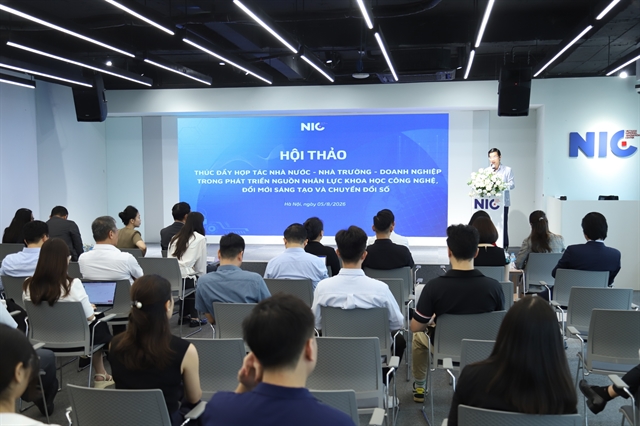
HÀ NỘI — Closer cooperation among Government agencies, universities and businesses to develop a skilled workforce in science, technology, innovation and digital transformation, was needed to meet growing demand for high-quality talent, participants at a workshop said on Wednesday.
Đỗ Tiến Thịnh, deputy director of the Ministry of Finance's Vietnam National Innovation Centre, said developing high-quality human resources required long-term cooperation among all three parties.
Thịnh said the Government should create the policy framework, universities provide training and research, while businesses connect education with market demand through technology transfer, practical learning opportunities and recruitment.
The NIC would continue working with Government agencies, universities, research institutes and domestic and international partners to expand programmes linking education, research and innovation with the needs of businesses and the broader economy, he said.
He added that closer cooperation would help narrow the gap between training programmes and labour market demand, making workforce development more practical and sustainable.
Thịnh also called on partners to provide further input on policies and mechanisms to promote public-private cooperation in science and technology, innovation and digital transformation.
Samsung Vietnam highlighted its Samsung Innovation Campus (SIC) 2026 programme as an example of the tripartite partnership model. The company, together with the NIC and nearly 20 universities and colleges, aims to provide technology training for about 2,200 students in 2026.
Kim Yong Sup, deputy general director of Samsung Vietnam, said investment in talent development was as important as investment in production.
He said investing in production alongside human resource development was the most sustainable investment for the future, adding that factory infrastructure created economic value today while skilled technology talent would create value for decades to come.
He cited Samsung's Solve for Tomorrow competition, organised with the NIC, which encouraged middle and high school students to pursue science, technology, engineering and mathematics (STEM). The 2026 edition attracted more than 2,900 entries from about 1,400 schools across all 34 provinces and centrally administered cities.
Kim said Samsung had continued to expand education and talent development programmes in cooperation with Government agencies and educational institutions.
He said Samsung aimed to be more than a foreign investor or one of the country's largest exporters, adding that it wanted to become a long-term partner in developing Việt Nam's technology talent.
Participants at the workshop said science, technology, innovation and digital transformation had become key drivers of economic growth, labour productivity and national competitiveness, but noted that achieving those goals would depend on developing a workforce equipped with technical expertise, digital skills and the ability to adapt to a rapidly changing labour market.
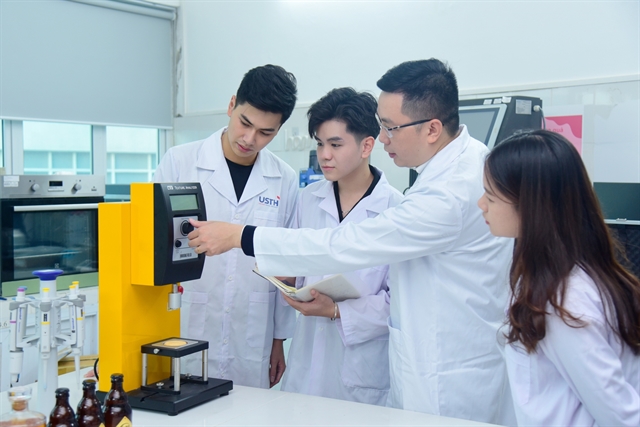
Phùng Trung Nghĩa, rector of the Thái Nguyên University of Information and Communication Technology called for stronger policy support to encourage collaboration among Government agencies, universities and businesses.
He said incentives were needed to encourage companies to invest in universities through laboratories, training centres, equipment, technology, scholarships and funding, while also allowing businesses to play a greater role in developing curricula, teaching, practical training and assessing learning outcomes.
Nghĩa proposed establishing a joint research and innovation fund with contributions from all three parties, alongside pilot programmes to test new training models, university-based enterprises and the commercialisation of research.
A common set of evaluation criteria to measure business participation, workforce quality and the practical application of research outcomes was also necessary, according to Nghĩa.
He said cooperation would be truly effective only when businesses became an integral part of the training, research and innovation process. — VNS