Solutions proposed to support firms amid Middle East conflict impacts
Top priority should be given to stabilising energy prices to ease input cost pressures and ensure supply stability – the most widely supported recommendation, chosen by 61.9 per cent of surveyed firms. Businesses urged close monitoring of global fuel prices and supply risks, along with flexible measures to curb abnormal domestic price fluctuations and secure supplies of fuel and essential materials.
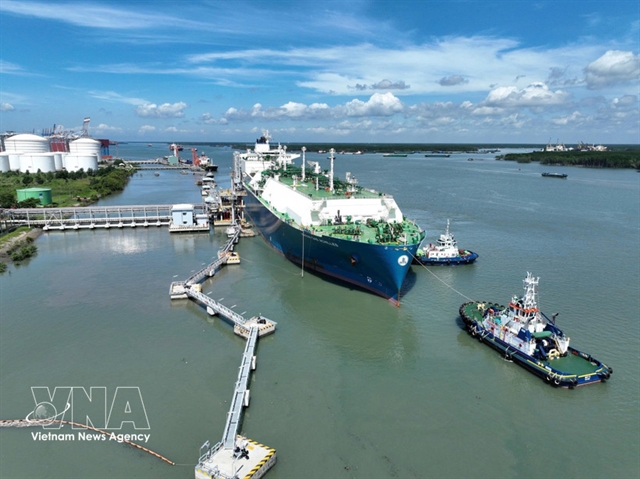
An LNG tanker docks at the Thị Vải LNG terminal in HCM City. — VNA/VNS Photo
HÀ NỘI — The Private Economic Development Research Board (Board IV) under the Prime Minister’s Advisory Council for Administrative Procedure Reform has submitted seven groups of solutions to the Prime Minister for consideration to help enterprises cope with the impacts of the Middle East conflict.
Top priority should be given to stabilising energy prices to ease input cost pressures and ensure supply stability – the most widely supported recommendation, chosen by 61.9 per cent of surveyed firms. Businesses urged close monitoring of global fuel prices and supply risks, along with flexible measures to curb abnormal domestic price fluctuations and secure supplies of fuel and essential materials.
The board also called for prompt credit support measures, including debt restructuring, lower interest rates and improved cash flow. Amid rising costs and constrained access to capital, policies such as interest subsidies, extended debt repayment, expanded short-term lending and faster tax refunds are needed to help firms, particularly small- and medium-sized enterprises, maintain liquidity.
Strengthening information sharing, forecasting and early warning systems was highlighted as another key solution to enhance adaptability to global volatility. Greater public-private dialogue is also needed to diversify supply sources, find alternative transport routes and expand markets, reducing reliance on high-risk regions.
Board IV stressed the importance of accelerating administrative reform, removing legal bottlenecks and ensuring consistent policy implementation to cut compliance costs. Simplifying procedures related to imports, tax refunds and access to capital would allow businesses to focus resources on production and risk response.
It also urged effective implementation of the Politburo’s Resolution No. 57-NQ/TW on breakthroughs in science-technology development, innovation and digital transformation, describing this as a critical driver for improving productivity, reducing costs and safeguarding economic security.
In addition, experts noted that disruptions to global food supply chains caused by geopolitical tensions could present an opportunity for Việt Nam to strengthen its role in global food supply, provided there is decisive Government direction.
The board further warned of rising cybersecurity risks amid global instability, calling for stronger support to help businesses improve resilience against cyberattacks.
According to Board IV, the Middle East conflict is exerting growing, multi-dimensional pressure on Vietnamese enterprises. A rapid survey of 228 firms conducted from March 16–22 showed that 62.7 per cent reported major or very major impacts on operations, while 55.3 per cent said effects have already been felt.
Rising input costs remain the most significant challenge, with 87.7 per cent of businesses reporting increases, driven mainly by higher energy, raw material, logistics and financial costs. Many firms have seen costs rise by 5–10 per cent, with some reporting increases of over 20 per cent.
At the same time, disruptions to international transport and logistics are compounding difficulties. Over half of surveyed firms said they have been affected, citing higher freight rates, longer delivery times and additional expenses. More than half also reported declining export orders, particularly in Asian and Middle Eastern markets, indicating that the shock is spreading from inputs to outputs.
The survey also revealed mounting financial strain, with 64.5 per cent of enterprises delaying or adjusting investment plans. Most firms rated their resilience as only moderate, while nearly a quarter assessed it as low, highlighting limited capacity – especially among small and medium-sized businesses – to withstand simultaneous shocks in costs, logistics, demand and capital. — VNA/VNS