Global demand for aquatic products to grow at 11% over next decade
Global demand for aquatic products for food and non-food uses is projected to grow by 11 per cent over the next decade, driven largely by expanding aquaculture and rising consumption in developing markets, according to the Food and Agriculture Organisation of the United Nations.

HCM CITY — Global demand for aquatic products for food and non-food uses is projected to grow by 11 per cent over the next decade, driven largely by expanding aquaculture and rising consumption in developing markets, according to the Food and Agriculture Organisation of the United Nations.
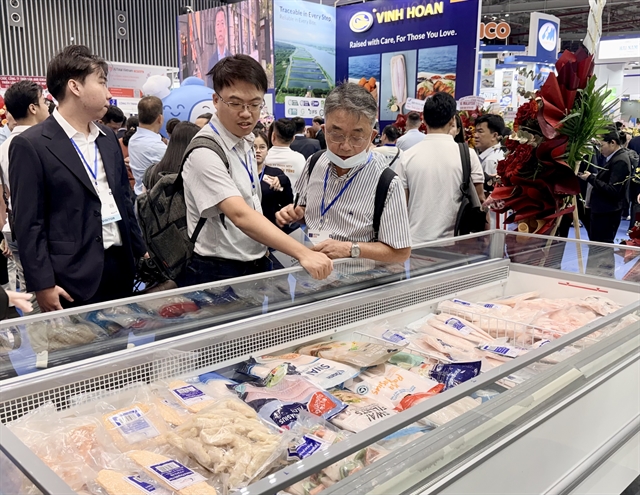
Shirlene Maria Anthonysamy, a fishery officer for markets and GLOBEFISH coordinator at the FAO’s Fisheries and Aquaculture Division, presented the outlook at a seminar on “Global Aquatic Food Market and Future Workforce: Trends, Opportunities and Sustainable Development for Vietnam’s Fisheries Sector”, held as part of the Vietnam International Fisheries Exhibition in HCM City on August 19.
FAO data shows global fisheries output at a record 235 million tonnes in 2024, comprising 195 million tonnes of aquatic animals and nearly 40 million tonnes of algae.
Aquaculture accounted for almost 103 million tonnes, up 8.2 per cent, while catches produced nearly 92 million tonnes, up about 1.7 per cent.
Over the next decade, aquatic animal production is expected to rise by 10 per cent to 214 million tonnes by 2034, with most of the growth coming from aquaculture, while capture fisheries are expected to remain broadly stable. Per-capita consumption of aquatic animal foods is projected to reach 21.8-21.9kg a year, Anthonysamy said.
She said Asia would remain at the centre of this growth. The region accounted for 89 per cent of global aquaculture production, while China, Bangladesh, India, Indonesia and Việt Nam together accounted for 82 per cent. Asia is increasingly becoming not only a major production base but also a key market for aquatic products.
“Asian markets absorb more high-value aquatic foods than anywhere else in the world.”
Seafood demand in Asia has jumped in the past decade, supported by improved cold chains, distribution, and marketing systems, and the growth of supermarkets. Rising fish prices have had little effect on consumption, while imports of high-value products such as salmon, bivalves, cod and lobster have increased.
Imports of pangasius catfish fillets in Asia have increased by 810 per cent over the past decade, she said.
The expansion has also changed consumption habits, with fish fillets becoming increasingly common in Asian markets.
Việt Nam has strengthened its position as a major seafood supplier, with pangasius now reaching markets on almost every continent.
But while rising demand offers opportunities for exporters, global seafood trade is also becoming more demanding.
“Market access is increasingly being driven by compliance and transparency,” she said, noting that requirements for sustainability, social responsibility and traceability are increasingly becoming the norm.
Geopolitical tensions, supply chain disruptions and changing consumer preferences are also reshaping trade patterns.
Digitalisation, e-commerce and traceability are becoming increasingly important across the seafood value chain, while consumers and buyers are demanding greater transparency over where and how products are produced. Adaptability is therefore a key competitive advantage for seafood businesses seeking to maintain and expand their position in global markets.
Deputy Minister of Agriculture and Environment Vũ Văn Hưng said Việt Nam’s seafood exports had enjoyed robust growth in recent years.
The industry is targeting US$12 billion in exports this year after reaching $6.9 billion in the first seven months of 2026, up 12.8 per cent year-on-year.
However, he said the industry could not rely on past successes as it entered a new stage of development.
Climate change, declining natural resources, disease, rising production costs, trade competition, and rapidly changing markets are creating growing pressure, while food safety, traceability, environmental, labour, carbon, and social responsibility requirements are increasingly becoming conditions for access to international markets.
Consumers are no longer concerned only with taste, quality, and price, but also want to know where and how products are made, and whether production is transparent and responsible, Hưng said.
He called for a shift from growth driven mainly by volume to growth based on quality and value-added products, and from relying on existing advantages to creating new ones through science and technology, innovation, data and better management.
The exhibition’s theme, “Innovation – Sustainability – Elevating Vietnamese Seafood”, should become a guiding principle for the industry, he said.
He said the $12 billion export target should not be measured solely by its headline value, but by the quality of that growth: higher-value products, a greater share of value created in Việt Nam, wider use of technology, greener and more transparent production, better returns for farmers and fishermen and stronger Vietnamese seafood brands.
To achieve this, he called for stronger cooperation between the Government, businesses, farmers and fishermen.
The Government should create an enabling environment through institutional reform, digital and green transformation, data development, market expansion and support for businesses seeking to meet new standards, he said.
Businesses should take the lead in investing in technology, developing new products, expanding value-added processing, improving traceability and building stronger value chains.
Farmers and fishermen should remain the foundation of those value chains, with greater access to standards, technology and data, and stronger cooperation to improve quality, efficiency and livelihoods. — VNS