Huế advances smart city development under Resolution 57
Under Hue's Smart City Development Project for 2026–30, with a vision to 2045, the city aims to put a shared smart urban management platform into stable operation.
HÀ NỘI — The central city of Huế is accelerating the development of a smart city based on digital infrastructure and data-driven management, with plans to build a city data centre in 2026 to support digital transformation and smart urban services through 2030.
The initiative is part of the city's implementation of Politburo Resolution 57-NQ/TW, issued on December 22, 2024, on breakthroughs in science and technology development, innovation and national digital transformation.
Under Huế's Smart City Development Project for 2026–30, with a vision to 2045, the city aims to put a shared smart urban management platform into stable operation. The platform will support online, data-based administration by collecting, consolidating and analysing information from specialised databases and Internet of Things (IoT) systems.
IoT infrastructure is also planned to reach villages and residential groups across the city.
In transport management, Huế aims to integrate all traffic-related IoT data into the shared operating platform and equip traffic signals at ten key intersections with smart technology, including artificial intelligence (AI)-based signal control and management software.
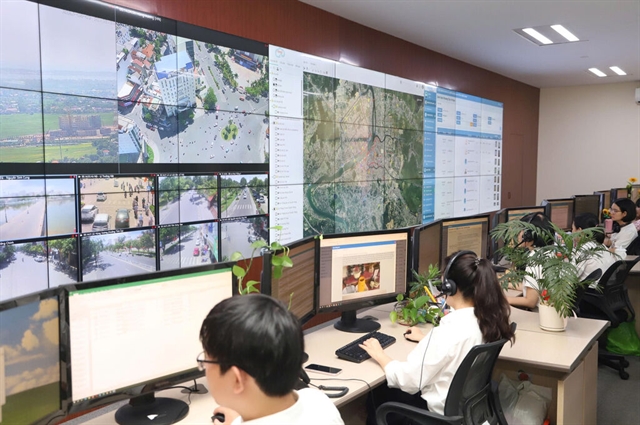
Trần Hữu Thùy Giang, vice chairman of the Huế People's Committee, said the Huế Intelligent Operations and Monitoring Centre (HueIOC) would serve as the central hub for monitoring and managing urban activities.
Its coverage includes construction, transport, the environment, public services, public security, healthcare, education, finance and agriculture. Meanwhile, the Hue-S digital platform serves as a unified interface for interaction between residents, businesses and local authorities.
Giang said the city had introduced a range of measures to support implementation, including establishing a coordinating council for smart city development and issuing regulations governing its operations.
It is also reviewing and improving regulations on smart cities, digital transformation, digital data and information security, while clarifying responsibilities and coordination mechanisms among agencies.
The city is prioritising a shared digital platform capable of collecting and analysing data from specialised databases and IoT systems. Other priorities include developing an urban data repository, improving data analysis and monitoring capabilities, and standardising data categories.
Telecommunications and connectivity infrastructure will also be upgraded, with investment in high-speed, broadband and low-latency data transmission using 5G technology and fibre-optic networks. The city plans to strengthen dedicated communication networks for intelligent transport systems to ensure stable connections among devices, the operations centre and data platforms.
In 2026, each city-level department is expected to develop at least one smart urban service on the Hue-S platform. Each commune-level administration is also expected to implement at least one smart city service scenario applicable across the commune level.
According to the Huê Department of Science and Technology, smart urban development requires both automated, real-time data and clearly assigned responsibilities. Although the city has introduced various smart tools, operating scenarios and coordinated upgrades are still needed.
Nguyễn Dương Anh, deputy director of the department, said it would propose scenarios suited to different levels of administration.
At city level, proposed applications include integrating agricultural and environmental data, providing early warnings of fires at heritage sites, monitoring buses, delivering fully online public services and expanding health insurance coverage.
At the commune and ward level, four proposed scenarios include handling environmental and natural-resource complaints within the required timeframe, providing natural-resource and environmental services through Hue-S, supporting new-style rural development and enabling online applications for land-use right certificates.
Anh said departments, agencies and local administrations should review their management and public-service needs, identify priority areas and register appropriate smart city services based on their responsibilities and actual conditions.
He also stressed the need to standardise, digitise and manage data, ensuring that information is accurate, regularly updated and capable of being connected and shared. Digitisation, he said, should be linked to practical use rather than producing data that cannot support operational needs.
The department, HueIOC and relevant agencies are expected to continue providing technical guidance and support, coordinating implementation, monitoring progress and addressing difficulties as smart city services are developed. — BIZHUB/VNS