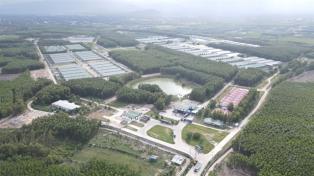
FPT Group to build ATE Plant
FPT’s new Bắc Ninh plant marks a milestone as Việt Nam strengthens its semiconductor ecosystem, expands testing and packaging capacity and deepens its role in the global supply chain.
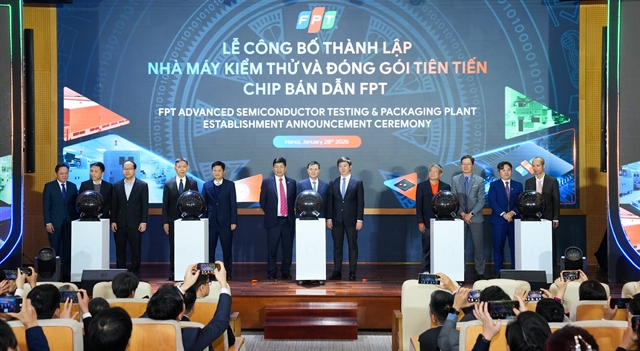
BẮC NINH — Local tech firm FPT Corporation has officially introduced the establishment of the FPT Advanced Semiconductor Testing and Packaging Plant at Yên Phong Industrial Park in the northern province of Bắc Ninh, marking positive progress as Việt Nam moves deeper into the global semiconductor supply chain.
It is the first semiconductor testing and packaging plant in Việt Nam that is fully owned and operated by Vietnamese entities, contributing to the completion of the national semiconductor ecosystem with a full spectrum of activities spanning research, design, manufacturing, training, testing and packaging and commercialisation in the global semiconductor value chain.
Chairman of FPT Corporation Trương Gia Bình stated: “We take another step toward completing Việt Nam’s semiconductor ecosystem. FPT will participate in the testing and packaging sector – so that Vietnamese technology chips can soon be applied in real life”.
“FPT has overcome challenges to connect and build our own ecosystem in the semiconductor industry. We have been co-operating closely with Viettel Group and domestic partners in a strategic move to promote the national semiconductor alliance and develop core technology capabilities spanning research, design, manufacturing, testing, packaging and commercialisation in the global semiconductor value chain.”
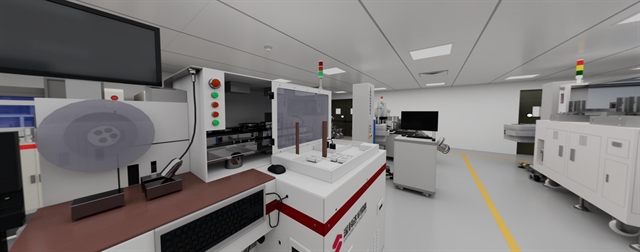
The plant, which covers 1,600sq.m and features six production lines for ATE tester and handler, burn-in, reliability testing and failure analysis testing, is scheduled for completion by the end of the first quarter of 2026.
FPT said it plans to add 18 new lines covering chip scale package and wafer level package, producing high-end chips serving IoT, automotive applications and AI-on-the-edge SoC (System-on-Chip) solutions in the 2028–30 period.
The corporation will also provide hands-on training and practical learning opportunities for semiconductor students in Việt Nam, contributing to the improvement of human resource quality in the semiconductor sector and supporting the national goal of developing 50,000 semiconductor professionals by 2030, including at least 35,000 specialists in manufacturing, packaging, testing and other key stages of the industry.
Dr Nguyễn Bích Yến, honorary chairwoman of the Institute of Semiconductor and Advanced Materials at Việt Nam National University and chairwoman of VSAP Lab as well as an IEEE member, said: “Việt Nam has been taking synchronised and serious action in semiconductors. Forerunning enterprises are driving progress by commitments in building a Vietnamese semiconductor value chain.
“Key components – from materials, design, packaging, testing and manufacturing to digital infrastructure and human resources – have been gradually taking shape. FPT stands out as a major pillar, not only enhancing technological capacity but also serving as a connector, leader and trust-builder for the entire ecosystem.”
Deputy Minister of Science and Technology Bùi Hoàng Phương added: “Việt Nam has advantages in human resources and has attracted numerous chip design companies to invest and employ Vietnamese engineers, laying the foundation for domestic chip design enterprises.”
“In the global supply chain, Việt Nam plays an increasingly important role in packaging and testing, although these stages are still largely dominated by foreign companies.”
Phương also said FPT’s investment in an advanced testing and packaging plant completes a critical missing link, helping to close Việt Nam’s semiconductor ecosystem.
On the occasion, FPT officially signed a series of cooperation agreements with leading semiconductor technology partners in Việt Nam and internationally, including Viettel Group, Restar, Winpac and VSAP LAB.
Last year, FPT launched an R&D centre for semiconductors and AI in Đà Nẵng City and the Việt Nam Semiconductor Incubation and Development Centre in Hà Nội.
FPT became the first Vietnamese enterprise to export commercial semiconductor chips to Japan in 2025, reaffirming its growing position in the global semiconductor value chain. — VNS