Đông Đô Hospital opens Paediatric Ophthalmology and Myopia Control Centre
According to statistics from the Ministry of Health, approximately five million children nationwide, representing 30–40 per cent of the school-age population, suffer from refractive errors, with myopia being the most common condition.

HÀ NỘI — Đông Đô Hospital officially opened a Paediatric Ophthalmology and Myopia Control Centre in Hà Nội on August 1.
The centre was established with a specialised focus on paediatric ophthalmology and myopia control, aiming to provide Vietnamese children with access to international-standard eye care in the country.
Equipped with specialised facilities and dedicated examination protocols for children, the centre is staffed by a team of doctors trained in paediatric ophthalmology.
Examination procedures are tailored to specific age groups, enabling comprehensive assessment of visual acuity, binocular vision and accommodative function, as well as evaluation of myopia progression risk and early detection of eye conditions.
Speaking at the opening ceremony, Đông Đô Hospital Executive Director Dr Đinh Thị Phương Thủy said that the hospital not only diagnoses and treats eye conditions, but also seeks to partner with families to manage and control myopia in children from an early stage.
“Eye care for children requires a comprehensive approach that combines early detection, regular monitoring, and the implementation of appropriate myopia control measures to safeguard their long-term vision,” said Thủy.
According to statistics from the Ministry of Health, approximately five million children nationwide, representing 30–40 per cent of the school-age population, suffer from refractive errors, with myopia being the most common condition.
Ophthalmology experts said that the prevalence of school-age myopia in Việt Nam is on the rise and affects a lot of younger children in particular. Many children are only brought in for examination after their vision has already deteriorated or their myopia has progressed rapidly, making treatment and management difficult.
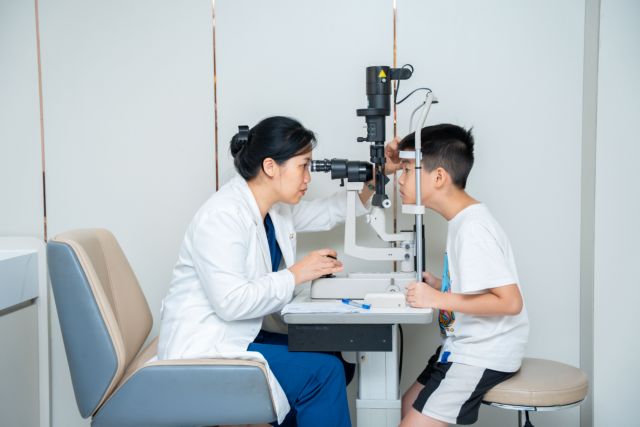
Surveys conducted in Hà Nội and HCM City also indicate that the prevalence of refractive errors among students has exceeded 50 per cent, reflecting a rising trend in school-age myopia in recent years.
Beyond just myopia, many children also suffer from conditions such as amblyopia, astigmatism, binocular vision disorders and other eye pathologies that often go undetected due to a lack of screening programmes and in-depth monitoring. Delayed diagnosis can impact visual development, learning ability and the child's future quality of life.
Rapidly progressing myopia not only leads to an increase in prescription strength, but also raises the risk of developing serious eye conditions in adulthood, such as retinal degeneration, retinal detachment, glaucoma and early-onset cataracts.
Experts suggested that eye care for children should focus on early detection, regular monitoring and the implementation of appropriate myopia control measures.
In recent years, Đông Đô Hospital has implemented many community initiatives with a focus on school-based eye care and international cooperation programmes in paediatric ophthalmology.
The hospital also plans to expand school-based screening programmes, enhance parental counselling on myopia prevention and adopt new diagnostic and treatment techniques, all to help to curb the rising prevalence of myopia among schoolchildren. — VNS