Beach hub to build a global finance and tech rendezvous
The central city has a plenty of favourable conditions to make it a sandbox of new models of fast and sustainable growth including an international finance centre, free trade zone, innovation, ‘green’ and digital transformation for the country’s rising ‘era.
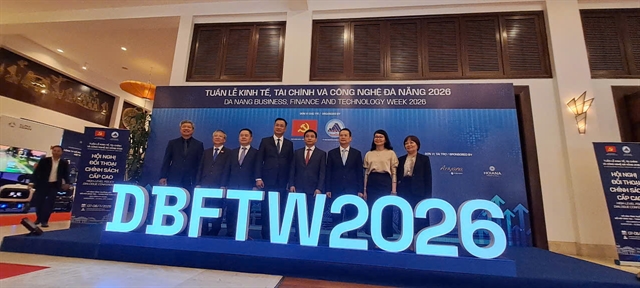
ĐÀ NẴNG — The central city has plenty of favourable conditions to make it a sandbox of new models of fast and sustainable growth including an international finance centre, a free trade zone, innovation, ‘green’ and digital transformation for the country’s rising ‘era.
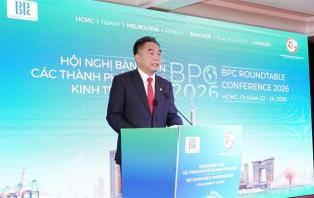
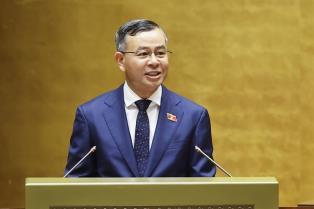
Deputy Prime Minister Nguyễn Văn Thắng opened his remarks at the Đà Nẵng Business, Finance and Technology Week, stressing that the central city was designed as an international linkage destination and a liveable urban in Việt Nam in creating a breakthrough mechanism of a key growth pole for the country.
“I highly appreciated the city’s initiative of hosting the finance and technology week in setting up a rendezvous for investment promotion and a forum of policy reform discussion, fintech, and expertise exchanges in very new topics that would be applied in Việt Nam,” Thắng said.
“The event is organised in the context of the country’s growing ambitions in fast economic and sustainable development and reforming new mechanisms for the country’s long-term vision of rising ‘era’ in the next decades,” he said.
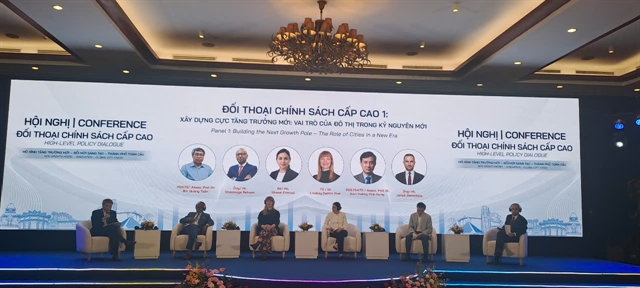
The deputy PM emphasised that the Week will be focusing in dialogues and recommendations on possible solutions in finance, mechanism, high-quality human resources, databases, and new approaching measures on growth and transparency.
Thắng also reconfirmed the Government’s commitment to building a transparent investment environment and trust among investors in pursuing sustainable development.
Professor Paul Romer, former chief economist at the World Bank and 2018 Nobel Laureate winner in economics, outlined strategies for growth and progress at the forum, stating that strong government is essential for progress, while science is as important as the market and science plays a role which is broader than just feeding new ideas into the market mechanism.
He stated catch-up growth is a better goal for almost all countries, and urbanisation is essential for catch-up growth.
“There are two kinds of growth. There's frontier growth, where brand new things are being introduced at the technology frontier. And catch-up growth, where regions that aren't using all of the available technologies grow rapidly because they start adopting the ones that already exist.
“Catch-up growth is typically faster and easier and offers very significant benefits, while urbanisation is an essential part of catch-up growth,” he continued.
He reminded that every country in the world is going to face a race between technology and education. New technologies are changing, and it creates new opportunities, but they also undermine existing ways of earning a living.
Dr Mirjam Staub-Bisang, chair of BlackRock Switzerland, shared that the European Free Trade Association (EFTA), the inter-governmental organisation of Iceland, Liechtenstein, Norway and Switzerland, has completed negotiations with Việt Nam.
“This is really a big deal. It's a first milestone for the Swiss-Vietnamese economic co-operation. We require more green investments than the public funds that they provide.
“Việt Nam can bring its capital in and keep it with growth of around 8 per cent last year, a record year for foreign direct investment.”
Hoàng Vĩnh Hưng, an architect of planning, Đà Nẵng has positive natural and economic advantages in turning into a key driving force in the role of national and regional economic power.
“The city has focused on the development of a free trade zone and a national centre of innovation in drawing mainstream investment. It’s easily connected with the Dung Quất Economic Zone and Chu Lai Industrial Zone in a range of multi-transport models,” Hưng shared.
“The development space is also supported by two pairs of Liên Chiểu deep-sea port and Đà Nẵng Airport in the downtown zone, and Kỳ Hà sea port and Chu Lai Airport to the south. These key infrastructure works would make it a logistics centre in the Greater Mekong sub-region," he added.
Đà Nẵng City is setting out an ambitious long-term vision to become a smart, liveable urban centre and a key national hub for logistics, start-up innovation, finance, free trade and sea-based economic growth by 2050, with a further goal of evolving into a global eco-city and desirable destination by 2075.
Đà Nẵng, merged with the former Quảng Nam Province, had accumulated US$20 billion in domestic investment and $11 billion of foreign direct investment. — VNS