Pepper exports rise 17.4 per cent in H1 despite tighter domestic supply
The country exported about 145,700 tonnes of pepper worth US$940.5 million in the January-June period, up 17.4 per cent in volume and 10.6 per cent in value year-on-year, according to the association.

HÀ NỘI — Pepper export volumes rose in the first half of 2026 from a year earlier, supported by resilient demand in key overseas markets despite tightening domestic raw material supplies, the Vietnam Pepper and Spice Association (VPSA) said.
The country exported about 145,700 tonnes of pepper worth US$940.5 million in the January-June period, up 17.4 per cent in volume and 10.6 per cent in value year-on-year, according to the association.
The growth came despite declining domestic production, with exporters relying increasingly on imported raw materials to maintain shipments, although export momentum has slowed in recent months as local supplies became more limited.
Asia remained the largest market, importing 66,456 tonnes, or 45.6 per cent of Việt Nam's total pepper exports, up 15.2 per cent from a year earlier.
Shipments to China jumped 64 per cent to 15,244 tonnes, while exports to the United Arab Emirates rose 10.9 per cent to 9,703 tonnes, reinforcing its role as a regional trading hub. Exports to India fell 27.2 per cent, while shipments to Thailand nearly doubled.
Exports to the US, Việt Nam's largest single market, increased 28.7 per cent to 35,360 tonnes, helping drive a 31.1 per cent rise in shipments to the Americas.
Exports to Europe rose 7.1 per cent to 30,930 tonnes, led by a 53.5 per cent increase in shipments to the Netherlands, although exports to Germany fell 24 per cent.
Meanwhile, Việt Nam imported nearly 45,200 tonnes of pepper worth $257.7 million in the first six months of the year, up 60 per cent in volume and 48 per cent in value from the same period last year, reflecting processors' growing reliance on imported raw materials as domestic output continued to decline.
Cambodia was Việt Nam's largest supplier during the period, accounting for 51.7 per cent of total imports with shipments of 23,390 tonnes, up 274 per cent year-on-year. Brazil supplied 15,130 tonnes, up 1.5 per cent, while imports from Indonesia fell 18 per cent to 4,580 tonnes.
The association said imports were becoming increasingly important in helping exporters maintain production and fulfil overseas orders as domestic pepper supplies continued to tighten.
According to the International Pepper Community (IPC), the global pepper market remained stable last week, with export prices in major producing countries showing no significant changes.
Domestic pepper prices in Việt Nam ranged between VNĐ133,000 and VNĐ135,000 (US$5.09-$5.16) per kilo, the lowest level in a year.
Cinnamon exports decline in first half
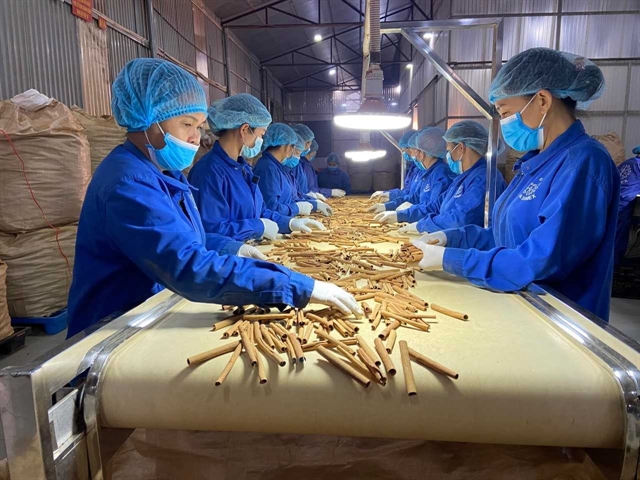
In contrast, cinnamon exports fell in the first half of 2026 as weaker demand in traditional Asian markets outweighed stronger shipments to the US and the Americas, according to VPSA.
The country exported approximately 61,300 tonnes of cinnamon for $156.2 million in the first half of this year, down 3.5 per cent in volume and 3 per cent in value from the same period in 2025, according to VPSA.
Asia remained the largest destination, accounting for 68.5 per cent of total cinnamon exports with shipments of more than 42,000 tonnes, down 11 per cent year-on-year. India, the biggest market, imported 24,432 tonnes, a decline of 1.7 per cent.
Exports to the Americas rose 31 per cent to nearly 13,000 tonnes, led by a 28 per cent increase in shipments to the US. Exports to Africa climbed 24 per cent, while shipments to Europe fell 6.5 per cent.
The association said weaker demand in several Asian markets weighed on overall export performance, although stronger sales to the US and the wider Americas partly offset the decline, reflecting efforts by Vietnamese exporters to diversify their markets. — BIZHUB/VNS