Offshore wind islands integrated with green hydrogen could optimise investment efficiency
Dư Văn Toán of the Institute of Meteorology, Hydrology, Environment and Marine Sciences under the Ministry of Agriculture and Environment discussed with Vietnam News Agency the feasibility of applying this model in Việt Nam and the policy mechanisms needed to support its development.

Many countries around the world have successfully developed grid-connected offshore wind power hubs integrated with green hydrogen production. Dư Văn Toán, of the Institute of Meteorology, Hydrology, Environment and Marine Sciences under the Ministry of Agriculture and Environment, discussed with Vietnam News Agency the feasibility of applying this model in Việt Nam and the policy mechanisms needed to support its development.
How will Resolution No. 70-NQ/TW and the revised Law on Electricity create new opportunities for renewable energy development and help resolve bottlenecks facing offshore wind projects?
The Resolution has laid a firm foundation for the development of renewable and new energy sources such as solar power, offshore wind and green hydrogen.
For offshore wind, Việt Nam aims to develop 6,000MW of offshore wind capacity by 2030, 15,000MW by 2035 and 139,000MW by 2050, contributing 20-25 per cent of total installed power capacity.
Many businesses previously faced difficulties obtaining licences for offshore wind surveys. However, since the revised Law on Electricity came into effect, these challenges have gradually been resolved.
Authorities have granted licences for key pilot projects in the south central region by Petrovietnam and in the Gulf of Tonkin by Vietnam Electricity (EVN).
More recently, authorities allowed Petrovietnam Technical Services Corporation (PTSC), a subsidiary of Petrovietnam, to assess wind potential and technical conditions for offshore wind electricity export projects to Malaysia and Singapore in Bình Thuận Province.
Survey licences were also granted to the US renewable energy group Pacifico Energy and Japan’s Sumitomo Corporation for offshore wind projects in Việt Nam.
These developments show that Việt Nam has begun establishing a legal and technical framework for offshore wind development, creating opportunities for both domestic and foreign companies.
In your opinion, what policy mechanisms are needed to tap Việt Nam’s offshore wind potential fully?
Việt Nam has already connected around 1,500MW of nearshore wind power in the Mekong Delta region to the national grid.
Vietnamese and foreign joint-venture companies have begun applying monopile foundation technology for nearshore wind projects with capacities of hundreds of megawatts. This provides a technical foundation for using the same technology for offshore projects located beyond six nautical miles from shore.
The Law on Electricity 2024 already includes provisions related to renewable and new energy, but these remain only an initial framework for offshore wind.
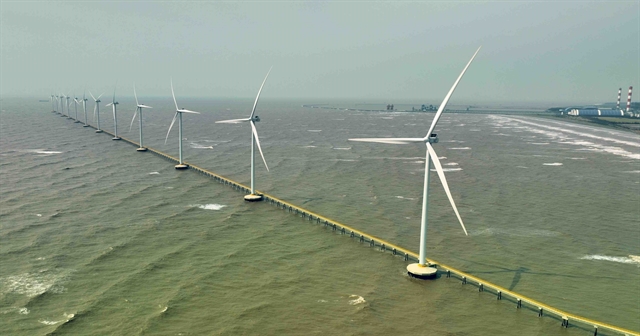
In reality, offshore wind remains a relatively new industry globally and has expanded rapidly only over the past decade. Countries such as Australia and Poland have recently introduced offshore wind legislation covering preliminary studies, surveys, environmental permits, grid connection fees and sea-use charges.
In Việt Nam, however, there is a lack of detailed regulations for offshore wind. Electricity licences are issued by the Ministry of Industry and Trade, while survey licences, environmental permits and environmental impact assessments fall under the Ministry of Agriculture and Environment. The offshore wind survey licensing process also remains relatively slow because of the large number of applications.
In particular, offshore wind power pricing is another matter of concern. According to the Institute of Meteorology, Hydrology, Environment and Marine Sciences, with offshore wind electricity prices ranging from US$0.12 to $0.15 per kWh across Việt Nam, foreign investors could achieve profitability.
However, the feed-in tariff (FIT) mechanisms previously applied to renewable energy projects launched before 2021 are no longer in effect, meaning a new pricing mechanism is needed to balance the interests of all parties.
In addition, investment incentives for offshore wind power projects should include support policies related to sea surface and seabed fees. Việt Nam could consider charging fees for nearshore projects while exempting far-offshore projects in the initial phase, allowing domestic companies to develop integrated service capabilities ranging from surveys and construction to maintenance and port services.
After 2030, once local companies become more competitive, the State could gradually introduce sea-use fees.
Some Petrovietnam subsidiaries are already providing services to foreign offshore wind power developers. With suitable support policies, Việt Nam could develop domestic companies capable of delivering comprehensive offshore wind infrastructure services, strengthen their competitiveness as the market opens further to foreign firms and help lower offshore wind power costs.
Many global offshore wind developers are integrating projects with green hydrogen production to improve economic efficiency. How feasible is this model for Việt Nam?
Recently, many offshore wind projects have been encouraged to integrate green hydrogen production, which is considered a clean fuel source.
When a grid-connected offshore wind plant cannot sell all of its electricity output at certain times, excess electricity can be used to produce hydrogen through seawater electrolysis, helping optimise the project’s economic efficiency.
Green hydrogen is already being widely used in sectors such as transport and coastal service vessels. As Việt Nam works towards its net-zero emissions target by 2050, some green port initiatives have started using green hydrogen for tugboats and small vessels operating within port areas.
In practice, offshore wind island models developed by Denmark and the Netherlands in the North Sea, with capacities ranging from 10GW to more than 28GW, have all been designed to integrate green hydrogen production with grid connections supplying electricity across Europe as part of carbon neutrality strategies.
Việt Nam should therefore consider integrated offshore wind and green hydrogen models to strengthen national energy security while reducing emissions.
The draft revised Law on Petroleum includes proposals related to new energy value chains, including green hydrogen. What are your expectations if the draft is approved by the National Assembly?
Around 30 countries worldwide have already introduced green hydrogen development strategies. In 2024, the Vietnamese Government also issued a national green hydrogen strategy.
Including green hydrogen-related provisions in the revised Petroleum Law is therefore timely and could provide a legal basis for developing new energy value chains and supporting services aimed at achieving net-zero emissions by 2050. — VNS