Year marked with mass infrastructure funding
Within less than 12 months, Việt Nam has seen three nationwide waves of project launches and completions, from April through December, with combined investment running into the quadrillions of Vietnamese đồng.

2025 has been marked by a sweeping wave of mega projects rolled out nationwide, as the Vietnamese Government pushes ahead with restructuring the country’s development space to lay the foundation for double-digit economic growth in the next phase.
Within less than 12 months, Việt Nam has witnessed three nationwide waves of project launches and completions, from April through December, with combined investment running into the quadrillions of Vietnamese đồng.
The opening wave came on April 19, marking the 50th anniversary of national reunification, with 80 major projects launched or inaugurated, for total investment of about VNĐ445 trillion (US$16.9 billion).
Four months later, around 250 projects and total investment of nearly VNĐ1.28 quadrillion were kicked off across 34 provinces and cities on August 19 to celebrate the 80th anniversary of National Day.
The final push is on December 19 when 234 projects with a total investment of VNĐ3.4 quadrillion are launched, inaugurated or opened to mark the kick-off of the 14th National Congress of the Communist Party of Việt Nam.
Ranging from expressways and airports to power and digital infrastructure systems, key projects include the Olympic Sports Urban Area in Hà Nội, the inauguration of several works and the launch of the first commercial flight under Phase 1 of Long Thành International Airport, and the groundbreaking of component 1 of the Lào Cai–Hà Nội–Hải Phòng railway.
Other highlights include the start of construction on the Red River landscape boulevard in Hà Nội, the Hòa Phát Dung Quất railway and steel production project in Quảng Ngãi, Tân Phú–Bảo Lộc expressway in Lâm Đồng, and the inauguration and technical opening of the eastern North–South expressway section linking Cần Thơ, Hậu Giang and Cà Mau.
Additional milestones include the inauguration of Huế International General Hospital, the groundbreaking of the Youth Cultural Centre project in HCM City, and the launch of the first phase of an urban rail line in the Phú Quốc special administrative zone.
By December 19, Việt Nam is expected to have completed or technically opened just over 3,500 kilometres of expressways nationwide, exceeding the target of bringing at least 3,000 km into operation by the end of 2025 towards a network of 5,000 km of expressways by 2030.
An additional 250 km of coastal road network is expected to be completed in 2025, lifting the total length in operation to around 1,700 km, stretching from Quảng Ninh in the north to Kiên Giang in the south, and forming a new development corridor along the coast.
Message for the future
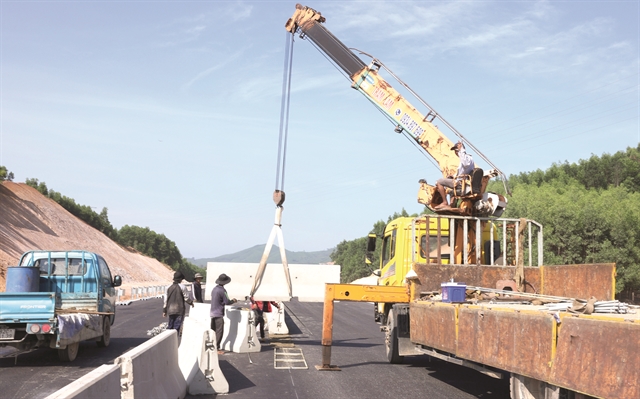
Behind those striking figures lies a clear message that 2025 is a year to build momentum for next-phase growth with a more integrated regional and national infrastructure network.
The 13th National Party Congress, in its strategic vision through 2030–45, identified the development of a modern, integrated infrastructure system as one of three strategic breakthroughs, alongside institutional reform and the development of high-quality human resources.
Developing infrastructure systems has become pressing as infrastructure today extends beyond transport and energy to include digital, smart and urban systems which are seen as critical to enhance the national competitiveness in the new era.
Prime Minister Phạm Minh Chính said the nationwide groundbreaking and inauguration events aimed to create momentum and inspiration as well as lay the groundwork for double-digit economic growth in the coming years.
These mega projects are designed to form an integrated regional and national network rather than just filling in the gaps.
New expressways have shortened travel times, reduced logistics costs and strengthened regional connectivity while investment in seaports, airports and logistics centres is expected to enhance Việt Nam’s position in regional and global supply chains and provide an important foundation for the goal of becoming a developed economy by 2045.
“Infrastructure investment is not only an investment for today, but for the long term," PM Chính stressed, noting that each bridge, road or airport completed now can open up new development opportunities for next generations.
Private sector role
At the year-end event marked with VNĐ3.4 quadrillion investment, the State no longer plays the dominant role in financing but a catalyst with just 18 per cent of the total investment while the rest is raised from the private sector, reflecting a structural shift in development thinking.
As private capital takes on a larger role, the private sector has become a long-term investor and strategic partner, which requires a more transparent, stable and disciplined institutional environment to prevent today’s massive investment from becoming tomorrow’s burden, and instead a foundation for growth.
The World Bank estimated that Việt Nam needs more than $334 billion for infrastructure development in 2026-31 period, in which the public investment could meet only half of the number.
Credit rating agency VIS Rating forecast that public investment could meet only around 70 per cent of the capital demand for infrastructure development by 2030, making the public-private partnership (PPP) model a strategic choice.
However, there are bottlenecks which hinder PPP practice uptake, including weakness in project preparation, risk allocation and shortage of long-term capital, according to the Asian Development Bank (ADB).
Shantanu Chakraborty, the ADB’s country director for Việt Nam, said Việt Nam should invest more heavily in the project preparation stage, apply international standards and establish a centralised data system for PPP projects to improve transparency and predictability.
Deputy Finance Minister Trần Quốc Phương said public resources could meet only part of infrastructure funding needs, with the remainder expected to come from the private sector through transparent and well-designed mechanisms.
Efforts are being enhanced to improve risk-sharing policies to create greater certainty for investors, Phương said.
“PPPs help not only attract investment from the private sector but also improve governance efficiency, enhance competitiveness and draw new technology,” he added. — VNS