VN sets out plan to become strong maritime nation by 2030
The programme, issued under Resolution No. 218/NQ-CP dated August 7, seeks to translate the Party Central Committee’s Resolution No. 20-NQ/TW on building and developing Việt Nam into a strong maritime nation, into specific tasks.
HÀ NỘI — The Vietnamese Government has issued a resolution on the action programme to develop the country into a strong maritime nation with the focus on modernising its marine economy, upgrading infrastructure and promoting green and smart industries through 2030, with a vision to 2045.
The programme, issued under Resolution No. 218/NQ-CP dated August 7, seeks to translate the Party Central Committee’s Resolution No. 20-NQ/TW on building and developing Việt Nam into a strong maritime nation, into specific tasks for ministries, agencies and local authorities, with clear responsibilities, implementation deadlines and evaluation criteria.
The Government aims to increase the contribution of coastal localities to the economy and develop modern, green and smart marine industries, while improving maritime infrastructure, science and technology capacity, digital transformation, environmental protection, defence and security, and living standards in coastal and island areas.
The programme focuses on improving governance of marine resources and space, strengthening the legal and planning framework, mobilising resources and developing large maritime companies and promoting science, technology and high-quality human resources.
It also targets developing modern and emerging marine industries, expanding maritime infrastructure and economic centres, protecting marine ecosystems, improving the lives of coastal communities, and strengthening maritime security and international cooperation.
Legal framework overhaul
The Government called for a review and overhaul of laws governing seas and islands, as well as related legislation on land, natural resources, the environment, science and technology, to remove overlaps and inconsistencies and create a more transparent and competitive legal framework.
The programme urged efforts to finalise a draft revised Law on Marine Resources and Environment and Islands, with clearer rules on the allocation, leasing, use and exploitation of marine space, financial obligations, environmental protection, pollution control and mechanisms for resolving conflicts over marine space.
The government will review and update the national marine spatial plan for 2021-30 with a vision to 2050, while developing technical regulations for functional zoning and marine-space use.
It plans to establish digital maps and databases to support planning, monitoring and management, as well as flexible mechanisms for periodically updating marine spatial plans.
Special policies will also be developed for special administrative areas, outlying islands and strategic locations to combine economic development with national defence and security.
Push for modern, green marine industries
The Government asked ministries and relevant agencies to review sectoral strategies and development plans to create a modern marine economic ecosystem with priority on smart, low-emission production and services that use resources and energy efficiently.
It will promote nearshore marine economic activities within 12 nautical miles and develop the oil and gas industry, offshore technical services and sustainable exploitation of marine resources.
Special mechanisms will be considered for deep-water and offshore projects, marginal fields and offshore energy projects.
Việt Nam will also develop green and smart seaports, its merchant fleet, shipbuilding and ship repair industries and maritime logistics, while improving connections between seaports and road, rail, inland waterway and air transport.
Accordingly, the Government will review the master plan for Việt Nam’s seaport system for 2021-30, with a vision to 2050, and implement a national programme for the maritime and marine engineering industries.
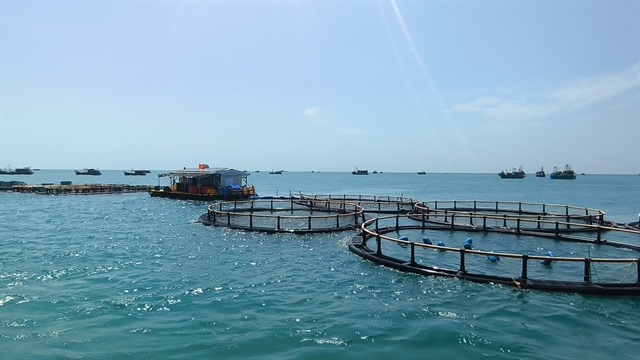
In fisheries, Việt Nam plans to restructure the sector by reducing nearshore fishing, promoting responsible offshore fishing and developing industrial and high-tech marine aquaculture.
The plan calls for investment in infrastructure, breeding, storage, processing and fisheries insurance, alongside support policies for fishermen.
The Government also reiterated its commitment to tackling illegal, unreported and unregulated (IUU) fishing and taking coordinated measures to remove the European Commission’s "yellow card" warning.
It plans to strengthen fisheries management, catch monitoring, traceability and law enforcement at sea, while promoting aquaculture technologies, smart cages, digital systems, automation, artificial intelligence and renewable energy.
The programme is also seeking to build internationally recognised marine tourism and services, including large-scale tourism hubs and clusters, green tourism, cruise tourism, ecotourism, community tourism, night-time economies and marine festivals.
Policies would be raised to develop emerging marine industries, including high-tech marine aquaculture, marine pharmaceuticals, marine biotechnology, seawater desalination, wave power, hydrogen, green ammonia and subsea cable infrastructure. — VNS