Việt Nam's monetary policy faces its toughest balancing act yet
Monetary policy is only one strand of macro-economic management, and by nature it can move aggregate demand in the short term but cannot, on its own, locate or hold an economy-wide equilibrium.
Dr. Võ Trí Thành*
When Prime Minister Lê Minh Hưng met with the State Bank of Vietnam (SBV) and the system of credit institutions on the morning of August 13, 2026, the purpose was not simply to take stock of the banking sector's performance in the first months of the year. It was to set out clearly the requirements that monetary policy management and banking operations must meet going forward.
Any judgment about the banking sector has to be grounded in the actual picture of the economy. GDP grew 8.18 per cent in the first half of 2026 – a figure experts rightly regard as high, even if it still falls short of the target of 10 per cent, driven by export expansion, processing and manufacturing as well as public investment disbursement.
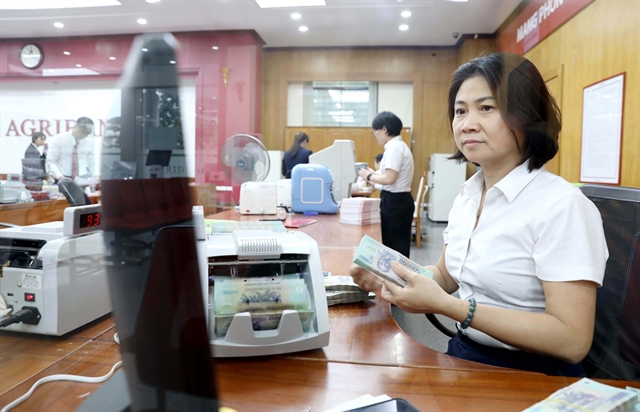
One contribution that deserves real recognition is the banking sector's work, in these early months, to keep capital flowing smoothly and stably through the economy. That is why the Prime Minister acknowledged that monetary policy management has been carried out proactively and flexibly, contributing meaningfully to controlling the economy's major balances – above all, maintaining macro-economic stability, curbing inflation and supporting growth.
This came against a very difficult domestic and international backdrop. Even so, the SBV kept the exchange rate stable, and the Việt Nam đồng (VNĐ) even appreciated slightly – one of very few currencies in the region to gain value while most others in Asia lost 2-6 per cent. That has done a great deal to keep inflation within bounds, given how exposed Việt Nam's open economy is to world oil prices. Had the SBV not managed the exchange rate well amid recent volatility, imported inflation would have hit us far harder.
None of this came free, though. Holding the exchange rate steady required trade-offs elsewhere in the SBV's toolkit, most notably interest rates – the rise in VNĐ rates this period was an inevitable cost of protecting the đồng's value and containing inflation. Tellingly, the Prime Minister noted that the Government leaned primarily on fiscal tools to drive growth in these early months, deliberately leaving monetary policy room to manoeuvre on inflation and macro stability. The results achieved this period therefore reflect monetary, fiscal and other macro policies working together – visible in the SBV's effort to hold rates steady under real pressure while steering credit toward production and the economy's new growth drivers.
On balance, I believe the SBV's management since early 2026 has been on the right track, but those lessons need applying at a higher level: the Government is targeting growth of at least 10 per cent for 2026, against genuinely challenging inflationary pressure and an unpredictable international environment. This is why the SBV should build on its achievements while being honest about remaining shortcomings, implementing solutions decisively through the rest of 2026 – with macro stability and inflation control remaining the supreme objective. But the SBV's task does not end there. It also has to solve a broader problem: coordinating flexibly with other ministries to find what I would call the 'general balance point' between inflation and high growth.
Finding an economy's 'balance point' is never the work of one policy lever. It is the sum of all macro policies acting together – growth drivers moving in sync, aggregate supply and demand growing sustainably, while the economy's major balances stay intact. Monetary policy is only one strand of macro-economic management, and by nature it can move aggregate demand in the short term but cannot, on its own, locate or hold an economy-wide equilibrium. What it can do is serve as an 'anchor' for macro stability and inflation control, and a short-term 'rudder' that helps balance growth objectives when conditions allow, through flexible management – the right tools, in the right dosage, informed by up-to-date data and a range of scenarios.
Alongside that, we need interconnected financial and monetary indicators to serve as a real basis for the Government's macro-scenario planning. Ministries and the SBV, coordinated by the Ministry of Finance, need early-warning models based on economic and financial signals, so we are not caught off guard while holding that general balance point – and better placed to respond to risks pre-emptively and size the supply of capital, credit and interest rates appropriately.
The credit figures tell an important part of this story. As of July 31, 2026, system-wide credit reached about VNĐ20.26 quadrillion, up 8.98 per cent from the end of 2025 – aligned with the roughly 15 per cent growth target set for 2026 – with about 77.3 per cent of outstanding loans serving production and business.
Credit management in 2026 looks different from previous years: there has been a deliberate shift toward “steering” capital into priority sectors and new growth drivers, such as through packages prioritising exports, innovation, science and technology, social housing, industrial-park real estate, and SMEs. What stands out is that credit to exporters and high-technology enterprises grew 28.26 per cent and 38.98 per cent, respectively – a sign that credit is increasingly finding its way to the parts of the economy that generate real value added, rather than dispersing indiscriminately.
Looking ahead, the Government's growth ambitions pose a real challenge for monetary policy, requiring close coordination with fiscal policy above all. I would frame the SBV's task around three interlocking priorities.
First, maintain macro stability while carving out more room for monetary policy to support growth, through flexible management and tools grounded in data – harmonising objectives across models and scenarios rather than reacting to any single indicator alone.
Second, unblock the flow of capital without sacrificing its quality. This means using monetary tools flexibly to safeguard liquidity and ease pressure on interest rates – as the SBV did skillfully in early 2026 – and using credit support packages effectively, especially for priority sectors; the packages for fisheries and social housing are genuinely valuable models. Credit institutions can keep cutting costs, simplify procedures and push digital transformation to make credit cheaper and easier to access.
Third, continue restructuring toward a banking system that is safe, healthy, modern, and aligned with international standards. This means resolving weak credit institutions, strengthening financial capacity and risk management, modernising supervision and early warning, accelerating digital transformation and ensuring data security. Its success will also depend heavily on how well we develop the capital market – particularly the stock and corporate bond markets.
These three tasks are tightly interconnected: stability as the foundation, the efficient circulation of credit as the driving force, and a safe, modern banking system as the condition that lets both goals hold over time. They, to some extent, also echo the Prime Minister's broader point – that scale must go hand in hand with quality, credit growth with risk control, digital transformation with data security and international integration with governance that meets international standards. This is a requirement not just for banking, but for Việt Nam's growth model as a whole.
My hope is that we have enough the tools, the flexibility, the experience, and the appetite for reform to carry the weight now resting on monetary policy and the banking system – and to ensure credit growth goes hand in hand with macro stability and a healthy, safe banking system. VNS
* Võ Trí Thành is former vice president of the Central Institute for Economic Management and a member of the National Financial and Monetary Policy Advisory Council. With a doctorate in economics from Australian National University, he focuses on macroeconomic policy, trade liberalisation and institutional reform.