Việt Nam urged to build semiconductor R&D capabilities
Although the country has made initial progress in developing chip design engineering, research and training institutions, domestic businesses and investment projects, significant gaps remain in R&D capabilities, technology product development and participation in higher value-added segments.
Vũ Hoa
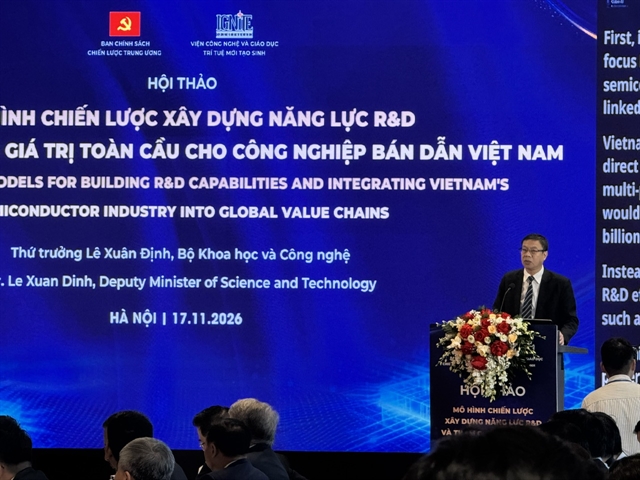
HÀ NỘI — Việt Nam needs to move beyond attracting investment and participating in global semiconductor supply chains to develop its own research and development (R&D) capabilities, master technologies and secure a stronger position in the global value chain, experts said at a seminar in Hà Nội on Tuesday.
Entitled 'Strategies and Models for Building R&D Capabilities and Integrating Việt Nam’s Semiconductor Industry into Global Value Chains', the seminar was organised by the Party Central Committee's Commission for Policies and Strategies in coordination with the Institute of New Generative Intelligence Technology and Education.
It brought together around 200 policymakers, scientists, experts and representatives of research institutions, universities, technology corporations, financial institutions and investment funds to discuss development models and policy solutions for the industry.
In his opening remarks, Nguyễn Hoàng Giang, deputy head of Party Central Committee's Commission for Policies and Strategies, said semiconductors had become a foundational industry, playing an important role in economic development, technological self-reliance and national competitiveness.
"For Việt Nam, developing the industry would support the shift in its growth model, promote high-tech manufacturing and improve productivity and economic competitiveness," Giang said.
Although the country has made initial progress in developing chip design engineering, research and training institutions, domestic businesses and investment projects, significant gaps remain in R&D capabilities, technology product development and participation in higher value-added segments.
"The priority is to translate strategic policies, particularly Politburo Resolution 57-NQ/TW on breakthroughs in science and technology, innovation and national digital transformation, into concrete programmes and measurable outcomes," Giang noted.
He said Việt Nam needed to assess its position in the global semiconductor value chain, identify its competitive advantages and determine which segments offer the greatest potential for technological breakthroughs.
Giang also noted that foreign investment attraction must be linked with domestic R&D development and stronger capabilities among Vietnamese enterprises. Otherwise, the country would risk remaining in lower value-added segments of the global supply chain, he said.
One proposed approach was a five-party cooperation model connecting the State, scientists and research institutions, businesses, investors and banks.
Under this model, the State would provide strategic direction and institutional support, while universities and research institutes would develop technologies and train skilled workers. Businesses would connect research with production and markets, with investors and banks providing financial resources.
Associate Professor Nguyễn Ái Việt, director of the Institute of New Generative Intelligence Technology and Education, called for greater emphasis on substantive R&D capabilities and investment in people rather than equipment alone.
He also proposed reviewing existing semiconductor laboratories, making information about them publicly available and developing a shared laboratory network to avoid duplicate investments.
“Without a common platform where universities and businesses can meet regularly, cooperation agreements may simply be left unused,” Việt said, stressing the need for innovation infrastructure that would provide a space for enterprises and researchers to connect and jointly develop projects.
Other proposals included developing shared R&D infrastructure, establishing living laboratories, carrying out high-quality workforce training programmes and creating mechanisms to attract investment into semiconductor technologies.
Given Việt Nam's limited resources, shared research facilities could help improve investment efficiency and strengthen links between research institutes, universities and businesses.
International cooperation and technology diplomacy were also highlighted as important channels for accessing advanced knowledge, technologies and management experience while gradually developing indigenous technological capabilities.
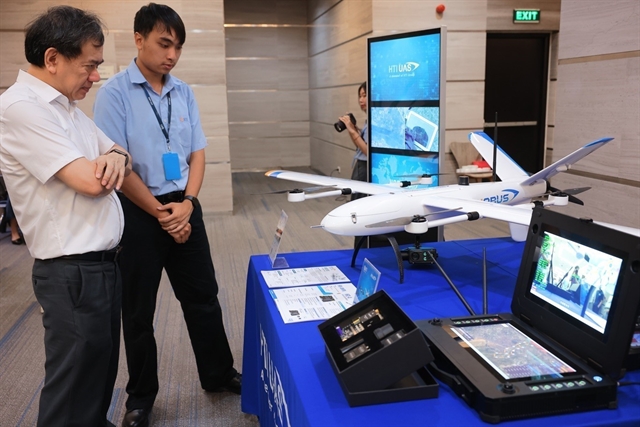
Deputy Minister of Science and Technology Lê Xuân Định outlined three priorities for developing the industry: concentrating R&D resources on strategic semiconductor segments, reforming science and technology financing and training skilled R&D personnel through practical projects.
Priority segments include AI chips, Internet of Things chips, compound semiconductor power chips for green energy and chips for 5G and 6G telecommunications equipment.
Định said funding mechanisms should shift towards commissioning research projects based on practical needs and business demand, while allowing for the risks inherent in R&D.
"Under Decree 260 on strategic technology development, semiconductor products could receive support covering up to 100 per cent of testing costs domestically and internationally, alongside preferential tax policies," he said.
The Ministry of Science and Technology also plans to put into operation a National Centre for Semiconductor Chip Pilot Production, providing high-performance computing systems, shared electronic design automation software licences and internationally standardised testing laboratories, according to Định.
At the seminar, participants also highlighted the need for a long-term development roadmap, identifying the capabilities Việt Nam should build over the next five years, the technologies and market segments it should master within 10 years and its desired position in the global value chain over the next 20 years.
International experts shared lessons on building semiconductor ecosystems and turning research into commercial products.
Richard Thurston, former senior vice president and general counsel of TSMC, said developing a successful semiconductor industry would require much more than building fabrication plants.
“Anybody can build a fab. Anybody can operate a fab, but very few can successfully grow it,” he said, emphasising the importance of developing the wider ecosystem needed to sustain the industry.
Thurston identified the gap between scientific research and commercialisation, often called the 'valley of death', as a major challenge. Việt Nam would need sustained investment, modern infrastructure, institutional coordination and stronger mechanisms to turn scientific achievements into commercially viable products, he said.
He also highlighted the importance of protecting intellectual property and trade secrets to encourage innovation and attract investment, going on to suggest that Việt Nam explore opportunities in mature-node chips and advanced packaging, alongside developing domestic design capabilities.
According to Thurston, Việt Nam's engineers and scientific talent are among its most promising assets, but these strengths must be supported by a comprehensive national semiconductor strategy and effective cooperation between domestic and international partners.
The recommendations will be reviewed by the Central Commission for Policies and Strategies as input for advising the Party Central Committee, the Politburo and the Party Central Committee Secretariat on strategic directions for Việt Nam's semiconductor industry. — VNS