Việt Nam studies ways to broaden use of sustainable aviation fuel
The proposed SAF roadmap will take into account Việt Nam's international commitments, the Carbon Offsetting and Reduction Scheme for International Aviation (CORSIA) and the country's ability to develop a domestic SAF supply while avoiding shocks to domestic airlines and the air transport market.
HÀ NỘI — Việt Nam is studying domestic feedstocks and technologies for producing sustainable aviation fuel (SAF) as the country is accelerating the development of a roadmap to gradually introduce the fuel into the country's aviation market, the Civil Aviation Authority of Vietnam (CAAV) said.
The authority is surveying available feedstocks including agricultural biomass, used cooking oil and waste, as well as suitable conversion technologies.
In a recent report to the Ministry of Construction, the CAAV said its findings will be used to propose a SAF supply chain model, management measures and a phased roadmap for deployment in Việt Nam.
The proposed SAF roadmap will take into account Việt Nam's international commitments, the Carbon Offsetting and Reduction Scheme for International Aviation (CORSIA) and the country's ability to develop a domestic SAF supply, while avoiding shocks to domestic airlines and the air transport market.
Việt Nam has already gained initial experience in importing, supplying and using SAF, while some energy companies are also examining opportunities to produce SAF domestically.
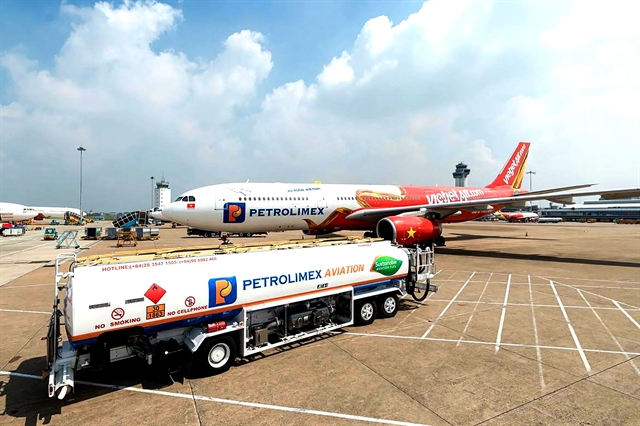
Petrolimex Aviation imported and supplied SAF for Vietjet flights at Tân Sơn Nhất International Airport in 2024 and participated in SAF blending in 2025.
Vietnam Airlines used 2,200 tonnes of SAF in 2025, reducing lifecycle carbon emissions by about 5,600 tonnes, the carrier said. In May 2024, it operated a commercial passenger flight from Singapore to Hà Nội using SAF, becoming the first Vietnamese airline to use the fuel on a commercial passenger flight.
On August 15, Vietjet used SAF produced by Petrolimex Aviation on its flights. Petrolimex Aviation blended and supplied 1,200cu.m of SAF for Vietjet flights.
PetroVietnam has assigned its subsidiaries, Bình Sơn Refining and Petrochemical JSC (BSR) and PetroVietnam Oil Corporation (PVOIL), to work on SAF production.
BSR has studied producing SAF using the hydroprocessed esters and fatty acids technology, while PVOIL and the Vietnam Petroleum Institute have studied used cooking oil and other potential feedstocks.
To sustain long-term growth, airlines belonging to the International Air Transport Association have set a goal of achieving net zero emissions by 2050, with SAF expected to account for up to 65 per cent of the emissions reductions needed to meet that target.
However, the CAAV said airlines' readiness remained uneven, with some carriers lacking specific SAF plans or sufficient information to assess their ability to deploy the fuel. In addition, existing activities had yet to form a complete SAF supply chain, and there was not enough information to fully assess the feasibility of deploying SAF nationwide.
Airport fuel infrastructure is an important part of the SAF supply chain, according to the CAAV.
At Hà Nội's Nội Bài International Airport, the local aviation fuel service company has initially assessed that existing infrastructure could potentially be used for SAF or Jet A-1 blended with SAF.
Still, further assessments are needed to determine the compatibility of storage tanks, pipelines, equipment and refuelling systems, while requirements for fuel quality, testing, certification and traceability also need to be clarified.
The CAAV said it would continue working with Petrovietnam and Petrolimex on SAF production and deployment in Việt Nam.
At a September 2025 meeting of the provisional Joint Committee for the ASEAN-EU Comprehensive Air Transport Agreement in Bangkok, ASEAN countries asked the EU to consider allowing SAF to be certified under both the EU's RefuelEU Aviation framework and ICAO's CORSIA standards.
Việt Nam would continue to participate in discussions aimed at harmonising SAF recognition between EU and ICAO mechanisms in order to facilitate implementation by domestic carriers, the CAAV said.
CAAV Director Uông Việt Dũng said that the launch of SAF would be strategically important for the long term, because it would lay the groundwork for a sustainable domestic SAF supply chain which meets international market requirements and encourages cooperation among airlines, fuel suppliers, regulators and financial institutions.
SAF is produced from renewable and sustainably sourced materials such as used cooking oil, agricultural residues, woody biomass and municipal waste. It can reduce lifecycle carbon emissions compared with conventional jet fuel. — VNS