EFTA trade deal offers strategic opportunities
Economic expert Associate Professor Ngô Trí Long spoke to Công Thương (Industry and Trade) Magazine about the opportunities, impacts and requirements for Việt Nam to make effective use of the EFTA-Việt Nam Free Trade Agreement

Associate Professor Dr Ngô Trí Long, an economist and former director of the Ministry of Finance's Institute for Market and Price Research, spoke to Công Thương (Industry and Trade) Magazine about the opportunities, impacts and challenges presented by the EFTA-Việt Nam Free Trade Agreement and what Việt Nam needs to do to maximise its benefits.
How do you assess the significance of the EFTA-Việt Nam Free Trade Agreement in the current context?
Amid growing uncertainty in the global economy, intensifying trade competition and the ongoing restructuring of global supply chains, Việt Nam’s signing of a free trade agreement (FTA) with the European Free Trade Association carries considerable economic and strategic significance.
After 14 years and 21 formal rounds of negotiations, the two sides announced the conclusion of negotiations in July. The achievement reflects sustained efforts towards international integration while reaffirming Việt Nam’s commitment to diversifying its markets and partners and reducing the risks associated with dependence on a limited number of traditional markets.
EFTA comprises Switzerland, Norway, Iceland and Liechtenstein. Although these countries have relatively small populations, they are high-income economies with strong purchasing power, advanced technological capabilities and substantial financial resources.
One notable feature is the complementary nature of the economic structures of Việt Nam and EFTA. Việt Nam has strengths in manufacturing, processing, agricultural products and consumer goods, while EFTA excels in finance, pharmaceuticals, precision engineering, marine technology, clean energy and modern governance. This complementarity creates opportunities for cooperation beyond trade in goods, extending to production links, investment, technology transfer and innovation.
According to EFTA, two-way trade in goods reached 4.8 billion euros (US$5.36 billion) in 2025, with Việt Nam recording a trade surplus of 2.5 billion euros ($2.79 billion), a substantial increase from 500 million euros ($558 million) a decade earlier. These figures exclude Switzerland's gold trade.
The figures demonstrate that bilateral trade has developed on a positive foundation, although considerable room remains for further cooperation. In my view, the agreement's strategic significance lies in expanding Việt Nam's market opportunities at a time when international trade is becoming increasingly unpredictable.
Market diversification is not simply about selling more goods; more importantly, it strengthens the economy's resilience to external shocks.
The market-opening commitments are expected to create additional opportunities for Vietnamese goods. How should businesses view these opportunities?
The most immediate benefit is improved market access through tariff preferences. According to the Ministry of Industry and Trade, EFTA countries have committed to immediately liberalising more than 90 per cent of tariff lines, covering approximately 99.5 per cent of Việt Nam's export value to the bloc. Việt Nam will eliminate tariffs on more than 86 per cent of tariff lines, equivalent to 99.9 per cent of imports from EFTA, according to the agreed schedules.
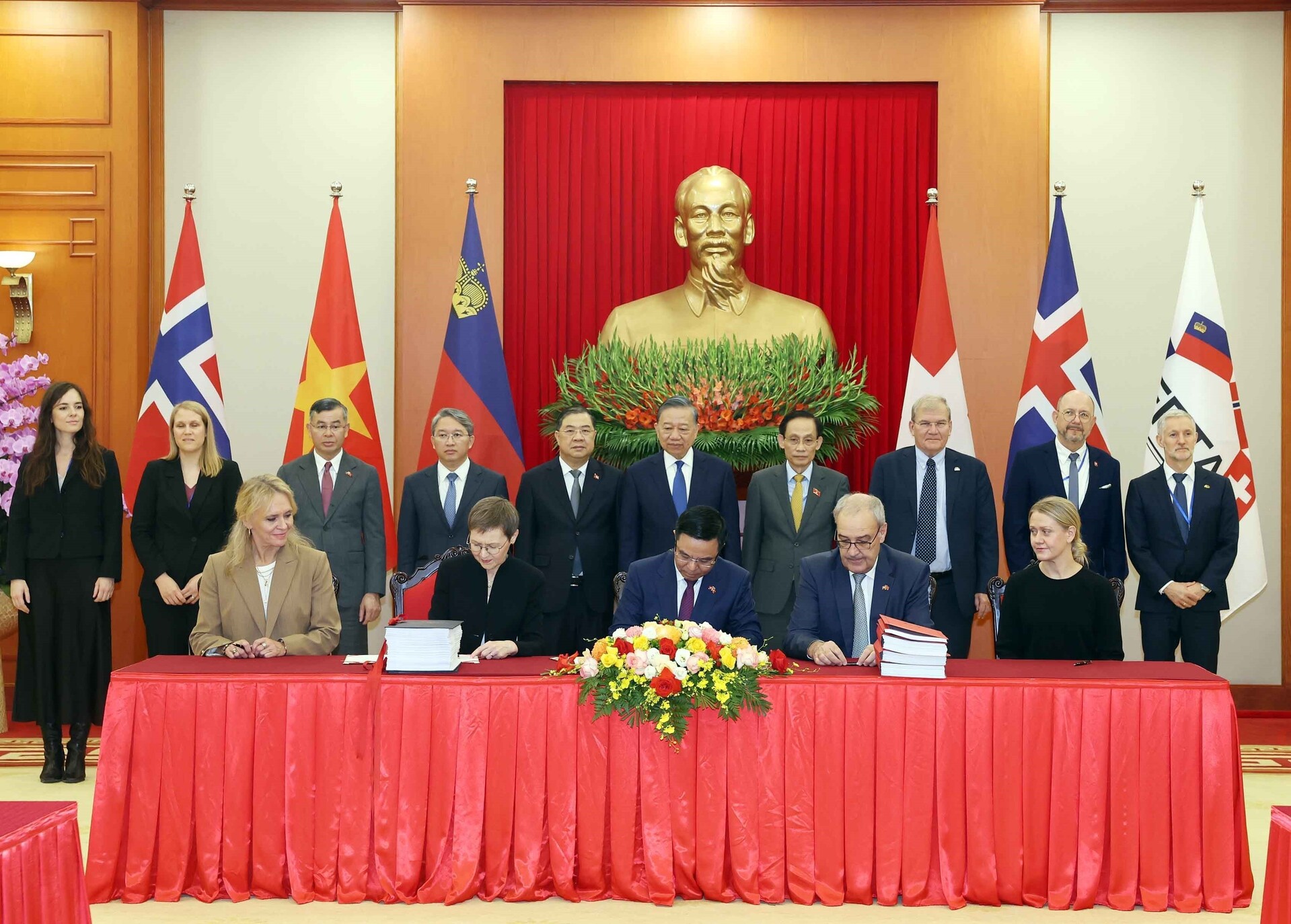
EFTA will maintain the elimination of import duties on Vietnamese-origin industrial goods and seafood when the agreement enters into force, creating opportunities for textiles and garments, footwear, electronics, seafood, machinery and agricultural products.
However, tariff preferences alone do not guarantee higher exports. Businesses must also meet requirements on product quality, rules of origin, technical standards, traceability and sustainability. For example, Vietnamese coffee exports will generate greater value if businesses move beyond raw materials towards processing and branding.
Similarly, seafood exporters must meet stringent food safety and sustainability requirements.
The real opportunity is to export higher-value products. Investment in technology, branding and quality will be essential to shift from volume-based to value-driven exports.
Beyond trade, what do you see as the long-term strategic benefits the agreement could bring to Việt Nam?
One of the agreement's most promising benefits is its potential to attract high-quality investment, advanced technology and management expertise. Figures released by the ministry show that, by the end of 2025, Switzerland had 234 active investment projects in Việt Nam, with total registered capital exceeding $2.4 billion. Norway had 62 projects, with total registered investment capital of approximately $201.57 million.
This provides a notable foundation for cooperation, but a gap remains between EFTA's technological and financial potential and the scale of its existing investment in Việt Nam.
Switzerland has strengths in precision engineering, finance, pharmaceuticals and food processing. Norway has extensive experience in maritime industries, offshore wind power and aquaculture. Iceland stands out for its geothermal energy resources and seafood processing technologies.
These sectors align with Việt Nam's need to renew its growth model, particularly through the development of high-tech industries, the marine economy, clean energy and advanced processing.
However, the success of the agreement should not be measured by increases in registered foreign investment alone. What matters is how much added value, technology transfer and new production capacity such investment generates for Vietnamese businesses.
An investment project only delivers genuine long-term benefits when it brings domestic suppliers into its supply chains, provides technical training for workers and enables Việt Nam to participate in higher-value stages of production. Conversely, if projects are limited to assembly and contract manufacturing, with most inputs imported, their spillover effects on the wider economy will remain limited.
It is therefore necessary to move away from the mindset of attracting investment at any cost and towards selecting projects based on quality, technology and their wider economic benefits. The FTA provides a favourable framework, but the ability of domestic businesses to absorb technology will ultimately determine the results.
As markets open further, competitive pressure will also intensify. What should Việt Nam prioritise to turn its integration commitments into genuine competitiveness?
Greater opportunities invariably come with stronger competitive pressure. Vietnamese businesses will have to meet higher standards, while goods and services from EFTA will enjoy more favourable access to the domestic market under specific commitments.
The question now is how domestic businesses can become competitive enough to thrive in a more open market.
In my view, Việt Nam should focus on four priorities. First, improve the institutional framework and ensure transparent implementation, providing businesses with clear guidance on tariffs, rules of origin, technical standards and preferential procedures, particularly for small- and medium-sized enterprises.
Second, help businesses improve productivity, modernise technology and meet international standards, while shifting trade promotion towards brand development, supply chain integration and higher-value products.
Third, link investment attraction with the development of supporting industries and skilled human resources. EFTA investors should be encouraged to partner with Vietnamese businesses, develop domestic suppliers and cooperate in training, research and innovation.
Fourth, measure the FTA's effectiveness through the quality of economic growth, including preference utilisation rates, domestic value added, supply chain participation and technology adoption, rather than trade turnover alone. In particular, Việt Nam must avoid the mindset that signing an agreement means the task of international integration has been completed.
Signing is only the starting point; implementation capacity and businesses' ability to capitalise on the agreement will determine its success.
What are your greatest expectations for the trade agreement in the period ahead?
I expect the agreement to deliver three major benefits: expanding exports to markets with strong purchasing power, attracting investment linked to advanced technologies and helping Vietnamese businesses participate more deeply in global value chains.
However, these benefits will not materialise automatically. They depend on institutional quality, business capabilities and effective implementation.
The greatest value of the agreement is that it creates fresh impetus to transform production, improve competitiveness and strengthen the country's position in the global economy.
The success of an FTA should be measured by the extent to which Việt Nam's competitiveness and standing in the global economy are enhanced. That is the more meaningful long-term measure of a free trade deal in Việt Nam's new stage of development. VNS