Việt Nam, RoK share experience in budget management, regional connectivity
At a meeting with Busan Vice Mayor for Administrative Affairs Kim Kyung Duk, the two sides exchanged experience in budget management, the decentralisation of local budgets, mechanisms for support from the central budget, policies to attract private-sector investment in technical infrastructure, and governance and financial mechanisms serving regional connectivity.
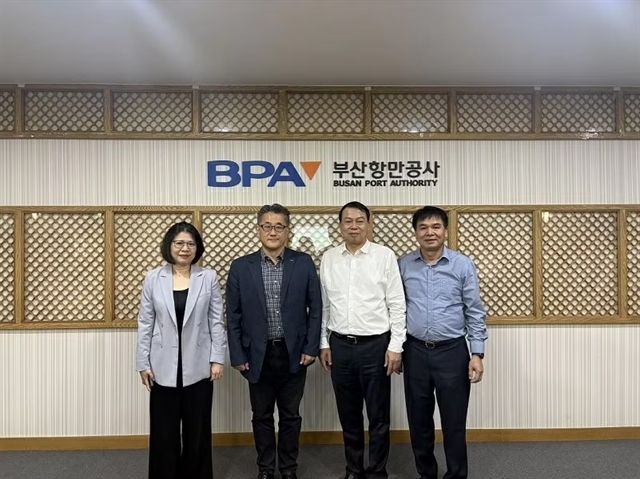
SEOUL — A delegation led by Deputy Minister of Finance Nguyễn Đức Chi held meetings with the Busan city administration, visited the Hyundai Motor plant in Ulsan and worked with the Busan Port Authority during a visit to the southeastern region of the Republic of Korea (RoK) from September 30 to October 1.
Vietnamese Consul General in Busan Đoàn Phương Lan joined the activities.
At a meeting with Busan Vice Mayor for Administrative Affairs Kim Kyung Duk, the two sides exchanged experience in budget management, the decentralisation of local budgets, mechanisms for support from the central budget, policies to attract private-sector investment in technical infrastructure, and governance and financial mechanisms serving regional connectivity.
Busan authorities said central government grants currently account for about 42 per cent of the city’s budget. Busan is calling for more substantive fiscal decentralisation and proposing that the national–local tax revenue ratio be adjusted to 6:4 to give local authorities greater resources for reinvestment.
In infrastructure investment, it is promoting public–private partnerships for major projects to mobilise additional resources from private investors while ensuring reasonable service fees for residents.
The delegation visited Hyundai Motor’s Ulsan plant, the world’s largest single automobile manufacturing facility. Covering nearly 5 million sq.m, the plant employs 31,000 workers and has an annual production capacity of 1.52 million vehicles. It has an on-site dedicated automobile port capable of handling 1.1 million vehicles annually and exporting 4,500 vehicles a day. The factory produces green vehicle models such as the Ioniq 5 and Nexo, as well as the full range of Genesis vehicles.
Hyundai Motor Group has ranked third globally for four consecutive years, selling 7.27 million vehicles last year, including 4.14 million Hyundai-branded vehicles. Operating 14 plants in 10 countries, it has introduced a strategy to transform itself into a smart mobility solutions provider based on three pillars: electrification, hydrogen technology and software-defined vehicles (SDVs).
A key focus of the discussions on regional connectivity was the Bu-Ul-Gyeong Super Regional Economic Alliance, comprising Busan, Ulsan and Gyeongnam, which is being developed under the Korean Government’s “five hubs – three special zones” policy.
The regional connectivity unit has been upgraded to an executive body, operating through regular and special consultations among the three localities.
The alliance aims to establish an interregional transport network with travel times of less than one hour and strengthen its collective bargaining power to attract government agency headquarters and substantial subsidies.
At the Busan Port Authority, the delegation learned about experience in developing an international transshipment port, the operation of a free trade zone within the port and plans to expand the new Busan port.
Busan authorities spoke highly of Việt Nam’s maritime potential and said they are studying ways to promote cooperation with Vietnamese ports.
The RoK’s practical experience in fiscal decentralisation, private capital mobilisation for infrastructure and regional connectivity mechanisms provides useful reference for Việt Nam as the latter works to improve its budget and public finance mechanisms and regional development policies in the coming period. — VNA/VNS