Việt Nam tightens social housing resale rules, overhauls power investment framework
Social housing owners will be allowed to resell their properties after five years, but only to buyers who meet the eligibility requirements for purchasing social housing with resale price to be agreed upon by the parties.
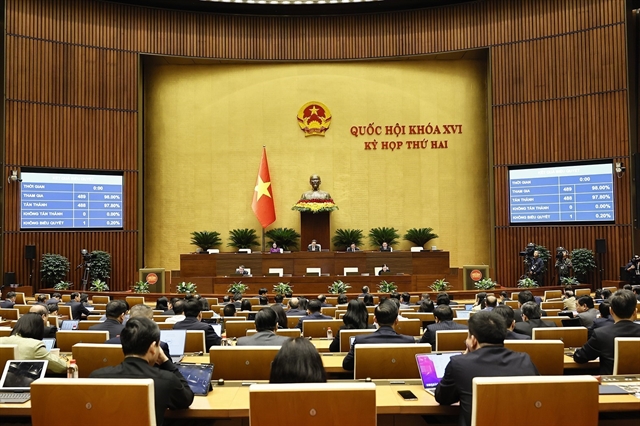
HÀ NỘI The National Assembly on November 21 passed a revised Law on Housing, tightening conditions for the resale of social housing, and amendments to the Law on Electricity to introduce new mechanisms to facilitate investment in the power sector.
The revised Law on Housing was approved with 467 of the 485 deputies participating in the vote in favour. It comprises 13 chapters and 129 articles and will take effect on July 1, 2027.
Under the new rules, social housing owners will be allowed to resell their properties after five years, but only to buyers who meet the eligibility requirements for purchasing social housing, with the resale price agreed by the parties.
Minister of Construction Trần Hồng Minh said the legislation also clarifies policies on rental housing, foreign ownership of housing and the development of social housing in commercial housing projects. The law also strengthens apartment building management regulations.
Electricity law
The amended Law on Electricity was passed with 488 of the 489 deputies participating in the vote in favour, or 97.8 per cent. It will take effect on June 1, 2027, while certain provisions on offshore wind surveys will come into force on July 1, 2027.
The revisions focus on streamlining investment procedures, clarifying investor selection mechanisms and strengthening the regulatory framework for direct power purchase agreements (DPPAs), energy storage and offshore wind development.
Under the new legislation, certain power projects included in electricity development plans may be exempted from procedures for obtaining in-principle investment approval. However, this will not exempt them from requirements concerning land allocation, land leasing, changes in land-use purposes, forest-use conversion or other relevant procedures.
The Government will also specify criteria for selecting investors without auctions or competitive bidding, alongside post-inspection mechanisms and sanctions for those failing to fulfil their commitments.
For DPPAs, the law clarifies that participating parties must pay electricity costs, power system service charges, balancing payments and other relevant expenses, and ensure that costs are calculated in full and transparently.
The law also establishes provisions for energy storage systems, covering licensing, capacity pricing, investment incentives and technical requirements for battery storage systems connected to the national grid.
For offshore wind projects, it retains support mechanisms including minimum long-term contracted electricity output, generation mobilisation, marine-area and land-use fees, and electricity pricing arrangements.
The law also provides transitional provisions on marine-area allocation for offshore wind surveys, covering applications received before the law takes effect that remain unresolved.
It also assigns the Minister of Industry and Trade responsibility for implementing the roadmap to eliminate cross-subsidies in electricity pricing, including regulating wholesale electricity pricing methods and setting retail tariffs for different customer groups. - VNS