Việt Nam launches national programme to help firms meet global green standards
The Government has approved a nationwide programme to support sustainable business practices through 2030, which presents Vietnamese companies with a major opportunity to accelerate green restructuring and strengthen their competitiveness.
HÀ NỘI — The Government has approved a nationwide programme to support sustainable business practices through 2030, which presents Vietnamese companies with a major opportunity to accelerate green restructuring and strengthen their competitiveness.
Approved under Decision 926/QĐ-TTg signed by Deputy Prime Minister Nguyễn Văn Thắng on May 25, the programme aims to support around 25,000 enterprises, cooperatives and household businesses in transitioning toward sustainability, including the adoption of Environmental, Social and Governance (ESG) standards and circular economy practices.
The programme also targets the development of at least 20 successful pilot models that could later be replicated nationwide.
For the first time, household businesses have been included as a key target group under the national sustainable business strategy, reflecting efforts to broaden policy coverage across the private sector.
The initiative is expected to help balance economic efficiency with social responsibility and environmental protection, while supporting Việt Nam’s commitment to achieving the 17 Sustainable Development Goals by 2030 and net-zero emissions by 2050.
It is widely seen as a strategic step to help enterprises, cooperatives and household businesses to overcome disruptions in global supply chains and adapt to tightening international standards.
Nguyễn Quang Vinh, vice president of the Vietnam Chamber of Commerce and Industry (VCCI), said that the decision marks an important institutional milestone.
Expanding support to household businesses demonstrates the inclusiveness of the policy framework, Vinh said. Support measures also go beyond awareness campaigns to provide practical tools helping domestic firms improve competitiveness and overcome technical barriers, such as the European Union’s Carbon Border Adjustment Mechanism and the EU Deforestation Regulation.
Under the programme, participating businesses will receive support in areas including registration and maintenance of accounts on international e-commerce platforms, participation in domestic and overseas trade fairs and consultancy services for applying green business standards.
The move comes as the green transition is becoming a prerequisite for Vietnamese businesses to maintain exports, participate in international supply chains and access green finance.
Major markets including the EU, the US, the Republic of Korea and Japan have continued introducing new requirements related to carbon border adjustment mechanisms, anti-deforestation rules, digital product passports, social responsibility and product carbon footprints.
President of the Vietnam Green Transformation Association Đặng Huy Đông said ESG standards and carbon audits have effectively become a 'green visa' for Vietnamese products seeking deeper access to global markets.
Nguyễn Đoàn Thông, a representative of the HCM City branch of the VCCI, said ISO standards, ESG and net-zero commitments are no longer optional trends, but have become tickets to integration, helping businesses join global supply chains and access green capital flows.
Addressing challenges
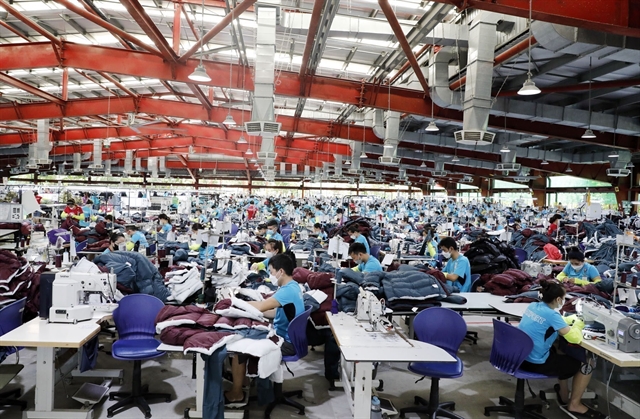
However, experts noted that compliance costs remain one of the biggest obstacles facing businesses, particularly small and medium-sized enterprises (SMEs).
Lê Duy Bình, managing director of Economica Vietnam, described the target of supporting 25,000 businesses and household firms as ambitious, but achievable if resources are allocated effectively.
He said that the biggest bottleneck now for the private sector is the high upfront compliance costs of green standards.
Without direct financial support mechanisms, access to green credit and specialised technical consultancy, SMEs will struggle to shoulder transition costs on their own, he said.
Businesses have expressed hope that the policy would soon be translated into practice, as many have struggled to cope with increasing green standards to maintain market shares with limited resources.
According to the Vietnam Textile and Apparel Association, most businesses, especially SMEs, continue facing difficulties related to capital, technology and personnel needed for the green transformation.
Many firms are aware of what they need to do for more sustainable operations, but do not have sufficient resources for large-scale investment.
Some companies said they are facing pressure from a dual transition process that requires both digitalisation and green transformation, despite limited resources.
Businesses are also facing challenges due to the absence of a unified ESG standards framework in Việt Nam. Different export markets and international partners often require different standards, creating confusion during implementation.
Đào Anh Thắng, deputy general director of Nhựa Tiền Phong, said the green transition is a long-term journey requiring substantial financial, technological, human and infrastructure resources.
Businesses thus need stronger support through green credit, clearer technical standards and the development of eco-industrial ecosystems to reduce transition costs, he said.
Nguyễn Văn Nam, director of a packaging company in Hưng Yên Province, said that what businesses need most now is clear, streamlined and transparent guidance on eligibility criteria and procedures so the policy can work quickly. — VNS