Tây Ninh removes bottlenecks to unlock high-tech agriculture ambitions
Tây Ninh Province is positioning itself to become one of Southeast Việt Nam's leading high-tech agricultural hubs as businesses invest heavily in smart farming, advanced livestock production and digital crop management.
TÂY NINH — Tây Ninh Province is rapidly emerging as one of Việt Nam's most ambitious high-tech agricultural frontiers, with billions of đồng flowing into smart farms, automated livestock complexes and digitally managed crop production.
Yet behind the rapid investment, businesses say the province's long-term success will depend on removing persistent bottlenecks in land access, infrastructure, administrative procedures and skilled labour.
The province has attracted a growing number of major investors helping build integrated agricultural value chains spanning production, processing and exports.
According to Vũ Mạnh Hùng, chairman of Hùng Nhơn Group, the company is developing the DHN Tây Ninh High-Tech Agriculture Complex, which comprises of eight projects worth several trillion đồng.
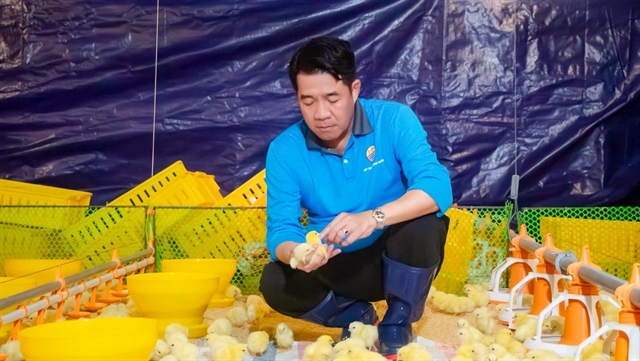
Two projects have already begun operations. The DHN Tây Ninh High-Tech Livestock Farm in Tân Hội Commune was built with an investment of VNĐ200 billion (US$7.6 million) and is capable of producing around 20 million breeding eggs annually.
Meanwhile, DHN Tây Ninh 5 in Tân Thành Commune, also worth $7.6 million, houses about 196,000 breeder chickens and supplies roughly 28 million breeding eggs each year.
The remaining six projects include additional high-tech livestock facilities and food processing plants.
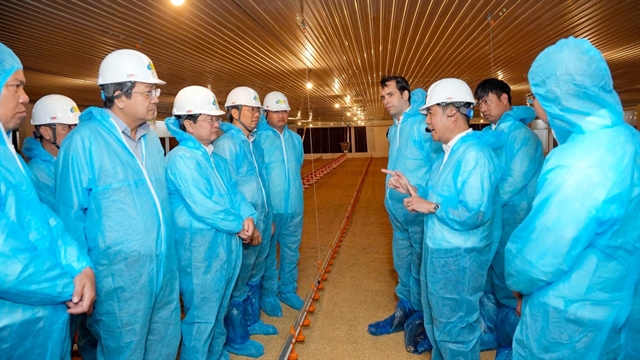
Hùng said the entire complex had been designed around automated closed-house systems equipped with Industry 4.0 technologies that monitor temperature, humidity, feeding, water supply and environmental conditions.
Green farming
The facilities are built to meet international standards for biosecurity and traceability while targeting halal certification to support exports.
Once fully completed by 2030, the complex is expected to supply more than 20,000 parent breeding pigs, over 10 million chicks, around 30,000 tonnes of chicken meat and approximately 500 million eggs each year, helping position Tây Ninh as a regional centre for high-tech livestock production.
Despite the progress, Hùng noted that administrative procedures remained a major obstacle.
Some projects that have already received investment approval still require several months to complete land use rights certification, according to Hùng.
DHN Tây Ninh 6 remains delayed because about 3.7 hectares of land have yet to be cleared, leaving the construction site fragmented and slowing implementation.
Separating the site for a high-tech slaughterhouse from the food processing complex has reduced the efficiency of what was originally designed as an integrated production chain meeting international standards.
Green agriculture is also gaining momentum in the province.
Đoàn Quốc Khánh, executive director for Raw Material Development at Vinamilk, said the company's Vinamilk Green Farm in Tây Ninh represented an investment of more than VNĐ1.2 trillion ($45.8 million) across some 685ha.
The ecological dairy farm currently raises more than 8,000 dairy cows, with average milk yields reaching between 28 and 30 kilograms per cow per day, according to Khánh.
The farm applies a range of advanced technologies, including robotic feed pushers, electronic chips to monitor cattle health, automated milking systems, biogas technology and recycled water for organic rice cultivation.
The company hopes authorities will accelerate legal procedures so urgent construction work can begin before the rainy season.
Vinamilk is also seeking support for two key projects: the second phase expansion of its dairy farm, which would double the herd to around 16,000 cows, and a new 13.6ha dairy processing plant.
Digital transformation
In the crop sector, Đặng Huỳnh Ức Mi, chairwoman of Agris Tây Ninh JSC, said the company was developing nearly 18,000ha of sugarcane, producing around 1.1 million tonnes of cane each harvest.
The area is expected to expand to almost 20,000ha during the 2026-27 crop season, according to Mi.
Its two sugar mills in Tây Ninh process around 1.5 million tonnes of cane annually, producing roughly 345,000 tonnes of sugar while also generating biomass power, solar energy, organic fertiliser and other value-added products.
The company has taken the lead in digital transformation through its AgriOS platform, integrating artificial intelligence, remote sensing technologies, drones, drip irrigation, electronic farm records and extensive mechanisation throughout the production process.
However, Mi said shrinking agricultural land, fragmented farm ownership, incomplete irrigation infrastructure, complex administrative procedures and shortages of young skilled workers continued to hinder the transition towards high-tech farming.
Despite operating in different sectors, businesses have put forward similar recommendations, including faster administrative processing, simplified investment procedures, better shared infrastructure, stronger support for land consolidation and more favourable long-term investment policies.
Policy support
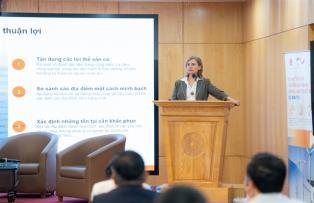
Provincial officials acknowledge that creating a more enabling policy environment will be just as important as attracting investment.
Đinh Thị Phương Khanh, deputy director of Tây Ninh's Department of Agriculture and Environment, said high-tech agriculture would remain one of the province's strategic priorities as it seeks to increase productivity, improve the competitiveness of agricultural products and develop a greener, more sustainable farming sector.
The department is promoting the adoption of science and technology among farmers, cooperatives and businesses while accelerating mechanisation, digital transformation and the establishment of production area codes for crops and livestock, according to Khanh.
Authorities are also strengthening value chains linked to product traceability, reviewing production planning, developing concentrated farming zones with better infrastructure and helping cooperatives improve branding, access to finance and adopt modern technologies.
Training programmes for agricultural officials and cooperative managers are being expanded alongside stronger partnerships with businesses to promote agricultural exports, digital commerce and wider market access.
By 2030, Tây Ninh aims for 60 per cent of its key crop production areas to adopt high-tech farming methods, while 90 per cent of concentrated livestock farms are expected to apply advanced technologies. The province also plans to further expand circular agriculture, green farming and digital production models.
According to Vice Chairman of the provincial People's Committee Huỳnh Văn Sơn, Tây Ninh enjoys significant advantages thanks to its strategic location connecting the Southeast Region with the Mekong Delta, together with its international border gates, international port and rapidly expanding transport infrastructure.
These advantages provide a strong foundation for developing large-scale agriculture closely linked with logistics, deep processing industries and exports.
The province is pursuing double-digit economic growth while prioritising industrial development, services and high-tech agriculture as key drivers of future expansion.
Sơn reaffirmed Tây Ninh's commitment to supporting investors by promptly addressing obstacles, improving the business environment and creating favourable conditions for businesses to expand their long-term operations.
As regulatory barriers are gradually removed through stronger governance and practical reforms, Tây Ninh is expected to move beyond building smart farms and modern factories towards establishing a competitive, green and circular agricultural economy that raises farmers' incomes and strengthens the global value of Vietnamese agricultural products. — VNS