




AMRO says Việt Nam’s economy remains resilient with growth projected at 7.2 per cent, but warns rising energy prices and rapid credit expansion are increasing risks to macro-financial stability.
Once operational, the zone is expected to contribute 8-12 per cent of the province’s gross regional domestic product and between 150,000 and 250,000 high-quality jobs.
Việt Nam needs to foster a new generation of private enterprises with stronger technological capabilities to lead key industries and shift from supporting growth to driving the country’s modernisation.
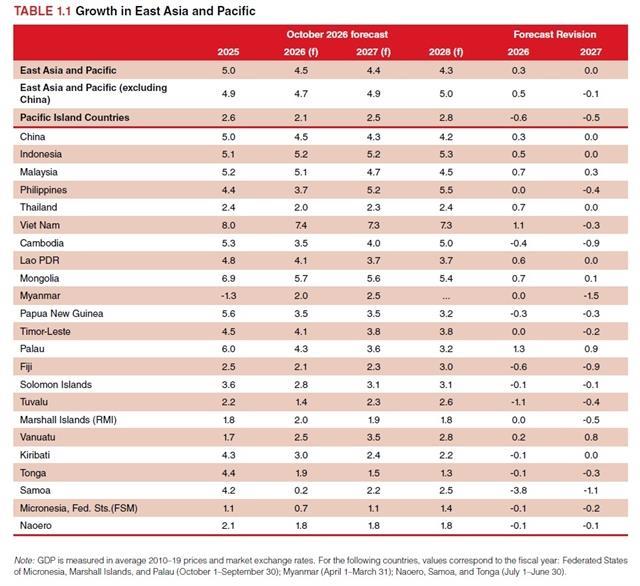
Gross domestic product (GDP) growth is projected to moderate to 7.2 per cent in 2026 and 7.0 per cent in 2027 under the ADB''s baseline scenario, after expanding by 8.0 per cent in 2025.
Amid the challenging environment, the sector should tap into niche markets, driven by demand for premium and specialised dairy products as well as nutritional foods for the elderly and children.
Prime Minister Phạm Minh Chính reaffirmed the double-digit growth target, citing resilient first-quarter performance despite mounting global risks and domestic challenges.
The Ministry of Industry and Trade is determined to maintain export growth of 15–16 per cent while sustaining a trade surplus of around US$23 billion to make a significant contribution to achieving double-digit GDP growth in 2026 and beyond.
The nighttime economy could become a new growth driver for HCM City if it is developed as a complete ecosystem rather than through fragmented efforts, experts and policymakers have agreed.
The Vietnam Economic Forum 2026 in Hà Nội gathered policy makers and researchers to discuss the urgency of reshaping the country’s development strategy amid fast-changing global and domestic conditions.
Deputy PM Nguyễn Chí Dũng has called for stronger business links and proposed Italian industrial parks in Việt Nam to deepen investment, technology transfer and supply chain cooperation.