Việt Nam set for strong growth as ASEAN+3 faces rising global risks: AMRO
Việt Nam is expected to lead ASEAN+3 in growth, supported by resilient demand and investment, as AMRO warns of rising risks from global energy shocks.
HÀ NỘI — Việt Nam is poised to record the fastest economic growth in the ASEAN+3 region in 2026–27, supported by strong domestic demand and stable inflation, even as global risks intensify, according to the latest ASEAN+3 Regional Economic Outlook (AREO) 2026 released by the ASEAN+3 Macroeconomic Research Office (AMRO) on April 6.
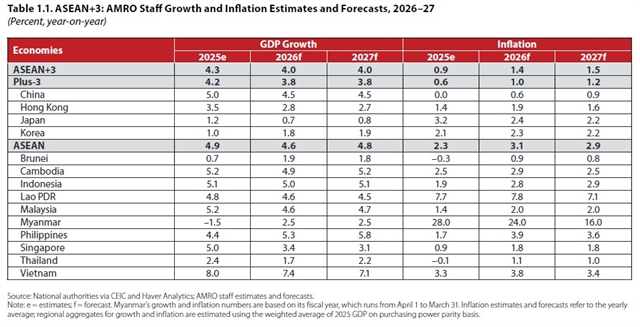
AMRO forecasts Việt Nam’s GDP growth at 7.4 per cent in 2026 and 7.1 per cent in 2027, easing slightly from an estimated 8 per cent in 2025. Inflation, measured by the consumer price index (CPI), is expected to average 3.8 per cent in 2026 before moderating to 3.4 per cent in 2027.
The report highlights that Việt Nam continues to benefit from strong domestic demand, robust export performance and sustained foreign investment inflows, particularly in high-tech manufacturing and electronics.
Across the broader ASEAN+3 region, growth is projected at 4.0 per cent in both 2026 and 2027, following stronger-than-expected expansion of 4.3 per cent in 2025. Inflation is forecast to rise modestly from 0.9 per cent in 2025 to 1.4 per cent in 2026 and 1.5 per cent in 2027.
AMRO said the region entered 2026 from a position of strength, supported by resilient domestic demand, firm exports and improved external buffers.
However, escalating geopolitical tensions, particularly the ongoing conflict in the Middle East, have increased downside risks by pushing up global energy prices and disrupting supply chains.
Within ASEAN, growth is expected to remain relatively robust at 4.6 per cent in 2026 and 4.8 per cent in 2027, with inflation rising to 3.1 per cent in 2026 before easing slightly. China, the region’s largest economy, is forecast to grow 4.5 per cent in both 2026 and 2027, with inflation remaining subdued at below 1 per cent.
AMRO noted that the impact of the Middle East conflict will depend on its duration. A prolonged shock could spill over from energy markets to industrial inputs, logistics, food prices and tourism, affecting economies unevenly depending on their exposure and policy space.
Despite these risks, the report underscores a structural shift in the region towards stronger intra-regional trade and demand. The region has emerged as the world’s largest market, accounting for 28 per cent of global final demand.
“The long-standing view of the region as the world’s factory is increasingly outdated,” said AMRO Chief Economist Dong He, noting that economies are now driven more by regional consumption and production linkages.
The share of ASEAN+3’s value-added exports to the United States has fallen from around one-third to 20 per cent, while the proportion retained within the region has increased to nearly 30 per cent, reflecting a shift towards stronger intra-regional demand.
He urged policymakers to preserve flexibility to respond to shocks, maintain financial stability and provide targeted fiscal support to vulnerable groups, while avoiding broad stimulus measures that could fuel inflation.
He added that sustaining growth will depend on deepening regional cooperation, maintaining open trade and investment flows and accelerating the transition towards greener energy systems. — BIZHUB/VNS