PM urges firms to lead push for double-digit growth
Prime Minister Phạm Minh Chính urged enterprises to take greater responsibility for rapid and sustainable development, stressing that they must be the main drivers of growth as Việt Nam is aiming for double-digit growth toward a high-income country by 2045.
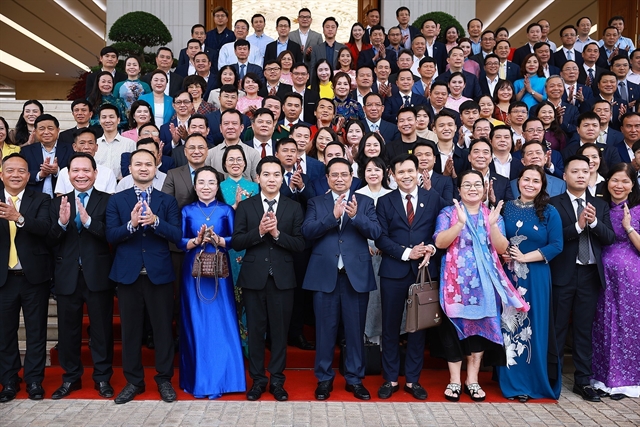
HÀ NỘI — As Việt Nam sets its sights on becoming a high-income economy by 2045, Prime Minister Phạm Minh Chính has called on businesses to step up as the engine of rapid and sustainable growth, urging them to match ambition with responsibility in a decisive decade ahead.
Addressing Vietnamese enterprises on March 27, Chính said the Government would continue to listen with sincerity, share concerns with empathy and deliver concrete policies to remove obstacles, all in pursuit of the country’s two centennial strategic goals.
He said the economy had weathered challenges during 2021-25 under the Party’s leadership, the National Assembly’s backing, the Government’s decisive actions and the collective efforts of the political system, businesses and the public. Economic performance improved steadily quarter by quarter and year by year, reshaping Việt Nam’s economic landscape and enhancing its global standing.
Since late 2024, the Politburo has issued nine strategic resolutions, followed by others submitted to the National Assembly by the Government for swift legalisation, laying a solid foundation for double-digit growth in the 2026-30 period.
According to the Prime Minister, science and technology, innovation and digital transformation must underpin Việt Nam’s development in the next phase, as the country targets high-income status, with enterprises playing a far more central role.
Entering the 2026-30 period, the 14th National Party Congress reaffirmed an average annual growth target of 10 per cent or higher. To achieve this, he said Việt Nam must renew traditional growth drivers while accelerating new ones such as science and technology, innovation, digital transformation, green transition, the circular economy, creative industries and the low-altitude economy.
Việt Nam must also expand into new development spaces, including the marine economy, space and underground infrastructure, a shift that requires changes in mindset, methodology and execution, he said.
While the Party and State will continue refining the institutional framework, mechanisms and policies, Chính made clear that enterprises must serve as the main drivers of growth. He urged them to take greater responsibility for rapid and sustainable development while actively contributing to institutional reform.
Delegates were urged to focus discussions on accelerating the transition to a science and technology-driven growth model, which he described as both an objective requirement and a strategic choice.

He also pushed for the creation of globally competitive Vietnamese corporations, the formalisation of business households into proper enterprises and the scaling up of small and medium-sized firms into large multinationals.
It is also equally vital to better leverage the digital and green economies, along with free trade agreements, to climb global value chains, deepen global integration, improve product quality and strengthen self-reliance and strategic autonomy, he said.
Higher labour productivity and a workforce up to international standards are essential, he added, while openly asking what institutional and policy bottlenecks the State must clear to unlock breakthroughs for firms.
To steer the economy through global headwinds and deliver double-digit growth, every ministry and locality must also aim for double-digit expansion, he said, while spotlighting national unity and international cooperation to address global and external challenges.
In his view, Việt Nam must continue pursuing diversification and multilateralisation of foreign relations, being a reliable partner and responsible member of the international community while pooling external resources, including capital, governance expertise and technology.
Robust business sector
The Ministry of Finance’s report presented at the event showed that Việt Nam’s business sector currently contributes around 60 per cent of GDP and employs more than 16 million workers. By the end of 2025, the country had more than one million active enterprises, up more than 25 per cent from 2020.
About 18,000 new enterprises were established each month on average since mid-2025.
The private sector has emerged as a key growth engine, while State-owned enterprises continue to play a leading role in strategic industries. Foreign-invested firms remain an important component, helping connect the domestic economy to global supply chains, Deputy Minister of Finance Cao Anh Tuấn said.
However, persistent challenges remain, including regulatory inconsistencies, slow administrative reforms and unresolved legal bottlenecks.
Tuấn said achieving double-digit growth would require a fundamental shift in governance, from improving the business environment to creating national competitive advantages and empowering enterprises to lead development.
He called for stronger institutional reforms, including reducing business conditions, improving legal frameworks and introducing regulatory sandbox mechanisms for emerging sectors such as financial technology and artificial intelligence.
Businesses, in turn, were urged to increase investment in innovation, upgrade management practices and workforce skills and deepen participation in global value chains.
“The goal of double-digit growth is not only about speed, but about transforming the growth model and enhancing national competitiveness,” Tuấn said.
He added that enterprises must take on a pioneering role in innovation and help position Việt Nam more strongly in the global economy as the country seeks to avoid the middle-income trap and achieve long-term development goals.
At the conference, major Vietnamese corporations such as Petrovietnam, Viettel, EVN, BIDV and TH Group presented their achievements and outlined future development strategies to the Government. They also put forward recommendations aimed at strengthening the role of the business sector in driving rapid and sustainable economic growth.
Overall, enterprises called for more decisive institutional reforms, stronger support for digital transformation and technology adoption, improved infrastructure systems and more favourable conditions to facilitate investment. These measures, they emphasised, are essential to empower businesses to take the lead in advancing Việt Nam’s long-term growth and competitiveness. — VNS