Over 2,000 kilometres of urban railways to be built in Hà Nội and HCM City
Việt Nam's two largest cities are investing in key routes to fix inner-city traffic congestion and open up urban development spaces.
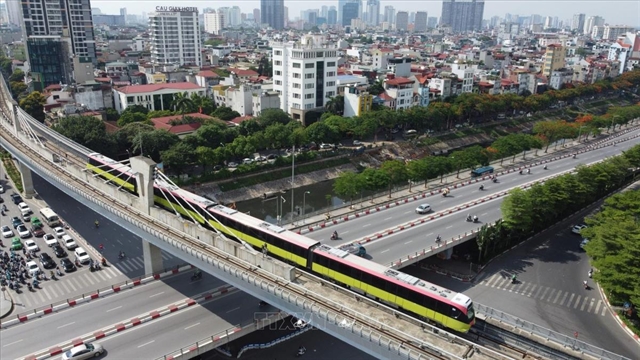
HÀ NỘI — Forty-six urban railway lines and sections with a total length of over 2,000 kilometres will be built in Hà Nội and HCM City, and are expected to be in operation by 2030, according to a report from the Ministry of Construction.
Eighteen lines and sections with a total length of 979 kilometres will be built in Hà Nội, and 28 others with the total length of 1,024 kilometres will be built in HCM City.
Work has started on 11 out of the 18 projects in Hà Nội, with eight under construction and three in the preparation stage.
The sections under construction include those on Line 3.1 from the Nhổn area to Hà Nội Station, on Line 2.1 from the urban area Nam Thăng Long to Trần Hưng Đạo Street, and on Line 5 from Văn Cao Street to Hòa Lạc satellite urban area.
They also include five new sections whose construction began in June with completion aimed for 2030, including two sections on Line 1 and 2 connecting Hùng Vương Stadium and Nội Bài Airport. These also entail Line 8 from Hòa Lạc to Dương Xá Commune, Line 14 from Thăng Long Bridge to Ocean Park urban area, and the loop Line 10 connecting Cổ Loa Commune with the Times City urban area.
The three sections in the preparation stage are those on Line 3.2 from Hà Nội Station to Hoàng Mai Ward, the extended section of Line 3.3 from the Nhổn area to Sơn TâyTown, and the extended section of Line 2A to Xuân Mai Commune.
Of the 28 lines and sections planned for HCM City, eight are being prioritised for completion by 2030.
They include one section on Line 1, three sections on Line 2, Lines 4 and 6, the Thủ Thiêm-Long Thành Line, and the Bến Thành-Cần Giờ Line.
Construction has started on two out of three sections on Line 2, which connect Bến Thành Market with Tham Lương and Thủ Thiêm areas.
Feasibility study reports are being prepared for the remaining six lines and sections.
The Ministry of Construction will coordinate with relevant ministries, agencies and the authorities in the two cities to resolve issues related to these projects, including planning, technical standards, funding, site clearance and investment procedures, according to the report. — VNS