National traceability system to strengthen reputation of Vietnamese farm produce: Deputy PM
Deputy Prime Minister Hồ Quốc Dũng praised the Ministry of Agriculture and Environment for developing and putting the system into operation, saying it would improve transparency across the agricultural supply chain, enable the tracing of product origins and help safeguard the quality and reputation of Vietnamese agricultural products in international markets.
HÀ NỘI — The introduction of Việt Nam's national agricultural product traceability system is a major step in the digital transformation of the agriculture and environment sector, helping enhance the quality, transparency and global competitiveness of the country's farm produce, Deputy Prime Minister Hồ Quốc Dũng said at the launch ceremony in Hà Nội on Tuesday.
The system marks an important milestone in implementing the Politburo's Resolution No. 57 on breakthroughs in science and technology, innovation and national digital transformation, he said.
He praised the Ministry of Agriculture and Environment for developing and putting the system into operation, saying it would improve transparency across the agricultural supply chain, enable the tracing of product origins and help safeguard the quality and reputation of Vietnamese agricultural products in international markets.
The Deputy PM stressed that traceability has become a global requirement rather than an option for a few export products or markets. As consumers and importing countries demand greater transparency, food safety and supply chain accountability, he said Việt Nam must strengthen product traceability to build strong agricultural brands and access high-value markets.
He called for priority to be given to major agricultural products with high output and export value, particularly those destined for key markets such as China, the European Union and the United States. The system should then be expanded to other products that require stricter quality control and food safety management.
He also urged ministries, local authorities and relevant agencies to improve data sharing and verification mechanisms while helping businesses, cooperatives and farmers join the system. He emphasised that traceability should be viewed as a practical tool to improve product quality and competitiveness, not as an additional administrative burden. He also instructed authorities to continue simplifying administrative procedures and remove unnecessary technical requirements that could create obstacles for producers.
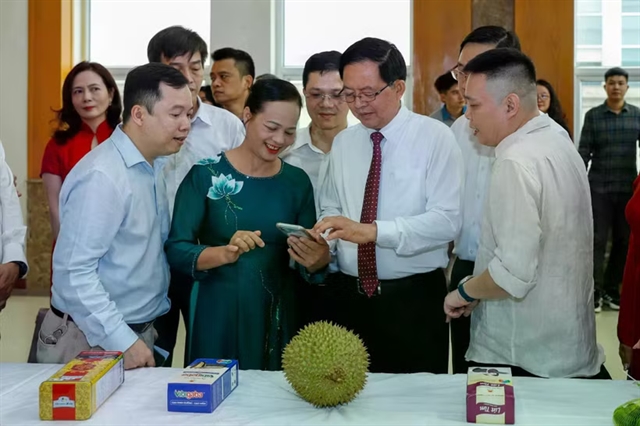
The traceability system was officially launched after a successful pilot programme covering exported durian.
The ministry said the platform will also enhance the State's ability to monitor food safety, issue early warnings and respond to quality problems. At the same time, it will create a shared agricultural database covering growing areas, production facilities, packaging, processing, distribution, exports and consumption, supporting the digital transformation of Việt Nam's agriculture sector.
The national platform consists of three main components: a public portal for consumers to verify product information, a management system for authorities and supply chain participants, and a mobile application for smartphones and other smart devices.
Built on a modern, open architecture, the system uses electronic digital signatures, blockchain technology, GS1 international product identification standards and GS1 Digital Link QR codes to ensure secure, transparent and reliable data sharing. It is designed to handle around 1,000 search requests per second, support 30,000 simultaneous QR code scans and process more than 85 million traceability scans each day.
To date, the platform has integrated traceability data for more than 18,500 products across 181 product categories from 170 businesses in 24 of Việt Nam's 34 cities and provinces. — VNA/VNS