Marine economy drives growth in southernmost province
The southernmost province of Cà Mau is leveraging its maritime strengths to create new momentum for economic growth, with fisheries, renewable energy, marine tourism and logistics emerging as key development pillars.
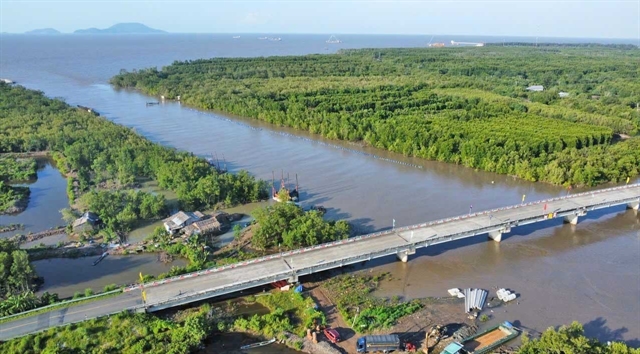
CÀ MAU — From shrimp farms and wind turbines to coastal tourism and deep-water ports, Cà Mau Province is reshaping its future around the vast economic potential of the sea.
Located at the southernmost tip of Việt Nam, Cà Mau holds a strategically important position with three sides facing the sea, a coastline stretching across 310 kilometres and maritime areas for exploration and exploitation covering around 120,000 square kilometres.
Together with one of the country’s largest mangrove ecosystems and the Hòn Khoai island cluster located along international shipping routes, the province is gaining opportunities to develop its marine economy while simultaneously safeguarding national defence and security.
According to Phạm Văn Mười, deputy director of the provincial Department of Agriculture and Environment, the marine economy has continued to make significant contributions to local growth in recent years, with fisheries remaining the backbone sector.
The province’s total seafood output reached more than 1.26 million tonnes, while shrimp farming areas expanded to over 435,000 hectares, reinforcing Cà Mau’s position as the country’s largest shrimp production hub.
Seafood processing has maintained stable growth with 89 factories and a combined annual capacity exceeding 500,000 tonnes.
During the 2021–25 period, processed seafood output surpassed 1.49 million tonnes, generating export turnover of more than US$10.4 billion.
In 2025 alone, seafood exports exceeded $2.4 billion, contributing significantly to economic growth and job creation.
Alongside fisheries, the province is developing new growth drivers from marine tourism and renewable energy.
Between 2018 and 2025, Cà Mau welcomed around 40.3 million visitors, including nearly 4.7 million tourists to coastal areas. Revenue from marine tourism reached approximately VNĐ4.56 trillion ($175 million).
The province has also attracted 26 wind power projects and one gas-fired power project with a combined capacity of around 4,650MW and total registered investment capital exceeding VNĐ170 trillion ($6.5 billion).
Transport infrastructure has continued to improve, with more than 1,800 kilometres of commune roads and over 16,000 kilometres of rural transport routes helping expand development space and strengthen regional connectivity.
At the same time, the province has stepped up efforts in marine resource management, environmental protection and climate change adaptation.
Cà Mau has maintained effective conservation of its 27,000-hectare marine protected area while strengthening environmental monitoring, pollution control, mangrove protection and coastal erosion prevention measures.
Residents’ living standards have gradually improved, with annual income per capita rising from VNĐ34 million (U$1,320) in 2018 to VNĐ65 million ($2,500) in 2025.
Marine defence and security have remained stable, while management of fishing vessels and efforts to combat illegal, unreported and unregulated (IUU) fishing have also been strengthened.
“Looking at Cà Mau today means seeing a locality rising from the sea and developing strongly thanks to the marine economy,” Mười said.
Strategic vision
Based on assessments of its potential and current conditions, Cà Mau has identified marine economic development as a strategic, central and long-term mission.
The province targets average GRDP growth of 10 per cent or higher during the 2026–30 period, with marine economic sectors expected to contribute around 40–45 per cent of total State budget revenue. GRDP per capita is projected to exceed US$6,000 by 2030.
By 2045, Cà Mau aims to become a strong marine economy province based on modern, green and sustainable development.
According to Lê Văn Sử, vice chairman of the provincial People’s Committee, alongside economic development, the province places special emphasis on strengthening national defence and security.
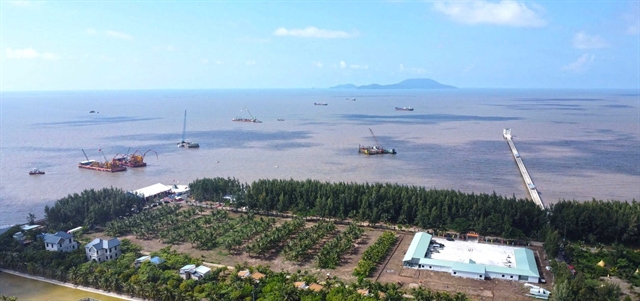
Several strategic infrastructure projects are being invested in by the Government, including the Cà Mau–Đất Mũi Expressway, a sea-crossing bridge linking Cape Cà Mau with Hòn Khoai Island, and the dual-use Hòn Khoai Port.
These projects are expected not only to create new trade opportunities for the Mekong Delta region but also strengthen defence and security in the country’s southwestern waters.
Implementing Resolution 36 issued by the Communist Party of Việt Nam in 2018 on the sustainable development strategy for the country’s marine economy, Cà Mau has planned development based on marine economy growth while combining marine exploitation with aquaculture and protection of national sovereignty.
Provincial leaders say Cà Mau needs to shift strongly from “training based on existing capacity” to “training based on strategic development demand” in order to meet future development requirements.
The province has also affirmed that development cannot “trade the environment for growth” but instead must pursue sustainable pathways that adapt to climate change and promote a circular economy.
Future potential
At a recent seminar on marine economic development, Dr Trần Đình Thiên, an economist, said Cà Mau holds an especially important position in the national marine economic strategy, with major advantages for renewable energy, seaports, marine tourism, marine industry and coastal urban development.
To ensure sustainable growth, the province should prioritise high value-added marine sectors, apply modern technologies and strengthen marine environmental governance.
Meanwhile, Associate Professor Dr Nguyễn Bá Hoàng, rector of Bà Rịa Vũng Tàu University, said transport infrastructure and logistics would be key to unlocking new growth space for Cà Mau and the broader southwestern region.
Under development orientations for the 2026–40 period, the province is expected to focus on multimodal transport infrastructure development, including seaports, inland waterways, roads, aviation and railways.
In particular, the Hòn Khoai deep-water port and strategic transport links are expected to become major drivers for marine economic growth and logistics development.
As Cà Mau Province pushes ahead with investments in ports, logistics, renewable energy and marine tourism, provincial leaders believe the sea will not only shape the locality’s economic future but also redefine it as one of Việt Nam’s emerging coastal growth hubs. — VNS