Large-diameter forests key to sustainable growth of Việt Nam's wood industry
Despite having nearly 5 million ha of planted forests, Việt Nam still faces a shortage of high-quality large-diameter timber for deep processing, experts said.
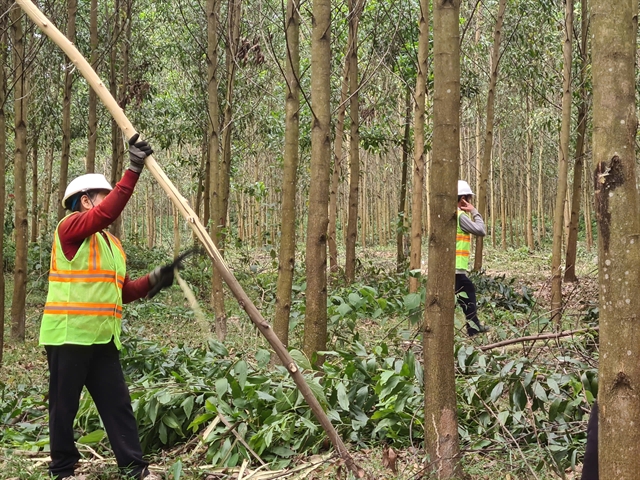
HÀ NỘI — Developing large-diameter forests becomes critical for the wood industry to ensure sustainable raw material supplies for exports and move up the value chain amid increasingly strict international traceability and environmental requirements.
As international markets tighten requirements on the origin and sustainability of timber, the industry's competitive advantage is shifting from processing capacity and costs towards the ability to secure stable, certified and traceable supplies from forest areas.
The shift is taking place while the wood export continues to post significant growth. Exports exceeded US$17 billion in 2025, while shipments reached $8.6 billion in the first half of 2026, up 4.9 per cent from a year earlier and are projected to reach 2025 level, supported by recovering consumer demand and free trade agreements.
The growth, however, highlighted pressure on raw materials.
Despite having nearly 5 million ha of planted forests, Việt Nam still faces a shortage of high-quality large-diameter timber for deep processing, according to experts at a webinar on July 24.
The industry's raw materials come mainly from two sources, including imported timber from countries with strong forest governance, including the US and EU, and domestic timber from production forests and rubber plantations.
Demand from the furniture, plywood, engineered wood, woodchip and pellet industries varies significantly. Furniture manufacturers require large-diameter logs for deep processing, while plywood producers use medium-sized timber. Woodchip and pellet producers mainly consume small-diameter timber, branches, tops and other plantation by-products.
The diverse demand for different types of segments has intensified competition for domestic acacia and eucalyptus timber.
In northern Việt Nam, shortages have become more severe after natural disasters damaged large areas of planted forests, pushing up timber prices. Plywood and peeled-veneer producers have struggled to compete with woodchip plants for raw materials.
Unplanned investment has added to the imbalance. In some localities, multiple companies have invested in wood pellet production without adequate planning for raw material supplies, resulting in processing capacity that exceeds the availability of timber in the area.
Phùng Quỗc Mẫn, deputy president of the Vietnam Timber and Forest Product Association, said that strong export performance did not necessarily mean the industry was developing sustainably.
The weak links between raw material areas and processing industries remained a major bottleneck that would need to be addressed, he said.
Tô Xuân Phúc, director of Forest Trends' Forest Policy, Trade and Finance Programme, said the development of raw material areas should be considered nationwide rather than as an issue confined to the southeastern region or the Mekong Delta.
Việt Nam has about 10.1 million ha of natural forests and 4.9 million ha of planted forests, including around 4.1 million ha of production forests, which provide most of the raw materials for the wood-processing industry.
About 880,000 ha of forests have received sustainable forest management certification under the FSC and PEFC systems.
The furniture, engineered wood, pellet and woodchip industries require an estimated 59 million cu.m of raw materials a year, highlighting the importance of planted forests to the wood industry's value chain.
However, after more than 20 years of efforts to develop large-diameter forests, Việt Nam has yet to achieve the expected results.
Phúc said market demand had not been strong enough to encourage growers to extend forest rotation cycles, while short-term economic returns had continued to favour the production of small-diameter timber.
The development of processing facilities in many localities had not been properly aligned with raw material planning, he said.
Trần Lam Sơn, deputy general director of Thiên Minh Company, said raw material areas should be planned according to the strengths of each locality.
Cà Mau, for example, has low-lying terrain but high acacia yields and could be suitable for developing biomass materials, while higher-elevation provinces such as Đồng Tháp, An Giang and Tây Ninh could focus on large-diameter forests for deep processing, he said.
Vũ Quang Huy, general director of plywood producer TEKCOM, said timber supplies should be allocated according to their value, with large-diameter logs given priority for deep processing to maximise economic returns.
He cited estimates that extending the forest rotation cycle to 10-12 years to produce large-diameter timber could generate profits for growers about 2.5 times higher than harvesting young trees after four to five years.
According to Vũ Tấn Phương, director of the Vietnam Forest Certification, the carbon market has the potential to provide additional financial resources to encourage the development of large-diameter forests, improve the quality of raw materials for deep processing and increase incentives for forest owners to participate in the value chain.
However, most forest owners are households and individuals operating on a small scale, with limited technical and financial resources.
The key challenge is therefore to offer practical incentives to encourage growers to change their business models and shift from short-term harvesting of small-diameter timber to long-term large-diameter forest development while participating in the carbon credit market.
To strengthen linkage, the Handicraft & Wood Industry Association of HCMC conducted field surveys in Cần Thơ and Cà Mau in early July and is expanding the initiative to Tây Ninh and An Giang to develop pilot models linking local raw material areas with industrial processing centres. — VNS