Việt Nam advances deep processing with first aluminium ingot production
The first aluminium ingots were officially unveiled on July 26 at the Đắk Nông Aluminium Electrolysis Plant in Nhân Cơ Industrial Park, Lâm Đồng Province.
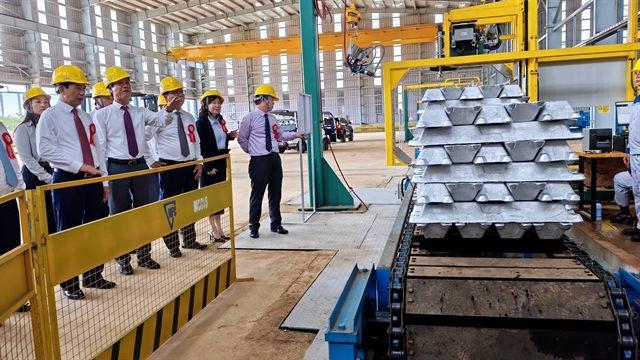
HÀ NỘI — Việt Nam has produced aluminium ingots domestically for the first time, completing the value chain from bauxite mining and alumina production to primary aluminium smelting and marking a major step in the development of the country’s metallurgical and mineral-processing industries.
The first aluminium ingots were officially unveiled on July 26 at the Đắk Nông Aluminium Electrolysis Plant in Nhân Cơ Industrial Park, Lâm Đồng Province.
The ceremony was attended by General Phan Văn Giang, Politburo member, Deputy Prime Minister and Minister of National Defence, together with representatives of central ministries, agencies and the provincial authorities.
The milestone came after more than 11 years of construction and investment. The first batch of aluminium achieved a purity level of 99.71 per cent.
The plant's first phase has an annual production capacity of 150,000 tonnes. Output is expected to rise to 300,000 tonnes by the end of 2026 before reaching the designed capacity of 450,000 tonnes per year in the first quarter of 2027.
Speaking at the ceremony, Giang said that the successful production of aluminium ingots was a historic milestone for Việt Nam's metallurgical industry.
He said the project demonstrated the ability of Vietnamese enterprises to master technology, improve management capacity and develop a high-quality workforce.
He added that domestic aluminium production would help Việt Nam move away from exporting raw materials and semi-finished products towards supplying strategic materials for industries including electricity, mechanical engineering, automobiles, railways, aviation, defence, construction and high technology.
Việt Nam is estimated to hold around 5.8 billion tonnes of bauxite resources, concentrated mainly in the Central Highlands.
Once the plant reaches full capacity in 2027, it is expected to produce 450,000 tonnes of aluminium annually, generating production value of approximately VNĐ35-36 trillion (US$1.3-1.4 billion). Domestic output is also expected to reduce aluminium imports by around $1.5 billion each year.
The project is projected to employ more than 1,000 workers directly and create another 3,500-4,000 jobs in related activities.
Giang called on ministries and agencies to continue improving mechanisms and policies for the development of the aluminium industry.
He also urged support for enterprises conducting research, mastering modern metallurgical technologies, training skilled personnel and accelerating digital transformation in production.
Lâm Đồng Province, he said, should continue investing in transport, energy and logistics infrastructure, while streamlining administrative procedures to attract downstream aluminium-processing projects.
Y Thanh Hà Niê Kđăm, a member of the Party Central Committee and Secretary of the Lâm Đồng Provincial Party Committee, said the successful production of the first aluminium ingots would open up opportunities to establish an aluminium industrial value chain in the Central Highlands.
He added that the achievement resulted from close coordination among central authorities, the local government and the investor.
Since the project began in 2012, the province had supported land compensation and clearance, infrastructure development, security and efforts to resolve implementation difficulties.
The plant is expected to promote processing industries and high-tech manufacturing in Lâm Đồng and the wider Central Highlands, while supporting economic restructuring, employment creation and more efficient use of bauxite resources.
The province plans to continue developing transport, logistics and energy infrastructure, improving workforce training and administrative reform, and attracting projects in deep aluminium processing.
Provincial authorities said completing the bauxite–alumina–aluminium chain would create conditions for the development of new materials and related manufacturing sectors, while expanding the industrial base of Lâm Đồng and the Central Highlands. — BIZHUB/VNS