Manufacturing sector faces steep cost inflation amid Middle East war
With higher input costs often passed on to customers, output prices increased at one of the sharpest rates since the survey began in 2011.
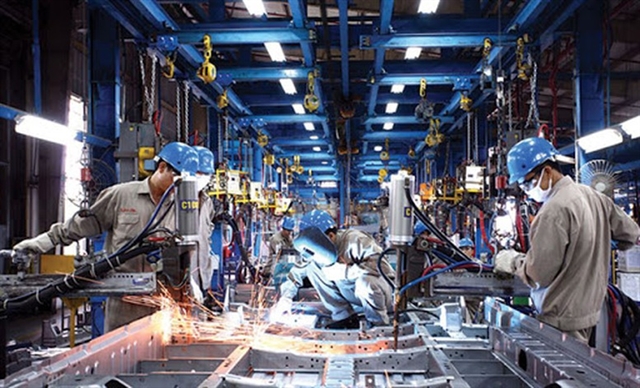
HÀ NỘI — The war in the Middle East caused a marked acceleration in the rate of input cost inflation in the manufacturing sector during March, with selling prices subsequently raised at the fastest pace in almost 15 years, a survey of S&P Global released today shows.
According to the survey, the Vietnam Manufacturing Purchasing Managers' Index (PMI) remained above the 50.0 no-change mark in March, extending the current sequence of improving business conditions to nine months.
That said, the PMI dropped to 51.2 from February's 54.3 and pointed to the least marked strengthening of operating conditions since last September.
S&P Global noted that a key feature of the survey was the impact of the war in the Middle East on inflation. An increase in the price of oil resulted in higher costs for freight, fuel and transportation.
As a result, close to half of respondents recorded an increase in their input costs during March, with the pace of inflation the sharpest since April 2022.
With higher input costs often passed on to customers, output prices increased at one of the sharpest rates since the survey began in 2011. The pace of inflation seen in March was the steepest in just under 15 years.
Sharply rising prices in the sector acted to limit demand. Total new orders continued to rise as some firms reported that clients had purchased in advance to try to get ahead of price increases. The rate of expansion was only modest, however, and the weakest since last September.
Meanwhile, international demand suffered, with new export orders decreasing markedly following stable new business from abroad in February.
In line with the picture for total new business, manufacturing production increased at a much-reduced pace during March. The latest rise in output was the eleventh in as many months, but least pronounced since June 2025.
Slower growth of new orders and higher input costs led to a reluctance among manufacturers to commit to additional purchases in March. Input buying decreased markedly, ending an eight-month sequence of expansion. Stocks of purchases were also down.
Where firms did buy inputs, they faced a substantial lengthening of suppliers' delivery times, one that was the most pronounced in four years. Respondents indicated that higher fuel costs resulted in transportation delays.
As well as scaling back purchasing activity, manufacturers also signalled a reduction in employment. Staffing levels decreased for the first time in six months. Firms reported difficulties replacing departing staff members and a drop in the number of temporary workers.
With employment down and firms facing difficulties in securing materials, backlogs of work increased in March. The slight accumulation was the first in four months. In some cases, manufacturers used stocks of finished goods to help satisfy order requirements, resulting in a marked fall in post-production inventories.
Business confidence dropped to a six-month low in March amid concerns around the impact of the war in the Middle East on international demand, prices and the supply of materials.
That said, hopes that underlying demand would remain solid and support growth of new orders and output meant that firms on balance continued to predict an increase in production over the coming year.
Andrew Harker, Economics Director at S&P Global Market Intelligence said: "The March edition of the S&P Global Vietnam Manufacturing PMI highlights the initial impacts of the war in the Middle East on firms in the sector.
"Given the country's reliance on oil imported from the affected region, the impact on prices and supply chains would have been expected to some extent.
"The rate at which input cost inflation accelerated though, and the subsequent increase in selling prices - which was the fastest in almost 15 years - shows the immediate and marked effects that firms are experiencing.
"Output and new orders remained in expansion territory in March, but rates of increase were well down on February and at least some of the growth seen was due to customers placing advanced orders to try to get ahead of price rises.
"The near-term outlook therefore appears bleak, unless a speedy resolution to the war and the disruption through the Strait of Hormuz can be achieved." — BIZHUB/VNS