Hà Nội's SMEs face challenges in joining supply chains
To implement the Politburo’s Resolution 68 on private sector development and realise Hà Nội’s new development orientations for the 2025–2030 period, the capital city is promoting the integration of small and medium-sized enterprises (SMEs) into global supply chains.
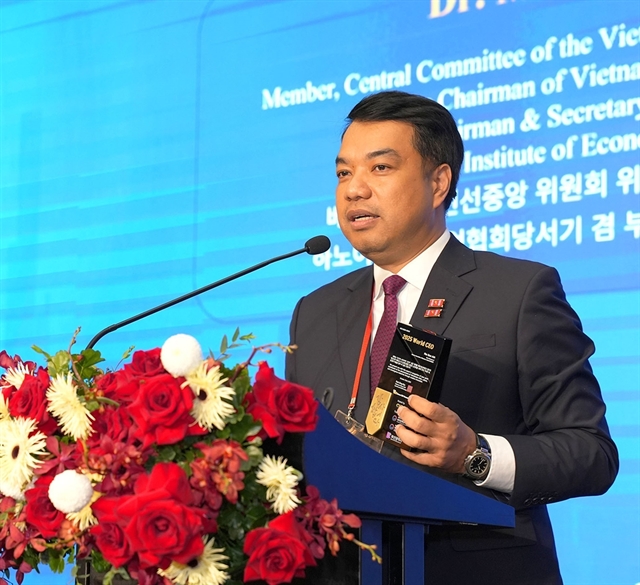
To implement the Politburo’s Resolution 68 on private sector development and realise Hà Nội’s new development orientations for the 2025–2030 period, the capital city is promoting the integration of small and medium-sized enterprises (SMEs) into global supply chains.
Mạc Quốc Anh, chairman and general secretary of the Hanoi Small and Medium-Sized Enterprises Association (Hanoisme) and director of the Institute for Business Economics and Development, speaks to the Vietnam News Agency about major challenges and solutions for SMEs in this integration.
What have SMEs contributed to the economy in both the capital city and nationwide?
SMEs account for more than 97 per cent of all enterprises in Hà Nội, and make a very important contribution to gross regional domestic product and the capital's budget. Any policy that promotes the development of a modern urban economy, therefore, cannot be separated from this business community.
They also create more than 50–60 per cent of new jobs every year, contributing significantly to social security stability and reducing unemployment pressure, especially amid strong global economic fluctuations.
Furthermore, SMEs are playing an increasingly important role in innovation. Hà Nội currently leads the country in the number of start-ups and tech companies. Most of them are SMEs operating in software, automation, e-commerce, logistics and high-tech agriculture. These are important 'seeds' for Hà Nội to pursue its goal of becoming an ASEAN innovation hub.
Hà Nội’s SMEs also serve as intermediate links in value chains. They are deeply involved in production, distribution and services in many sectors, such as supporting industries, food and beverage, building materials, textiles, fashion, logistics and tourism.
The development of major enterprises or international conglomerates investing in Hà Nội depends heavily on the supply capacity of this private sector force.
Meanwhile, SMEs are the most flexible and adaptive businesses. During the COVID-19 period, while many corporations had to downsize operations, SMEs quickly shifted to digital models, e-commerce and supply chain optimisation.
This flexibility helped Hà Nội recover faster than many other localities. In other words, SMEs ensure the sustainability of the capital’s economy and serve as key channels for absorbing and spreading modern socio-economic value.
The links between Hà Nội’s SMEs and major companies is expected to form the foundation of a new development model for the capital. How do these connections develop?
These links are key to forming a sustainable supply chain ecosystem for the capital in the next 10 years. However, many challenges prevent SMEs from connecting with large firms or foreign direct invested (FDI) enterprises.
Although SMEs are crucial to the nation's and capital's economies, they commonly face limited capital, outdated technology, management that does not meet international standards, and a lack of quality control systems.
The proportion of SMEs meeting first-tier supply chain standards remains very low. This creates a large gap in technology, standards and managerial capability, which is difficult to bridge.
This is especially true when major corporations, particularly FDI firms like Samsung, Canon, Honda, AEON and Lotte, impose stringent requirements regarding quality, processes and international standards like ISO, HACCP, IATF and ESG.
To meet supply chain standards, SMEs need to invest in machinery, production lines, automation and workforce training. Yet most SMEs in the capital lack medium- and long-term capital and struggle to access credit due to insufficient collateral, meaning they do not receive supply chain-specific incentives. This lack of capital hinders their ability to upgrade production.
Additionally, their workforce — especially in technology, automation engineering, supply chain management and research and development — is limited, making it difficult for SMEs to compete with large firms in talent recruitment.
Another major challenge is the lack of transparency in data, missing ESG standards and the inability to trace product origins.
The EU is implementing the Carbon Border Adjustment Mechanism, and the US and Japan are applying the ESG triad to assess sustainable development.
In this context, transparency of business data has become mandatory. In reality, many SMEs in Hà Nội are unable to prepare ESG reports, trace product origins or manage carbon emissions, and have yet to publicly disclose financial or production data. This slows their participation in international supply chains.
Furthermore, there are limitations in the supporting ecosystem itself.
Linking mechanisms between Hà Nội’s SMEs and large corporations or FDI firms remain fragmented due to the absence of a connection portal, a supplier capacity assessment system and regular audit and mentoring programmes to support strategic partnerships. As a result, although opportunities exist, SMEs cannot access them sustainably.
As the association’s leader, what solutions do you propose to improve this situation?
From the perspective of national policy and Hà Nội’s specific conditions, I believe that the city needs to establish an international standard supply chain ecosystem, the Hà Nội Supplier Network.
By joining this network, large enterprises would publicise their procurement needs, while SMEs would receive support in training and auditing, as well as process standardisation.
At the same time, Hà Nội should implement dedicated support packages for technology, standards and ESG for SMEs by supporting them to get ISO/IATF/HACCP certifications, prepare ESG reports, implement digital transformation and automation, and even expand credit incentives for supply chain upgrades.
The Government and Hà Nội authorities need to build strategic partnership mechanisms between large enterprises and SMEs. Major companies like Vingroup, VinFast, BRG, AEONMALL and Lotte should collaborate with the city to create a '1,000 Hà Nội Suppliers Programme', similar to Samsung’s supporting industry model in Bắc Ninh.
As for the Hanoisme, we will also promote training and consulting activities for SMEs to meet supply chain standards, and regularly review support activities to boost supply and demand links.
We also aim to enhance information transparency and encourage ESG practices among SMEs across the capital.
Meanwhile, SMEs must upgrade their own capabilities, actively engage in innovation and promote connection to major corporations to expand shared opportunities for cooperation and development. VNS