Hà Nội's second airport officially added to national airport plan
Việt Nam will have 36 airports by 2030, including 19 international airports and 17 domestic airports.
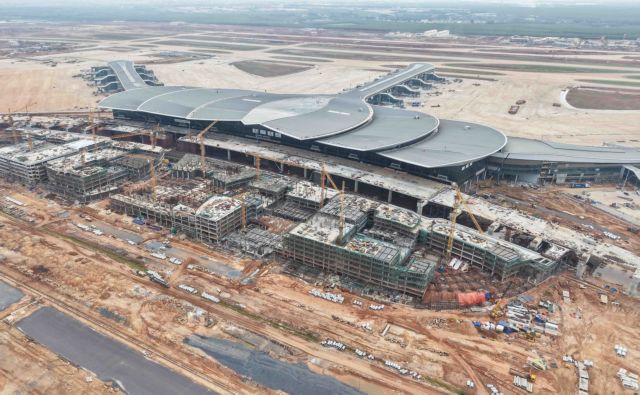
HÀ NỘI — Việt Nam has officially included a second airport for the capital region in its revised national airport development plan, which has been recently approved by the Ministry of Construction.
Under the ministry's Decision 1140/QD-BXD, the future facility is designated as an international airport to support growing travel demand.
The revised National Airport Master Plan for 2021-30 marks the second adjustment to Việt Nam's airport planning document in six months.
According to the construction ministry, the latest revision updates economic growth scenarios, air transport demand, regional development plans and national defence requirements. Future aviation demand projections are based on Việt Nam's target of at least 10 per cent annual GDP growth through 2030 and per capita GDP of about US$8,500 by 2030.
Under the revised plan, Việt Nam will have 36 airports by 2030, including 19 international airports and 17 domestic airports. Compared with the previous master plan, Ninh Bình has been added to the list of international airports.
By 2050, the network is expected to expand to 37 airports, comprising 20 international and 17 domestic airports.
The capital region's second airport is the new international airport added to the list.
Further studies to determine the airport's final location will be completed before 2030, the ministry said. For now, the proposed location is in the southern part of Hà Nội around Ứng Hòa and Chuyên Mỹ communes.
The revised plan also identifies five potential airports for future study in Tuyên Quang, Hà Tĩnh, Lý Sơn Island (Quảng Ngãi), Phú Quý Island (Lâm Đồng) and Tây Ninh.
For the first time, the national airport plan introduces detailed criteria for developing air logistics hubs, which will be established at airports handling at least 250,000 tonnes of freight annually that meet multimodal transport connectivity and warehousing requirements.
Priority locations for air logistics development include the Hà Nội region, the HCM City region and airports at Vân Đồn, Cát Bi, Quảng Trị, Chu Lai, Long Thành and Cần Thơ.
The plan also for the first time identifies Vân Đồn, Nội Bài, Gia Bình, Chu Lai, Tân Sơn Nhất and Long Thành as priority locations for aircraft maintenance, repair and overhaul (MRO) facilities to support the development of Việt Nam’s aviation services industry.
Including air logistics hubs and MRO facilities as formal components of the national airport plan signals a shift in Việt Nam's aviation strategy. Rather than focusing solely on airport infrastructure, priority is placed on developing a broader aviation economy, in line with regional trends for major aviation hubs such as Singapore, Incheon and Hong Kong (China).
By 2030, Việt Nam aims for its airport network to handle about 249 million passengers and 4.4 million tonnes of cargo annually, while ensuring more than 95 per cent of the population lives within 100km of an airport.
The ministry also said future airport investments will be implemented more flexibly, with project timing and scale determined by transport demand, economic conditions, funding availability and national defence needs, rather than fixed planning targets.
Also for the first time, the revised plan further calls for upgrades to low-altitude airspace management to accommodate unmanned aerial vehicles and other next-generation aircraft.
The plan also allows domestic airports that meet regulatory requirements to handle non-scheduled international flights. — VNS