Dung Quất EZ lands special free-trade zone Incentives
The proposed incentives are intended to accelerate investment in refining, petrochemicals, shipbuilding and energy infrastructure, while addressing constraints related to land, planning, administrative procedures, technology and skilled labour.
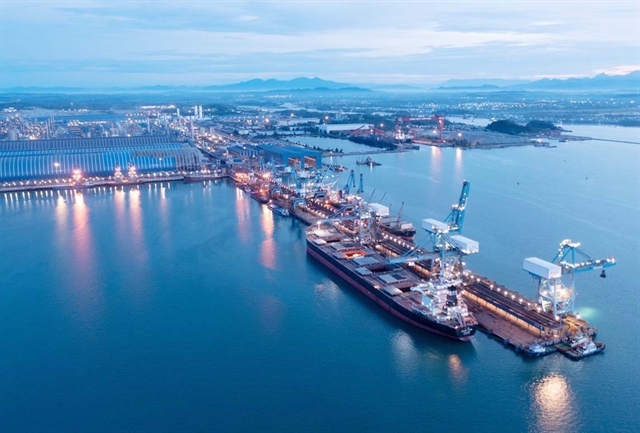
QUẢNG NGÃI — The Politburo has agreed in principle to grant the Dung Quất Economic Zone (EZ) in central Quảng Ngãi Province special mechanisms and policies similar to those applied to free trade zones in Hải Phòng and Đà Nẵng to pave the way for further investment in energy and heavy industry.
The provincial People’s Committee said on October 19 that the Politburo had agreed that the economic zone should benefit from mechanisms and incentives available to free trade zones as well as the highest incentives permitted under the Law on Urban Development.
The proposed incentives are intended to accelerate investment in refining, petrochemicals, shipbuilding and energy infrastructure, while addressing constraints related to land, planning, administrative procedures, technology and skilled labour.
Dung Quất, a major industrial hub in central Việt Nam supported by deep-water port facilities, currently has 296 active projects with total registered investment of more than VNĐ421.68 trillion (US$16.19 billion). Of these, 217 projects have become operational, with realised investment of around VNĐ282.46 trillion.
Industrial production value was estimated at VNĐ284.5 trillion in 2025, while the zone contributes an average of about VNĐ27.77 trillion in state budget revenue annually.
The Dung Quất oil refinery, which began operations in 2009, has a processing capacity of 6.5 million tonnes of crude oil a year. It has produced more than 101 million tonnes of petroleum products, generated revenue of more than VNĐ1.8 quadrillion and contributed more than VNĐ245 trillion to the state budget.
Under its development targets for 2030, the complex aims to meet all demand for petroleum products in the Central Highlands and central region and at least 30 per cent of national demand.
It also plans to maintain crude oil reserves equivalent to 20 days of production and petroleum product stocks equivalent to 20 days of consumption, with total final energy output reaching around 8 million tonnes of oil equivalent.
The complex aims to attract $5 billion in domestic and foreign investment by 2030, account for 30 per cent of Quảng Ngãi province’s economic growth and create 5,000 additional jobs.
By 2045, it targets $50 billion in investment and aspires to become a leading innovation hub for energy and materials, while strengthening national energy security. — VNS