Government orders review of expressway safe-distance rules after holiday concerns
The Government Office said in an official dispatch issued on September 1 that Deputy PM Phạm Gia Túc had instructed the ministries of public security and construction, provincial and municipal authorities and relevant agencies to examine concerns raised in media reports about traffic violations, accidents and the enforcement of safe-distance rules during the National Day holiday.
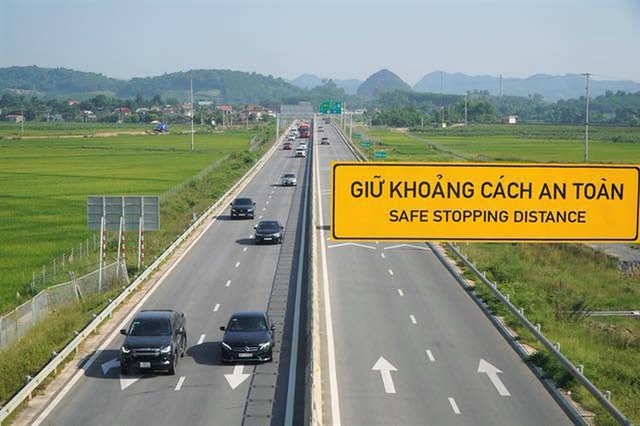
HÀ NỘI — Permanent Deputy Prime Minister Phạm Gia Túc has ordered an urgent review of concerns over penalties for violating safe distance rules on expressways.
According to an official dispatch issued on September 1, Deputy PM Túc had instructed the ministries of public security and construction, provincial and municipal authorities and relevant agencies to examine concerns raised in media reports about traffic violations, accidents and the enforcement of safe-distance rules during the National Day holiday.
From August 27, traffic police began enforcing the rules on the Pháp Vân-Cầu Giẽ-Cao Bồ-Mai Sơn-National Highway 45-Nghi Sơn expressway route.
Under Circular 38/2024/TT-BGTVT, in dry and normal weather conditions, vehicles travelling at speeds above 60km/h must maintain a minimum distance of 55 metres from the vehicle ahead. A shorter distance is considered a violation.
Following Decree 168/2024/NĐ-CP, drivers who fail to maintain a safe distance without causing a collision face fines of VNĐ4 million to VNĐ6 million and a two-point deduction from their driving licence.
If the violation results in a traffic collision, the fine rises to VNĐ20 million to VNĐ22 million, with 10 points deducted from the driving licence.
The Traffic Police Department under the Ministry of Public Security said the primary objective is not to issue as many fines as possible, but to prevent accidents and promote voluntary compliance with traffic laws.
It noted that maintaining a safe distance gives drivers sufficient time and space to react when the vehicle ahead slows down or encounters an unexpected situation. It also helps prevent multi-vehicle collisions and prolonged congestion on expressways.
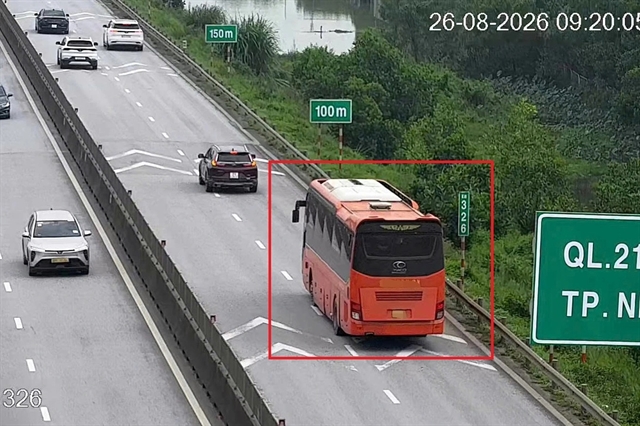
New penalties for failing to maintain safe distances on expressways have sparked debate among drivers, with some questioning how the prescribed distances can be accurately judged while driving.
Duy Khánh, a frequent expressway driver in Hà Nội, said he supported the principle of maintaining a safe distance but questioned how the rules would be applied in real-world traffic.
Khánh said frequent expressway drivers know there are situations where a slow-moving vehicle ahead, either travelling below the speed limit or occupying the high-speed lane, can make overtaking difficult.
In such situations, maintaining the prescribed distance while responding to changing traffic conditions could be difficult, he said.
He noted that vehicles might also suddenly change lanes or move into the gap between two cars, forcing drivers to repeatedly adjust their speed to maintain the required distance.
Khánh questioned whether maintaining a minimum 55-metre gap at speeds above 60km per hour would affect traffic flow, saying there are circumstances in which maintaining the prescribed distance is not entirely within the following driver's control.
A fixed distance does not always fully reflect road safety conditions, he added. A shorter gap could potentially provide sufficient reaction time when traffic is moving steadily and visibility is good, while a longer gap might not eliminate risks when visibility is poor or an obstacle appears suddenly.
Even instructional videos showing overtaking manoeuvres could make it difficult to visually estimate the distance between vehicles. Authorities should therefore provide clearer guidance on the circumstances in which drivers could be penalised, he said.
Hoàng Kiên, another driver in Hà Nội, said his main concern is the difficulty of estimating distances from 35 to 100 metres by eye while driving.
He said not many people know the spacing between roadside guardrail posts to use them as reference points.
"So, how are drivers supposed to estimate a 55-metre gap to the vehicle ahead?" Kiên asked.
He also pointed to differences between vehicles equipped with radar-based adaptive cruise control and older or lower-cost models that rely entirely on drivers to judge distance.
According to Kiên, drivers of vehicles with automatic distance-keeping systems have technological assistance. However, for standard vehicles, accurately gauging distances of 35, 55, 70 or 100 metres with the naked eye is no easy task.
Drivers prioritise safety
Meanwhile, Đỗ Xuân Thao in Hà Đông, Hà Nội, said drivers should not wait until they are fined before maintaining a safe distance.
Thao said a sufficient gap would give drivers more time to react if the vehicle ahead suddenly braked, encountered an obstacle or faced an unexpected incident.
He said the 55-metre minimum distance required at speeds of 60-80km/h under normal road and weather conditions should be viewed not simply as a threshold for avoiding fines, but as a safety habit for expressway driving.
Nguyễn Việt Hùng of Hà Nội said he supported the penalties and the practice of maintaining a safe distance.
Hùng noted that the rules are not new, but took effect on January 1, 2025. He said advance announcements by traffic police have given drivers time to understand the requirements and adjust their driving habits. — VNS