Execution gap holds back Việt Nam’s SMEs
Vietnamese small and medium-sized enterprises (SMEs) may not lack strategy or ambition, but many struggle to turn plans into results, business leaders and experts said at SME Forum 2026 in HCM City on Friday.
HCM CITY — Vietnamese small and medium-sized enterprises (SMEs) may not lack strategy or ambition, but many struggle to turn plans into results, business leaders and experts said at the SME Forum 2026 held in HCM City on Friday.
Speakers warned that a widening gap between “knowing” and “doing” has become a major bottleneck for companies seeking to scale up and remain competitive in an increasingly volatile business environment.
The issue comes as Vietnamese firms face mounting pressure to balance growth with adaptability, as global economic uncertainty, geopolitical tensions and rapid technological change continue to reshape markets.
As businesses expand, structural weaknesses often emerge, particularly in organisational structures and operational systems. Rapid growth without strong foundations can quickly undermine efficiency when market conditions shift.
The challenge is especially acute for SMEs, which account for roughly 97–98 per cent of all enterprises in Việt Nam and contribute about half of the country’s gross domestic product.
Limited access to capital, management expertise and business networks often makes it harder for smaller companies to navigate market disruptions, prompting calls for stronger corporate governance and operational restructuring.
Strategy means little without execution
A central theme of the forum was the growing “execution gap” — the disconnect between strategy and implementation.
Đào Gia Hưng, director of the SME division at VPBank, said the bank’s experience working with more than 200,000 enterprises shows that success often depends less on strategy itself than on the ability to execute it effectively.
“We have seen many Vietnamese companies grow from very small beginnings into businesses worth hundreds or even thousands of billions of đồng,” he said.
“But many others stall along the way. The difference is not opportunity, but the ability to execute and adapt,” he added.
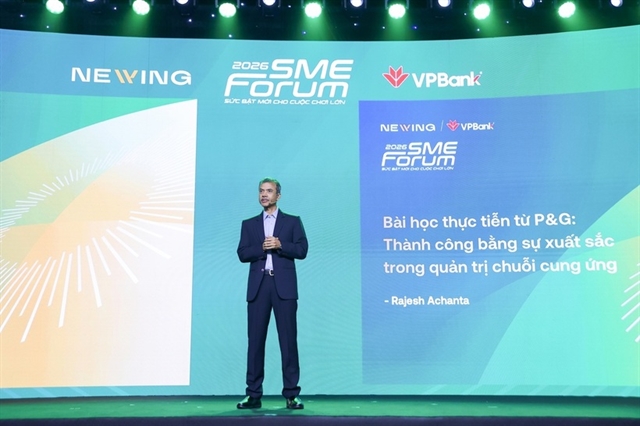
Rajesh Achanta, former vice president of Asia-Pacific supply chain operations at Procter & Gamble (P&G), said the current business environment is, in some ways, even more complex than during the pandemic.
Geopolitical shifts, trade disruptions and technological change are continuously reshaping supply chains and operating models, requiring companies to rethink how they manage complexity.
He said supply chains should be viewed not merely as operational functions but as strategic drivers of value creation, contributing directly to profitability and cash flow.
At P&G, the implementation of a “Supply Chain 3.0” model helped achieve product availability levels of 98–99 per cent while generating about US$1.5 billion in annual savings, he added.
Turning strategy into action
Speakers said competitive advantage increasingly depends not on who has the best strategy, but on who can execute it most effectively.
That requires stronger management capabilities, clearer alignment between operations and business goals, and greater investment in workforce skills and cross-functional collaboration.
In a volatile global environment, participants said, the ability to act decisively and translate strategy into action will determine whether Vietnamese SMEs merely weather market turbulence or emerge stronger.
The event, co-organised by VPBank and Newing, gathered more than 1,000 founders and business executives under the theme “New Momentum for the Big Game.” — VNS