Cost of sustainable aviation fuel poses challenge for green aviation goals
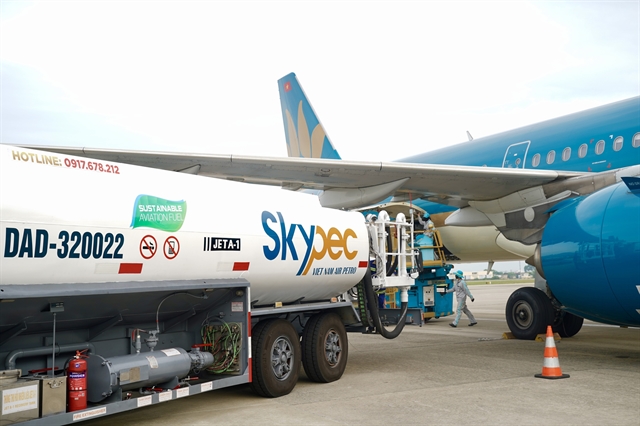
Việt Nam has the potential to produce about one million barrels of SAF a day between 2030 and 2050, supported by abundant agricultural residues from crops such as rice and cassava.
Compiled by Thu Trà
HÀ NỘI — Sustainable aviation fuel (SAF), regarded as one of the most effective near-term solutions to decarbonise aviation, remains two to five times more expensive than conventional jet fuel, making high costs the biggest obstacle to its adoption in Việt Nam, industry officials said.
Efforts are being stepped up to reduce emissions from the aviation sector as the country pursues its target of achieving net-zero emissions by 2050 and prepares to participate in the International Civil Aviation Organisation's Carbon Offsetting and Reduction Scheme for International Aviation (CORSIA) from 2026.
Deputy Minister of Construction Lê Anh Tuấn said the development of SAF in Việt Nam should follow a roadmap that balances emissions reduction goals, energy security and the competitiveness of businesses.
Southeast Asia has strong potential for SAF production due to rapid aviation growth, diverse feedstock resources and rising demand for low-carbon fuels and developing the industry would require coordinated efforts by governments, international organisations, businesses and development partners, Tuấn told a conference on SAF in Hà Nội last week.
Nguyễn Thị Phương Hiền, deputy director of the Ministry of Construction's Academy of Construction Strategy and Cadres Training, said Việt Nam currently consumes about 2.8 million to three million metric tonnes of Jet A-1 fuel annually. Demand is projected to rise to about four million metric tonnes by 2030 and around 11 million metric tonnes by 2050 as air travel continues to grow.
She said the biggest challenge to developing SAF in Việt Nam is economic, as production requires substantial investment and advanced technologies.
SAF currently costs about two to five times more than conventional Jet A-1 fuel, while investment incentives are still being developed, Hiền said, adding that Việt Nam also lacks a roadmap for SAF deployment, mechanisms to support sustainable feedstock development, traceability systems and the capacity to meet international certification requirements.
Philip Goh, CEO of the Asia-Pacific Sustainable Aviation Centre (APSAC), said sustainable aviation fuel accounted for less than 1 per cent of global aviation fuel consumption by 2025, reflecting its limited availability and high cost.
He said SAF remains significantly more expensive than conventional jet fuel, while production is concentrated in only a handful of countries. Uncertain demand and market volatility have also discouraged investment, as producers lack sufficient long-term offtake commitments to support new production capacity.
Despite the availability of technology, feedstocks and certified production processes, the missing ingredient for scaling up the SAF industry is a market large enough to encourage investment, Goh said. The development of such a market will depend largely on supportive policies and regulatory frameworks.
Scaling up SAF production
Hiền from the Academy of Construction Strategy and Cadres Training said Việt Nam should develop a roadmap for SAF deployment that reflects domestic conditions, while introducing policies to support the industry's development.
Priorities should include securing sustainable feedstock supplies, selecting appropriate production technologies, developing supply chains and supporting infrastructure, mobilising investment, establishing risk-sharing mechanisms, expanding international cooperation, promoting technology transfer and developing a skilled workforce.
Hiền said SAF development should follow a roadmap that balances emissions reduction, energy security, the competitiveness of the aviation industry and domestic industrial development.
Subash S, the International Civil Aviation Organisation (ICAO)'s deputy regional director for Asia and the Pacific, agreed. He said at the conference that each country should design an SAF roadmap based on its feedstock availability, energy resources, market demand and existing infrastructure.
He said implementation should be phased, beginning with assessments of available resources, followed by pilot projects, the establishment of incentive policies and regulatory frameworks, and ultimately the expansion of commercial production through greater investment and regional cooperation.
Developing SAF requires coordinated action across transport, energy, environment, finance, industry and investment policies, rather than relying on the aviation sector alone, he said.
He added that governments should integrate SAF into national policy frameworks and demonstrate leadership by committing to its use in State-managed aviation operations.
Meanwhile, Philip Goh from APSAC said Việt Nam has abundant feedstock resources for sustainable aviation fuel, including agricultural residues and biomass such as rice straw, rice husks and bagasse.
He said APSAC was prepared to support research, policy development and capacity building, while helping connect Việt Nam with ICAO, regional partners and the global aviation industry.
According to Sharmine Tan, Boeing's regional sustainability lead for Southeast Asia, Việt Nam has the potential to produce about one million barrels of SAF a day between 2030 and 2050, supported by abundant agricultural residues from crops such as rice and cassava.
In the near term, Việt Nam should prioritise the commercial deployment of SAF produced from bio-based oils and fats, she said. Over the longer term, the country should invest in technologies that convert bioethanol feedstocks, such as ethanol and isobutanol, as well as biomass through gasification and syngas-to-liquid processes, into sustainable aviation fuel to expand production from waste resources. — VNS