Container throughput at Vietnamese ports continues upward trend: MSB
Container throughput at Việt Nam’s ports is expected to maintain growth, with deep-water ports in particular set to record higher efficiency thanks to larger vessel deployment and the accelerated development of infrastructure, which will help enhance competitiveness, according to MBS Securities JSC.
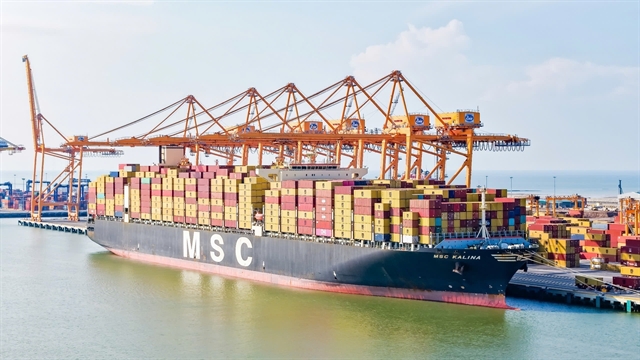
HÀ NỘI — Container throughput at Việt Nam’s ports is expected to maintain growth, with deep-water ports in particular set to record higher efficiency thanks to larger vessel deployment and the accelerated development of infrastructure, which will help enhance competitiveness, according to MBS Securities JSC.
By 2030, total investment demand for Vietnam’s entire seaport system is estimated to reach VNĐ359.5 trillion (US$13.8 billion), including VNĐ72.8 trillion for public maritime infrastructure, with the remaining VNĐ286.7 trillion earmarked for commercial terminals providing cargo-handling services.
Accelerating investment in seaport infrastructure will improve the sector’s overall competitiveness in the medium and long term, MBS experts noted.
In Hải Phòng, under the master plan for the development of Việt Nam’s seaport system, Hải Phòng seaports are classified as special-grade ports, serving as the principal maritime gateway for the northern region.
Hải Phòng is expected to complete berths at the Lạch Huyện International Port, develop the Nam Đồ Sơn Port, and strive to establish the Northern Hải Phòng Economic Zone by 2030. This development will be based on the integrated and synergistic utilisation of the strategic advantages of Gia Bình Airport, Lạch Huyện Port, and connection road networks, to position Hải Phòng as a regional-scale port city and reach a throughput target of 215 million tonnes.
In the southern region, following an administrative merger, HCM City possesses the country’s most extensive seaport system, with 99 berths, including offshore oil and gas ones. This accounts for nearly one-third of Việt Nam’s total number of berths and is 2.5 times higher than before the merger. By 2030, cargo throughput is targeted at around 253 million tonnes, of which container cargo is expected to reach 16.25–18.25 million TEUs.
To enhance the operational capacity of the entire seaport sector and position Việt Nam as a strategic logistics hub in the global supply chain, accelerating the development of the seaport system and supporting infrastructure has become a key factor.
In 2025, transport management and maritime services met development requirements, with cargo volumes and vessel calls through ports recording positive growth.
Statistics from the Việt Nam Maritime and Waterways Administration showed that the number of seagoing vessel calls through Vietnam’s seaport system reached 134,600 last year, up 32 per cent year-on-year. The number of inland waterway vessel calls through seaports and inland ports totalled 733,200. Cargo throughput via seaports rose by 10 per cent, while that through inland waterway ports increased by 17 per cent. — VNS