Connected data cuts compliance costs for businesses
Digital transformation specialists say interconnected data could help businesses reduce compliance costs, accelerate capital turnover and redirect resources from administrative paperwork towards production, research and market expansion.
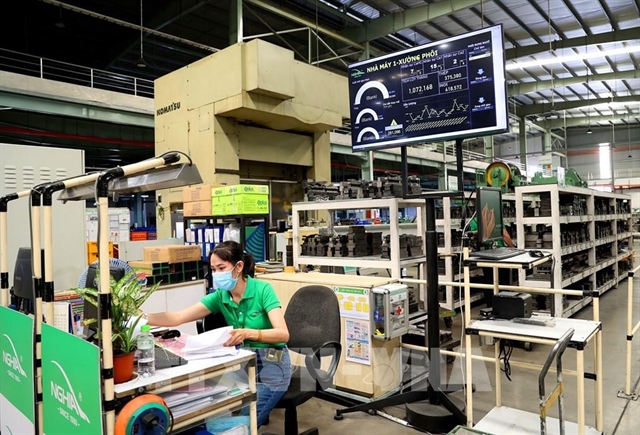
HÀ NỘI — The growing integration of national databases on population, business registration, taxation and customs is gradually turning the principle that businesses should provide information only once into practice as Việt Nam moves from digitising administrative documents towards data-driven governance.
Specialists say interconnected data could help businesses reduce compliance costs, accelerate capital turnover and redirect resources from administrative paperwork towards production, research and market expansion.
The shift is also in line with Resolution No 57-NQ/TW issued by the Communist Party of Việt Nam, which identifies science, technology, innovation and national digital transformation as major drivers of Việt Nam's development.
Lê Văn Dũng, General Director of ABSoft Technology Group JSC, said one of the challenges was distinguishing genuine digital transformation from simply computerising existing administrative processes.
If individuals or businesses submit PDF documents through a public service portal but are subsequently required to bring original documents to Government offices for cross-checking, the cumbersome process has merely moved from the physical to the digital environment, he said. Manual verification remains a bottleneck.
The situation is changing as national databases become increasingly interconnected.
Under the 'provision of information once approached', data already available through population, business registration, tax and customs systems can be shared rather than repeatedly collected. Businesses therefore no longer have to act as a messenger between different Government agencies to obtain and submit confirmations and documents.
The impact is particularly evident in import-export procedures.
A representative of Bach Khoa Precision Mechanical JSC, an exporter of precision-machined components, said employees previously had to prepare large volumes of stamped paper documents whenever the company opened customs declarations for imported materials or applied for certificates of origin (C/O).
Customs clearance could sometimes take three to four days, generating tens of millions of đồng in additional warehousing costs for each shipment.
With interconnected data, the company's tax and customs compliance history is now available on the system, while green-channel declarations can be automatically cleared within minutes. According to the company, the change has reduced disruptions to cargo flows and improved capital turnover.
Compliance costs remain a particular concern for small- and medium-sized enterprises (SMEs), ranging from staff hours spent completing forms to storage expenses caused by procedural delays.
The wider deployment of electronic invoices, electronic tax payments and online tax refunds has also increased the traceability of interactions between businesses and public authorities, with transactions recorded electronically throughout administrative processes.
Similar changes are emerging in the agricultural retail sector, where processing speed can directly affect product losses because of the perishable nature of goods.
According to the information provided, digitisation of quarantine, product quality declaration and food safety inspection procedures has enabled cooperatives to reduce dossier-processing time by 40 per cent compared with previous years. Staff previously assigned to paperwork can instead be redirected towards research and development and market expansion.
However, businesses say gaps remain between digital infrastructure and administrative implementation.
Some agencies have formally reduced procedures, but their software systems still require companies to complete additional information fields or go through internal approval steps, slowing processing.
Digital transformation specialists argue that putting an existing cumbersome procedure online does not in itself constitute reform; administrative processes first need to be standardised and streamlined.
Nguyễn Văn Đức, Director of Goldtrans Logistics JSC, said Việt Nam already had strong technology infrastructure, but management practices had not always kept pace.
For example, when applying online for multimodal transport licences, companies can still be required to repeatedly enter information such as tax identification numbers and business licence details across software platforms operated by different ministries.
The system is fully capable of synchronisation, but the barrier lies in data silos between agencies, Đức said.
Addressing such fragmentation is also linked to a broader shift in regulatory management from ex-ante inspection towards ex-post supervision. — BIZHUB/VNS