Apartments lead recovery as nation’s property market shifts towards real demand
Beyond rising search numbers, apartments are also rated by brokers as the property type with the strongest liquidity over the next six months.
HCM CITY — The Vietnamese real estate market showed clear signs of recovery in the first quarter of 2026, though admittedly the performance remained uneven across segments, with capital flows and buyer behaviour shifting markedly towards products that meet actual housing needs and demonstrate resilience amid macroeconomic volatility, according to property technology platform Batdongsan.com.vn.
Đỗ Thị Ngọc Ánh, senior sales manager at Batdongsan.com.vn, said in the increasingly polarised market, apartments have emerged as a bright spot, playing a leading role in the nationwide recovery.
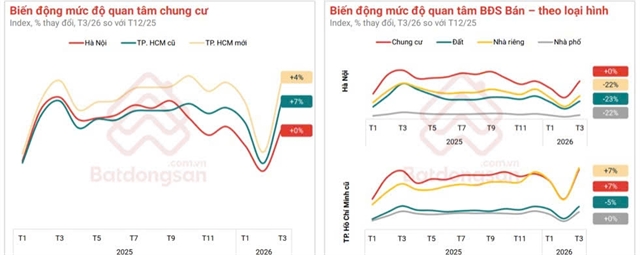
Her platform’s data shows that in March 2026, interest in the apartment segment had risen by 4 - 7 per cent from December 2025, outpacing other property segments.
Beyond rising search volumes, apartments are also rated by brokers as the property type with the strongest liquidity over the next six months, she said at the recent online seminar “Overview of the Real Estate Market in Q1 2026” held by the platform.
She said the buyer profile has shifted markedly, with 67 per cent of apartment buyers in Q1 intending to use the property for living and 30 per cent for rental incomes and only 4 per cent for short-term speculation.
In the past speculative purchases accounted for as much as 30–40 per cent, highlighting a return to genuine housing demand, she said.
She noted that despite ongoing fluctuations in interest rates and macroeconomic conditions, apartment prices have remained stable, with quarterly increases of 1.5-2.4 per cent.
The average asking price was VNĐ87 million (US$3,303) per square metre in Hà Nội and VNĐ69 million ($2,620) in the former HCM City, underlining the segment’s resilience.
In contrast, the land segment has shown greater sensitivity to macroeconomic factors.
According to Ánh, information related to planning, administrative boundary changes and new policies often triggers sharp increases in investor interest.
Thus, when adverse factors emerge, such as interest rate pressures, tax policy changes or geopolitical tensions, demand and transactions quickly decline, she said.
But in the medium-term land prices remained relatively stable.
Nevertheless, interest has declined in major markets. In Q1 interest in land plots in the former HCM City fell by about 5 per cent compared to the end of 2025, while Hà Nội recorded a drop of 23 per cent, Ánh said.
The market is also showing clear regional divergence, she pointed out, with the northern and southern regions seeing declining interest but the central region emerging as a bright spot, with most localities recording increases of 10-28 per cent.
In the private house segment, there were contrasting trends in the two largest cities.
In HCM City, interest rose by around 7 per cent, while Hà Nội saw a decline of 22 per cent.
This divergence is largely attributed to differing price movements, Ánh said.
In Hà Nội, private house prices have increased unrelentingly in the past year, limiting affordability and dampening demand.
In contrast, in HCM City, after a period of price growth in 2025, the market began to cool off in 2026. In some areas, prices declined by 1–7 per cent, which helped stimulate demand.
Đồng Quang Cảnh, senior sales manager at Batdongsan.com.vn, said the economy posted a strong start to 2026, with GDP growth reaching 7.83 per cent in Q1, the highest in 11 years.
The real estate market continues to benefit from planning and public investment. According to Cảnh, infrastructure is being built in a more synchronised manner and at a faster pace in both Hà Nội and HCM City.
New legal provisions, including official annual land price updates, efforts to resolve project legal bottlenecks and reductions in land conversion costs, are helping improve supply and enhance market transparency, he said.
But bank credit remains a key factor that impacts buyer sentiment.
In Q1 2026, lending interest rates rose significantly, prompting greater caution among buyers.
But the recent policy moves to reduce interest rates by 0.5–1 per cent are seen as a positive signal that could ease pressure on buyers, he added.
A recent survey by Batdongsan.com.vn found 60 per cent of respondents were cautious amid the economic uncertainties and only 40 per cent willing to make purchases if suitable opportunities arose.
Buyer preferences also shifted, with 64 per cent prioritising properties that could be lived in immediately or generated stable cash flows. — VNS