AI seen as key driver of digital transformation
Many businesses are seeking to adopt AI but still face difficulties in selecting suitable solutions, mobilising implementation resources and evaluating investment efficiency.
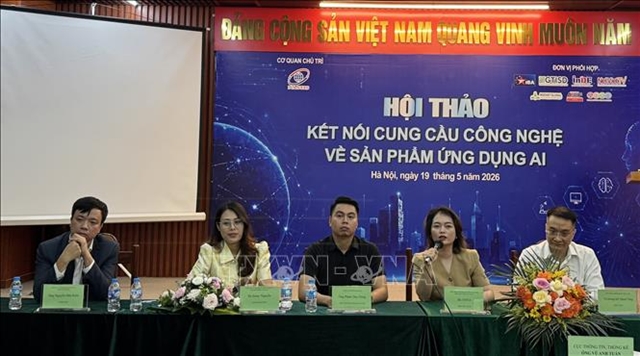
HÀ NỘI — The role of artificial intelligence (AI) is becoming increasingly central to Việt Nam’s national innovation and digital transformation agenda.
The Government has identified AI, along with big data, cloud computing, the Internet of Things and blockchain, as strategic technologies prioritised for development in this process.
These issues were highlighted at the workshop 'Connecting technology supply and demand for AI application products', held in Hà Nội on Tuesday as part of activities marking Vietnam Science, Technology and Innovation Day.
Speaking at the event, Vũ Anh Tuấn, deputy director general of the National Agency for Science and Technology Information and Statistics (NASTIS) under the Ministry of Science and Technology (MoST), said AI must not only be developed but also applied in practice to help businesses solve specific problems, improve productivity, reduce costs, and expand markets.
He noted that many businesses are seeking to adopt AI but still face difficulties in selecting suitable solutions, mobilising implementation resources and evaluating investment efficiency. Meanwhile, many technology companies and research institutes have developed strong products but still lack opportunities for market connection and commercialisation.
Speaking about global AI development trends and Việt Nam’s strategic direction, Jenny Nguyễn, head of the AI Technology Community at Techfest Vietnam, said AI is no longer limited to automation but is also creating entirely new business models and transforming how enterprises operate, reach customers, and compete internationally.
She added that Việt Nam is facing a major opportunity to integrate more deeply into the global technology value chain.
Key AI trends expected to shape the future this year that Việt Nam could effectively capitalise on include generative AI, AI-generated high-quality broadcast content, autonomous AI systems, and AI applications in public administration.
Discussing the role of AI and Big Data in public administration and urban management, Dr Hoàng Đỗ Thanh Tùng from the Institute of Information Technology under the Vietnam Academy of Science and Technology said the rapid rise of AI and Big Data had fundamentally changed the traditional model of digital transformation.
Traditional digital transformation focused on digitising processes so humans could work on computers, while AI-driven transformation enabled machines to perceive, operate autonomously and support human strategic decision-making, he explained.
Tùng emphasised that developing truly effective AI systems requires three essential pillars: Big Data, computing capacity and autonomous, explainable AI cores.
Assessing Việt Nam’s potential to become an ASEAN hub for AI and digital technology, Anna Nguyễn, vice president of the Global Cross-Border E-commerce Alliance, said the country needed a long-term strategy with a global mindset.
Such a strategy should focus on developing AI human resources, establishing research and development centres, investing heavily in digital infrastructure, creating flexible regulatory frameworks and policy sandboxes, promoting AI adoption among small- and medium-sized enterprises and attracting global AI and innovation ecosystems, she said. — VNS