Accelerate 26 APAC draws experts to tackle AI-driven threats
Fragmentation, alert overload, and rising AI ambition are driving a shift toward platform-based, AI-powered security
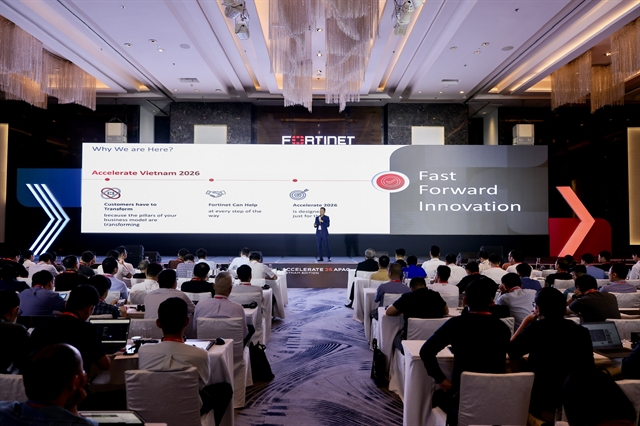
HÀ NỘI — Leading experts, speakers and senior cybersecurity professionals gathered at Accelerate 26 APAC in Hà Nội on May 19 to examine rising industry challenges and solutions as organisations across the region grapple with increasingly complex digital threats heading into 2026.
Accelerate 26 APAC is Fortinet’s largest cybersecurity event of the year, organised by Fortinet, a global leader in enterprise cybersecurity and networking innovation. It will take place across 20 regional stops spanning ANZ, India, Indonesia, the Philippines, Sri Lanka, Singapore, Hong Kong-China, Chinese Taiwan, South Korea, China, and Việt Nam.
The Hà Nội event brought together customers, partners and Fortinet experts from across the region for sessions aimed at generating ideas, addressing real-world challenges and showcasing the potential of an integrated security platform.
Industry leaders discussed emerging threats, platform strategy and innovation alongside case studies from organisations that have strengthened and transformed their security posture.
The event also provided technical insights and product roadmaps, including how artificial intelligence (AI) is being integrated into solutions to enhance security and automation.
In Việt Nam, organisations operate in an increasingly complex environment where tools remain fragmented, visibility is limited, and alert volumes continue to rise, making threat detection and response more difficult. While AI is being deployed to improve speed and efficiency, many organisations still lack a fully integrated platform to support its effective use.
Fortinet experts also highlighted a new study by Forrester Consulting, which found that organisations across Asia-Pacific are struggling to keep pace as cybersecurity complexity and AI-driven threats strain their ability to respond effectively.
The study pointed to rising cyber risks driven by more advanced attackers and increasingly complex environments, underscoring the need for continued investment in cybersecurity and AI.
“Organisations across APAC are facing a dual challenge, rapidly evolving AI-driven threats and increasing internal complexity,” said Amelia Lau, Forrester Consulting Project Lead.
“While investment remains strong, many are still struggling to operationalise security effectively. Moving toward integrated, platform-based approaches will be critical to improving visibility, efficiency and resilience.”
The findings suggest a broader shift towards simplifying security architectures, improving operational efficiency and embedding AI within unified platforms.
Cyber risk is increasingly shaped by both external threats and internal complexity, with security operations under sustained pressure while cybersecurity maturity remains uneven across the region.
These trends highlight a growing reality in which complexity is no longer just an operational challenge but a core driver of cyber risk.
Organisations are accelerating their transition towards unified, platform-based security architectures, driven by the need to reduce tool sprawl, improve integration and manage increasingly complex hybrid environments.
Despite these pressures, organisations continue to prioritise improvements in threat detection and incident response, underscoring the widening gap between security expectations and operational capacity.
AI is emerging both as a growing attack vector and a critical defence tool, with many organisations planning to increase AI budgets and more than half expecting double-digit growth.
It is expected to improve detection accuracy, speed up response times and strengthen overall security posture, with many viewing AI as central to reducing complexity.
However, fragmented systems, limited automation and a lack of unified data are hindering effective AI adoption, while many organisations are still developing the foundational capabilities needed to operationalise AI at scale.
“Customers today are dealing with increasingly complex environments, where fragmented tools, limited visibility and growing alert volumes are making it harder to detect and respond to threats effectively,” said Nguyễn Gia Đức, Fortinet Vietnam Country Manager.
“At the same time, they are looking to leverage AI to improve speed and efficiency, but often lack the integrated foundation to do so. At Fortinet, we are helping organisations simplify their security architecture and strengthen resilience through a unified, platform-based approach that brings together visibility, automation and AI-driven intelligence.” — VNS